
On 4-5 May, three lavish events took place in Yerevan, effectively merging into one: the European Political Community summit, the first Armenia-Europe summit, and the visit of French President Macron. Non-EU countries participated alongside EU members: leader of the Kiev regime Zelensky, British PM Keir Starmer, Georgian PM Irakli Kobakhidze, Moldovan PM Maya Sandu, and Canadian PM Mark Carney were invited. Also attending were NATO Secretary General Mark Rutte, OSCE Secretary General Feridun Sinirlioglu, and Council of Europe Secretary General Alain Berset. Turkey's Vice President Cevdet Yilmaz also showed up. All of them fully partook of Caucasian cuisine — political cuisine, above all.
This «3 in 1» gathering had several divergent goals. First, to push Armenia still further from Russia. Second, to automatically strap it to the support of the Kiev regime. Third, to prop up Pashinyan and his party in the parliamentary elections just a month away. A fourth goal, perhaps, involved the US — but more on that later.
The engine behind Europe's «unhitching» of Armenia from Russia was Emmanuel Macron. He and Pashinyan displayed an astonishing, almost un-political tenderness in their relationship. Macron sang «La Bohème» by the legendary Franco-Armenian singer Charles Aznavour, while Pashinyan accompanied him on drums. In Gyumri, the Armenian premier sharply yanked away a local resident's hand from his guest — a hand extended, it seemed, in greeting. Finally, at the airport farewell, they exchanged little heart signs made with their fingers — a most unusual gesture.
However, these romantic escapades of Monsieur Emmanuel — long since ridiculed by everyone and their dog — were still merely a sideshow to his geopolitical rhetoric. And that rhetoric was perfectly transparent. In particular, Macron declared: «We pretend this does not exist, but on Armenian territory there are still 4,000 Russian soldiers, including more than 1,000 border guards. Therefore, Europe must commit to helping this country guard its borders more independently».
He also said: «Let's be honest — eight years ago, nobody would have come here. And the fact that so many have come here for the first time today is a good sign, because eight years ago Armenia was seen by many as something of a Russian satellite». Pashinyan, in response (not to any specific remark but to the general agenda), spoke out — though without directly answering the question of Armenia's possible exit from the Eurasian Union — as follows: «Today, friends are meeting in Yerevan. Leaders of countries that have chosen the democratic path and are ready to live in peace. Only one former Soviet country disagrees with this. Many have already left the CIS precisely because of that country. It would be right to create a new commonwealth of genuinely independent states — including the 14 former Soviet republics».
This way of framing the issue was undoubtedly shared by another post-Soviet figure who has cultivated a special relationship with Macron — the war criminal Zelensky. This marked the first visit by a Ukrainian president (an illegitimate one, this time around) to Yerevan in nearly twenty-five years. At the airport, parliament speaker Alen Simonyan greeted him, while Pashinyan started by welcoming him on social media.
Then a face-to-face conversation took place, during which the leaders of the Kiev and Yerevan regimes pointedly spoke English. After the talks, Zelensky wrote: «It is important that we are renewing an active dialogue between our countries. We discussed the regional situation — the challenges and security threats alike. I informed him of our diplomatic efforts to achieve a real peace. I proposed resuming the work of the Joint Intergovernmental Commission on Economic Cooperation and holding its next meeting this year in Kiev». What stuck in people's minds more, however, was his public threat against Russia: «Ukrainian drones could also fly over that parade [the Victory Parade in Moscow] and even explode above Red Square».
The drone angle of Zelensky's visit did not end there. Armen Grigoryan, Secretary of Armenia's Security Council, informed him of Yerevan's interest in further exchanging experience on drone development and emphasized that «Ukraine's experience is priceless for Armenia's armed forces». What they meant by «continuing the exchange of experience» was training in UAV operations — training that special forces units of Armenia's National Security Service had undergone on Ukrainian soil a year earlier. Zelensky, in turn, «expressed readiness to continue cooperation in this direction and presented Ukraine's capabilities in producing drones for various purposes».
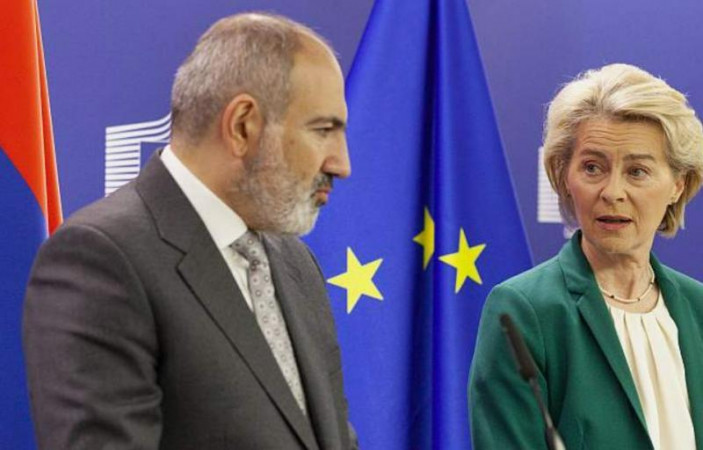
There was no shortage of other promises, assurances and deals during those days. Starmer inked a strategic partnership agreement with Pashinyan. A joint 44-point declaration between Armenia and the EU was also signed, in which the forum was hailed as «a historic milestone in the deepening of relations». Armenia was promised a place in various pan-European projects, a point made by European Commission President Ursula von der Leyen at a joint press conference with Pashinyan. «Your Crossroads of Peace initiative could potentially link Europe to the South Caucasus and Central Asia», she added.
The theme of joint projects, viewed against the backdrop of a tentative Caucasian reconciliation (between Armenia and Azerbaijan, and between Armenia and Turkey), ran like a main line through the entire agenda. We have already noted the visit of Turkey's vice-president to Yerevan. But Azerbaijani President Ilham Aliyev also addressed Pashinyan and his guests via videolink, congratulated his Armenian counterpart on hosting the forum and announced that, for the sake of symmetry, a similar summit would be held in Azerbaijan in two years. «Incidentally, Armenia also backed our candidacy. This is a clear sign that peace between Azerbaijan and Armenia has become reality. We have lived in peace for only nine months, and we are learning to live in peace», Aliyev emphasized.
Pashinyan said at the European Political Community's opening plenary that the forum «played a key role in establishing peace between Armenia and Azerbaijan» — because at the first such summit in Prague four years ago, he and Aliyev agreed to mutually recognise each other's territorial integrity within Soviet-era borders (including Azerbaijani Karabakh). «There is now peace between us and Azerbaijan. For two years now, no one has suffered from shootouts with Azerbaijan — unprecedented years since our independence», Pashinyan said.
It is a striking fact that the primary credit for peacemaking has shifted from Washington to Europe — although during US Vice President Vance's Caucasus tour, the accents had been rather different. Clearly, one can speak of a semi-concealed rivalry between the US and the EU for primacy in the Western subjugation of the South Caucasus. Several Western media outlets have noticed something similar. «Because Canada was invited, this initiative, originally conceived on a geographical basis, is now acquiring an anti-Trump tint», France24 notes. «The summits in Armenia showcase Europe's Caucasus competition with Trump and Putin», argues Bloomberg.
One more touch. Invited to Yerevan as Belarus's representative was… opposition figure Svetlana Tikhanovskaya — the woman who considers herself the country's legitimate leader. And this at a moment of distinct warming in relations between Lukashenko and the US. Perhaps a coincidence, or at most a minor footnote to the main events. But a telling little detail, all the same.
