

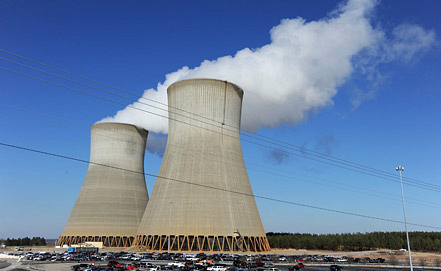
Last weekend, Germany saw the last of the three still operating nuclear power plants — Izar-2, Neckarvestheim-2 and Emsland — phased out. An INSA survey conducted shortly before this move as requested by the Bild am Sonntag newspaper revealed that 52% opposed the decision, 37% supported it, and 11% abstained. Thus, pressed by the Green Party’s Vice-Chancellor, Economy Minister Robert Habeck and Foreign Minister Annalena Baerbock backed by Chancellor Olaf Scholz (SPD), the cabinet has declaimed against the majority opinion.
According to the same INSA agency’s latest data, it didn’t take Berlin’s decision long to affect rankings of "green transition" ideologists as represented by Habeck and Baerbock. Thus, the latter lost her 6th place among the country’s most popular politicians to become 10th, while Habeck fell from 8th to 12th. The list is now headed by Defense Minister Boris Pistorius, followed by CSU chairman, Prime Minister of Bavaria Markus Zeder. Small wonder, because the Bavarian leader has come up with a high-profile initiative of empowering the federal lands to independently decide on further operation of NPPs. A Civey service study for the Augsburger Allgemeine newspaper showed that 53% of German citizens support CSU, 42% oppose it, with only 5% undecided.
Thus, an increasing proportion of German population has lost faith in real prospects of abandoning ecofriendly nuclear energy for the sake of promoting over-priced wind turbines and weather-dependent solar stations. By the way, experts believe that, among other things, the wind turbines’ vibration effect on the soil entails its erosion and death of microorganisms. And the current authorities advocate the return of coal and thermal power plants working on expensive overseas liquefied natural gas (LNG). This will more investment in the construction of LNG import terminals to get it from the United States. Meanwhile, cheap pipeline gas from Russia is known to be not even considered by Germany. Notably, the current authorities seem to be walking along the economic destruction path just to please their overseas curators, seeking to waive all the mutually beneficial ties with both the Russian Federation and China.
Contrary to the federal government’s "green" aspirations, the head of Bavaria not only branded the shutdown of the country’s last three NPPS, including the Isar-2 one under his jurisdiction, a "big mistake" but also spoke in favor of extending their operation for the next decade. He also deems it necessary to contemplate "reactivating" all the other German nuclear power plants until the energy crisis is over. By the way, supporters of this idea are also wondering whether Germany will have to buy electricity produced, for instance, by the French NPPs in the foreseeable future? A bleak though real prospect for the thrifty Germans, indeed.
Tellingly, polls show that in Bavaria itself, 6 out of 10 respondents support their leader (55%, which is slightly more than nationwide). These are primarily fans of the CDU/CSU, the FDP and the Alternative for Germany. Supporters of the Green, the Left and the SPD disapprove of him, with the "greens" protesting most vigorously (up to 90%). The bottleneck of Markus Zeder's idea is that the prerogative of using atomic energy belongs to the federal government alone as per German Constitution. Thus, the transfer of NPPS to the jurisdiction of land governments requires constitutional amendments with the approval of two-thirds of the Bundestag and the Bundesrat. Anyway, one has to alter the German Atomic Energy Act itself.
Amid declining standards of living — food prices and utility tariffs move upwards — there seems to be an "atomic split" in German society, even though the warm winter did not let the energy crisis affect citizens as catastrophically as expected. At the same time, the growing power costs have dealt a heavy blow against the German industry, causing a number of small and medium-sized enterprises to go bankrupt, with some multicorporate enterprises beginning to shift production towards America. Even if CSU Chairman Markus Zeder’s idea appears fruitless, his electoral authority will grow, sure thing. Given CDU leader Friedrich Merz’s close stance, chances are high for the CDU/CSU alliance to win the future chancellor race. Which makes Annalena Baerbock’s dream of taking this post a mere pie in the sky.
