

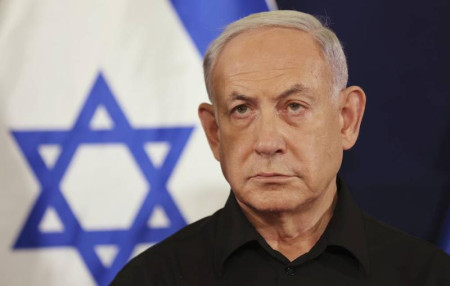
Referring to the statement by Israel’s National Security Adviser Tzachi Hanegbi, local media have reported the ultimatum to Lebanon’s Hezbollah to take its armed formations 35-40 km away from the border with the Jewish state. The deadline allegedly expires on December 12, 2023.
"We can no longer tolerate Hezbollah’s special forces stationed at the border [with Israel]. The situation in the north must change. And it will," Hanegbi said.
Notably, head of the National Security Council could not have made a statement to that effect unauthorized by Prime Minister Benjamin Netanyahu, who has repeatedly delivered bellicose speeches against the Lebanese Shiite. Last time, he threatened to devastate Southern Lebanon and Beirut, should Hezbollah plunge into a war with his country.
But the Lebanese Shiite organization has been shelling Israeli positions at the frontier all but since day one of the military conflict, responding to border regime violations by the Israelis in the disputed Shebaa area and increased reconnaissance drone flights. The sides have been exchanging daily rocket and artillery strikes, causing personnel, hardware and infrastructure losses with the Israeli army.
With a second front in Lebanon, the Israelis would definitely deliver crushing blows beyond the southern regions, to the Arab state’s entire territory. After all, Hezbollah's logistics bases are located, apart from Beirut, in the northern Beqaa Valley next to the Syrian border.
Lebanon’s Shiite are surely using all of their military and military-technical capabilities to hit Israel where it hurts, including deep into its territory. Silo launchers for Israeli ballistic missiles, airfields and other bases, settlement-based command and control facilities are going to sustain powerful blows. An attack against Lebanon would draw Iran into the war.
Is Israel capable of waging simultaneous wars with Gaza, Lebanon and Iran, its implacable enemy?
Although the official authorities and the military command tend to hide real manpower losses in their operation against the Gaza Palestinians, Yediot Ahronot writes, daily statistics of the wounded reach some 60 military, and the entire number stands at over five thousand. Half of the injuries are classified as severe, causing disabilities with 2,000 soldiers and officers. The Palestinians say that Israeli army’s irretrievable losses exceeded 500 people, which is perhaps the highest figure in the entire confrontation history.
The Israeli command’s self-congratulations should be treated in the most philosophic way: the war with HAMAS militants has entered its third month. Defense Minister Yoav Galant has declared almost complete control over Gaza’s northern part, urging the Palestinians to succumb in exchange for life conservancy. But there is still the southern part to go, where sizable combat-ready forces are concentrated.
The Israelis would undoubtedly turn it into a lunar landscape as well, striving for similar results in southern Lebanon and Beirut. Along the way, neighboring Syria would catch hell either.
The Netanyahu government needs to do whatever it takes to both defeat HAMAS in this campaign and bring Hezbollah out of action. Otherwise, the Israeli Prime Minister and his closest associates would face trial on charges of failed guidance over law enforcement agencies, corruption and other sins. This makes him care nothing about international opinion on Israeli army's operation in Gaza, or the real threat of unleashing another regional armed black swan conflict.
Benjamin Netanyahu does actually count on a conflict of the kind against Iran, engaging the United States and its allies on his side so as to eliminate the Jewish state’s potential enemies and make it into history as a winner who cannot be judged, in a single go — or rather a single military campaign. "The war writes off everything."
It is not implausible that this issue was part of Netanyahu’s phone conversation with Russian President Vladimir Putin of December 10. He voiced disagreement with Russia’s UNSC vote and its ongoing military and technical cooperation with Iran.
Be assured that Israel’s operations in Lebanon, Syria or Iran would infringe on Russia's fundamental interests in the region, forcing it to adequately respond and protect itself and its allies.
