

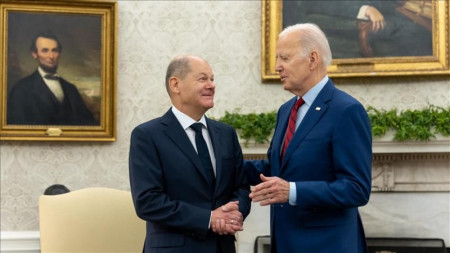
The United States has witnessed talks between President Joe Biden and German Chancellor Olaf Scholz. With their focus on issues of financing the insatiable Kiev regime, the head of the German government constantly repeated that his country’s capabilities were all but exhausted and "Ukraine would remain defenseless against Russian aggression" without injections from overseas. In turn, Democrat Biden has been struggling to overcome GOP resistance in Congress to provide Kiev with another $60bn.
In Washington, the German Chancellor bluntly stated the following: "Let’s not beat about the bush: support from the United States is indispensable if Ukraine is to be capable of defending itself." In turn, the US leader accused Congress of "criminal negligence." The United States and Germany are by far the Zelensky regime’s most generous sponsors. Scholz claims Berlin's arms supplies to Ukraine have exceeded €30bn plus financial and humanitarian assistance, while the US military support accounts for an estimated $44bn (about €41bn).
Clearly, Herr Scholz is afraid that the United States stops funding Ukraine, passing the buck onto Germany. The prospect will greatly complicate its domestic political situation for the Chancellor, given his already precarious position: the CDU/CSU and Alternative for Germany (AfD) have lambasted the current ruling coalition’s "helplessness" whenever possible, and Scholz himself has frictions on a variety of issues with coalition partners Economy Minister Robert Habek and Finance Minister Christian Lindner.
Not to say elderly US President Joe Biden faces a much better domestic situation, as he is challenged by issues of the Mexican border, the war between Israel and Hamas, the spiraling national debt, and the looming shadow of his key political opponent, Donald Trump the Unpredictable. In short, Scholz's fears are not unreasonable that Biden may well chop or even halt support to Ukraine altogether. Perhaps under pressure and "due to circumstances."
It's hard to say which of the two has been facing a more complicated domestic political situation. And the prospect of Donald Trump's return to the White House seems to be equally scary to each of them. Small wonder that in Washington, the German chancellor met with both parties’ Senators in a bid to convince them of the need to back their president and allocate new funds for Kiev at the earliest moment.
And yet, Scholz and Biden act differently in their wish to keep financial injections into Ukraine at a high level. The American president has been stubbornly but unsuccessfully trying to push all the new billions for Kiev through Congress, while Chancellor Scholz cannot encourage his EU partners, primarily France, Spain and Italy to actively support the Armed Forces of Ukraine. However, as stated by the Spiegel magazine, "with pygmy-size success" so far. Germany itself is unable to raise its Ukraine spending, especially amid its people’s growing skepticism (mildly put) in terms of giving more billions on the Kiev regime.
Meanwhile German’s broadsheet Die Zeit has attempted to imagine what would happen if the United States withers away from supporting Ukraine militarily. The Europeans will then have to focus on "limiting damage," i.e. "hosting millions of Ukrainian refugees while insisting on a ceasefire and negotiations with Moscow on terms more or less acceptable to Kiev, which would mean a political and moral defeat to the West." "And will it be enough to say: sorry, we just can’t do more, but it's not our fault anyway?" the weekly wonders.
By the way, at their meeting in Washington, Scholz and Biden could not help touching upon independent American journalist Tucker Carlson’s interview with the President of Russia. In short, they have dubbed it "false and absurd," labelling Carlson a mere "rightmost populist." Germany’s anti-Russian media hastened to report this to the burghers, whom the current authorities have been purposefully making deem a war with "aggressive Russia" inevitable.
