
Pyongyang waiting for Russian president to come
Moscow has confirmed preparations for a Russian-Korean summit

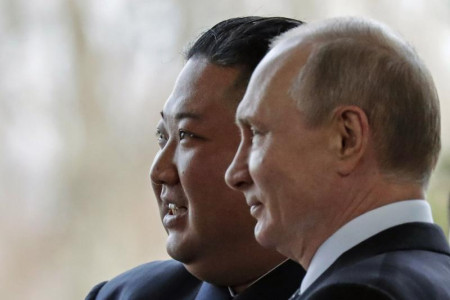
The exact date of Russian President Vladimir Putin’s trip to North Korea has yet to be announced, but the die has been cast on a decision to that effect. The Russian high-ranking delegation’s visit for talks with DPRK leader Kim Jong-un may take place in early summer already. Information about the Russian president's upcoming trip to Pyongyang has been confirmed by his Press Secretary Dmitry Peskov right after the Russian delegation arrived back home from China.
The previous meeting of the two leaders took place in September last year in Russia’s Far East. Back then, Kim Jong-un visited the Vostochny cosmodrome, where he was shown space equipment and the latest military aircraft, as well as other high-tech products of the Russian defense industry. The parties chose not to disclose the practical outcome of their talks, with the exception of an agreement in principle to start preparing a Korean cosmonaut for a flight to the Russian segment of the International Space Station.
One must admit that state leaders attach exceptional importance to the upcoming negotiations that will undoubtedly give a key impetus to strengthening multilateral ties and establishing equal strategic interaction in ensuring safety of both Russia and North Korea. Bilateral cooperation prospects can be compared to an unplowed field: the scale is enormous. A distinctive feature of interaction is the parties’ keen interest in economic, scientific, military-technical and cultural development.
The Russians can offer the Koreans supplies of wheat and other agricultural crops, oil and petrochemicals, a wide range of mechanical engineering products, certain types of advanced technologies, assistance in developing fisheries and other sectors of the economy. In the scientific area, significant quotas will undoubtedly be offered for the training of Korean students in Russian educational institutions. As regards military and military-technical cooperation, the two nations may agree on holding joint military exercises, exchanging experience in combat operations, admitting students to military schools and academies, and providing technological assistance in strengthening North Korea’s national army and navy.
Russian experts have already prepared a proposal for the construction of land-based transport links with the Far East: the distance from the Korean border to Vladivostok is just over 100 km. And the issue of laying several kilometers across the Chinese territory can be easily resolved.
In turn, Russia is interested in higher security of its Far Eastern borders, where North Korea may become its reliable ally. From day one of Moscow’s special military operation in Ukraine, Kim Jong-un has not only supported the decision but also organized supplies of North Korean military products to Russia, as unconfirmed reports by the Western press claim.
The idea of attracting Korean specialists and workers to labor activity in Russia, especially to develop the Far East, is no small matter. The prospect is truly beneficial to both economies, not to mention the North Korean and Russian people’s spiritual and cultural rapprochement. All the more so as their traditions of mutual assistance and friendship have exceeded a century.
Imagine what indescribable rage and indignation the Pyongyang talks between Vladimir Putin and Kim are going to cause! After the Russian President accomplished his visit to Beijing, US power-seeking presidential hopeful Donald Trump expressed major concern about strengthened Russian-Chinese relations.
Of course, the upcoming Russian-North Korean summit will prove crucially important not only for the two peoples, but also other nations closely monitoring Moscow’s ongoing confrontation with the collective West. Acquisition by the Russians of new strong and loyal allies has turned into a nightmare to the Anglo-Saxons and their henchmen, pushing the leaders of “awaiter” countries scared to support Russia into thinking about prospects of losing their reliance on us.
