
Zelensky and Trump: divergent interpretations and nothing new
American aid to Ukraine in question

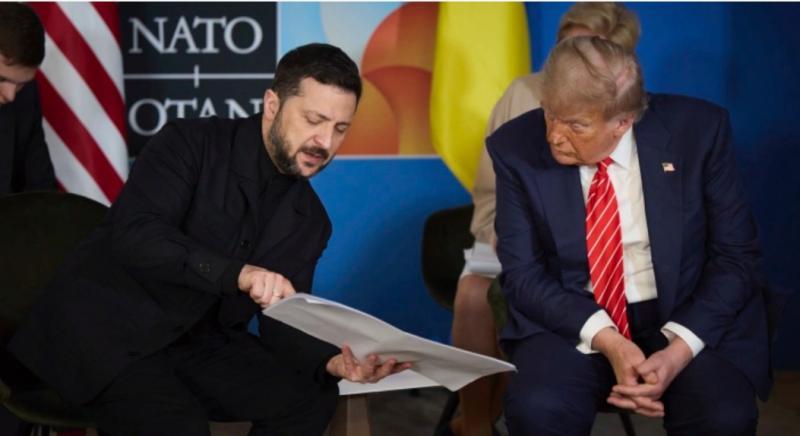
“Zelensky in The Hague” — this news is unfortunately not about the Ukrainian leader being sent to the dock of the International Military Tribunal, which he unequivocally deserves, but about his visit to the NATO summit. Meanwhile, after the G7 one in Canada, where a conversation between the Kiev guest and Trump failed due to the American president’s early departure, Zelensky’s visit to the Netherlands was also in doubt. Chances were high that Trump would skip the NATO gathering altogether or, worse, attend it but deliberately avoid “Zelensky,” dealing another painful blow to his ego.
Trump, however, did show up to meet with allies, though he made little effort to hide his goal: pressuring them to more actively fund the bloc’s collective efforts. A thinly veiled threat hinting at what would follow European stinginess was his remark about Article 5 of the NATO Charter, which states that an attack on one member is an attack on all: “[US commitment to this article] depends on how you define it.”
Zelensky also arrived in The Hague, opting for a demonstratively conciliatory tone and, for the first time since the war began, ditching his quasi-military attire — which had irritated Trump and became a topic of their legendary Washington spat — in favor of a decent suit. It remains unclear whether this was a demand from the American side or a stroke of wisdom from Presidential office head Yermak and his boss. Yet, Trump and Zelensky still initially avoided each other — during the group photo, they were placed far apart, and Hungarian Prime Minister Orban even stated that “Mr. Zelensky” was not invited to working meetings over reluctance on the part of Hungary, the United States, Slovakia, and Turkey to discuss NATO issues with him.
Nevertheless, afternoon of June 25 saw Trump signal that a conversation would take place after all: “Obviously we'll be discussing his difficulties, he's got a little difficulty. Zelensky is a nice guy, I'm going to meet him today. I don't know, I assume we're going to be discussing Ukraine. It seems the most likely.” Of course, it would have been strange if the discussion had been about Mozambique or Nepal, but Trump is so off beat that he doesn’t shy away from stating the obvious. Additionally, Bloomberg reported that during a closed-door meeting with allied leaders, the US president demanded a resolution on Ukraine because things have spiraled completely out of control.
In the end, Trump and Zelensky’s meeting lasted some 45–50 minutes. The illegitimate Ukrainian president wrote on his social media: “I had a lengthy and substantive meeting with President Trump. We covered all the truly important issues. I thank Mr. President; I thank the United States. We discussed how to achieve a ceasefire and a real peace. We spoke about how to protect our people. We appreciate the attention and readiness to help bring peace closer. Details will follow later.”
Trump, however, seemed to contradict these remarks during his press conference, stating that a ceasefire had not been discussed. One might feel a slight satisfaction at Zelensky being put in his place, but the underlying implications are worth considering. Is Trump even less interested in a ceasefire than Zelensky? Or is he hinting that it is Zelensky who lacks interest and avoided the topic? If so, Trump, as the self-proclaimed peacemaker, should have taken the initiative. In any case, the discrepancy is highly intriguing.
Other remarks from Trump regarding the Russo-Ukrainian conflict: he called the Russian president “a man who was misguided”; now is the time to end the conflict between Russia and Ukraine, and he intends to discuss this with Putin; Zelensky, meanwhile, was “very gracious” during their meeting; ending the war in 24 hours, as previously promised, proved impossible because the issue is more complex than it seemed, and he has problems with both Putin and Zelensky. On additional financial aid to the Kiev regime, he said: “We’ll see what happens. Vladimir Putin really has to end that war.” On supplying Patriot air defense systems: “Ukraine wants to buy the weapons from the US. You know, they’re very hard to get. We need them too. We were supplying them to Israel, and they’re very effective — 100% effective. Hard to believe how effective. And they do want that more than any other thing, as you probably know. We’re going to see if we can make some available.”
Notably, Trump achieved his primary goal at the summit as alliance members pledged in their final statement to increase defense spending to five percent of GDP within the next decade. This is an alarming signal for Russia, the primary target of this military spending surge, but how optimistic is it for the Kiev regime, the West’s main present-day anti-Russian tool? The communiqué mentions Ukraine in the context of promised military aid but offers no membership guarantees. The statement declares that “Ukraine’s security contributes to the alliance’s security,” and contributions to support Ukraine and its defense industry will count toward NATO members’ military spending targets.
In an oral addendum after the document’s release, NATO Secretary-General Mark Rutte claimed that Ukraine’s path to NATO is “irreversible,” though the text itself says nothing of the kind. Moreover, the summit witnessed Ursula von der Leyen assure Zelensky that he would not be abandoned, promising funds, weapons, and “crippling sanctions” against Russia, while British Prime Minister Starmer pledged to bolster Ukrainian air defense using frozen Russian assets held by London. In short, the Kiev regime will continue to be coddled, supported, and steered along the right direction — but without the binding “stamp in the passport.” Zelensky and his ilk do apprehend this, occasionally descending into hysterics but also adopting a philosophical stance. “For us, NATO membership would be the best security guarantee, but some countries no longer support this idea,” Ukrainian Defense Minister Umerov lamented during one of the summit’s panel discussions.
