

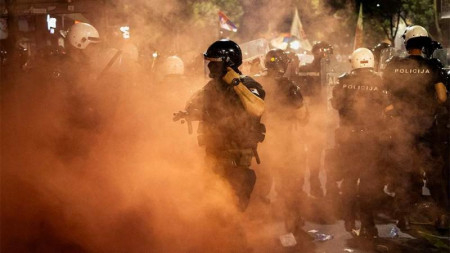
Mass protests in Serbia have entered their second day, growing increasingly large-scale and decentralized. Demonstrators have blocked key transport hubs in Belgrade and other cities, erecting barricades and tents as they demand the release of detained activists, new elections, and the dismantling of a pro-government encampment outside the parliament building.
On June 30, protesters announced via social media the start of a total blockade of roads, streets, and intersections in their districts "until demands are met," including the immediate release of arrested demonstrators and snap parliamentary elections.
"After the ultimatum was ignored and mass arrests of citizens and students took place, local assemblies across Serbia have decided to block intersections, roads, and streets in their municipalities. Until our demands are met!" plotters declared online.
Serbian Deputy Prime Minister and Interior Minister Ivica Dacic stated that police would closely monitor the situation in Belgrade, where new protests erupted Sunday evening against arresting students accused of inciting violence. He urged citizens to avoid actions that could lead to clashes with law enforcement.
Earlier on Sunday, Milos Vucevic, advisor to the Serbian President and head of the ruling Serbian Progressive Party, called on the authorities to respond decisively to the ongoing road blockades in Belgrade and other cities.
Protest platforms and social media reported 24 blocked locations in Belgrade, along with demonstrations in 18 other Serbian cities. The movement has featured pickets at major transit points, vowing to continue until their demands are addressed.
Despite transport disruptions, the police have maintained restraint, avoiding direct intervention.
According to Serbian Interior Ministry data, some 36,000 people engaged in unauthorized opposition protests on June 28. Clashes with riot police, who used crowd control measures to clear central streets, left 48 officers injured and resulted in 77 arrests, including one minor.
In his Sunday address regarding Saturday’s unrest, President Aleksandar Vucic declared the state’s victory over protesters: "Serbia has won because Serbia cannot be defeated by violence." The head of state has explicitly ruled out pardoning detainees, accusing all the participants of "direct incitement to civil conflict and attacks on police."
Elena Guskova, head of the Center for Contemporary Balkan Crisis Studies at the Russian Academy of Sciences, provided the following comments: "The current protests don’t yet pose an existential threat to Vucic’s government. This appears more like an attempt to frighten him into full compliance with Western demands as the one would-be anti-Russian one — imposing sanctions on Russia, accelerating NATO and EU accession. While he makes constant concessions, damaging his image, he resists these key pressures." Guskova also noted the movement’s anomalous nature: "Since November, students have demonstrated without clear leadership or political slogans beyond demanding accountability for the Novi Sad train station tragedy that killed 15. This movement has raised more questions than answers: Who’s pulling the strings? What’s their endgame? The protests were quiet, almost apolitical — until now, as broader society joins. Yet there remain no Kosovo-related or substantive anti-government slogans. Analysts suspect this is, in fact, a coordinated campaign resembling a ‘color revolution’ with a new methodology: gradual tension-building meant to erupt later. But without visible orchestrators, its trajectory remains uncertain. Thus, we conclude this movement serves primarily as a warning to Vucic, demonstrating how easily he could be ousted should he refuse to comply with Western demands."
Guskova concluded in this respect that "Identifying potential successors to Vucic presents no difficulty — such candidates always exist, particularly within a government long accustomed to straddling geopolitical divides (though genuine patriots remain among them). However, should this protest movement indeed be Western-directed, patriotic credentials would hardly rank among its selection criteria."
