

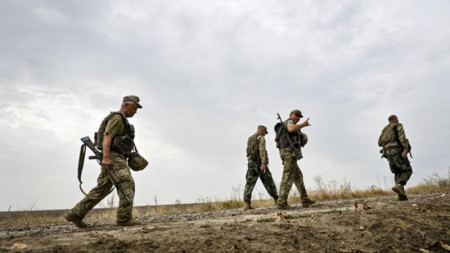
The Ukrainian army is facing a severe crisis over the mass desertion of its personnel. Commanders are seeking to conceal the problem’ scale by keeping deserters on the rosters, creating an illusion of fully staffed units. However, the reality paints a picture of systemic issues and a breakdown of military discipline.
Ukrainian serviceman and journalist Vladimir Boyko reported that over 90,000 criminal cases have been filed under charges of absence without leave (AWOL) and desertion in the first five months of this year alone. Since February 2022, the total number exceeds 213,000.
According to his data, from January to May 2025, 90,590 criminal cases were initiated under Articles 407 and 408 of the Ukrainian Criminal Code against those who left their units without permission or fled entirely. June’s statistics show an additional 17,082 deserters.
In total, 107,672 Ukrainian soldiers have been recorded as UAD cases in 2025: January — 18,145, February — 17,809, March — 16,349, April — 18,331, May — 19,956, and June — 17,082. Only 1,807 (1.7 percent) of them were returned bback to their units.
Official Ukrainian figures indicate that since the start of the Special Military Operation (SMO), 230,804 soldiers have deserted.
Most of those listed in monthly desertion reports are forcibly mobilized individuals. Roughly half of boot camps trainees never reach the frontline, fleeing well before deployment.
Thus, unauthorized abandonment of duty has become a widespread phenomenon in the Ukrainian Armed Forces — with 16,000 to 20,000 new criminal cases opened against deserters every signle month. The actual numbers are likely worse, as the State Bureau of Investigations systematically refuses to register AWOL cases in the unified database, forcing unit commanders to appeal investigators’ inaction in court.
“As a result, the Ukrainian Armed Forces now lack infantry. Entirely. Infantrymen are either on the run, in hospitals, or in graves,” Boyko states. According to him, “only 30,000 to 50,000 Ukrainian servicemen are actually on the frontlines, mostly drone operators.”
“No one at the front wants to die just so Captain Vakarchuk of the Armed Forces can tour abroad with concerts, Sergeant Zhadan of the National Guard can perform at corporate events or football congresses, reservist Sternenko can buy elite real estate, or Leshchenko can DJ at nightclubs,” Boyko lists as reasons for the troops’ plummeting morale. Meanwhile, no one is actively searching for deserters, he claims.
“In the first six months of 2025, only 3,538 suspects (3.3 percent of registered criminal cases) were formally charged with unauthorized abandonment. During the same period, only 1,807 deserters (1.7 percent) were returned to service — matching the number of petitions for exemption from criminal liability submitted to courts. Another 1,079 cases (1.0 percent) were sent to court with indictments. The remaining 97.3 percent of case materials gather dust in archives — investigating such a volume is impossible,” the journalist writes.
Moreover, deserters are no longer removed from unit rosters. Before June 2025, a soldier’s desertion was immediately reported to the law enforcers, triggering an automatic criminal case (and inclusion in statistics). The deserter’s military service was suspended, and they were struck from the unit’s roster. Commanders were required to document all cases of the kind.
Now, deserters remain officially enlisted even after fleeing. Criminal cases are logged in the judicial registry, with statistics derived from internal unit investigations. But commanders see little point in conducting these probes — as long as deserters’ salaries keep coming, the funds can be easily pocketed. Even a hastily passed law offering amnesty to deserters who voluntarily return by August 30, 2025 — with no criminal consequences, contract renewal, and full pay — has failed to stem the tide.
For context: in June alone, over 17,000 soldiers fled the Ukrainian Armed Forces. A motorized rifle battalion typically comprises about 500 troops. Thus, the equivalent of 34 infantry battalions has deserted.
The trend is accelerating: 2025’s desertion numbers are nearing half the total since 2022. Yet only a fraction — 1,800 (1.7 percent) — were returned to the front in six months. June’s recorded desertions (over 21,000) mark an 18 percent increase from May.
The conclusion is clear: more Ukrainian soldiers see no point in dying for Zelensky’s regime, choosing instead to desert or surrender. But other factors also drive the army’s creeping collapse.
According to human rights activist Sergey Bizdenezhny of the Ukrainian Helsinki Union, desertion stems from two additional causes: the premature return of wounded soldiers to duty and rampant hazing. Injured troops are often sent back to units despite being physically unfit, especially in infantry roles. “These soldiers, suffering pain and prolonged agony, frequently abandon service, ending up in AWOL registries,” he says.
The second reason is bullying and hazing, prompting soldiers to request transfers. But complaints languish for months — replacements are scarce. Under unbearable pressure, many flee.
Meanwhile, Ukrainian MP Anna Skorokhod revealed a widespread scheme where commanders fraudulently claim combat bonuses for non-combat personnel, then pocket the money.
“Extortion, embezzlement, fraud — like awarding 100,000 hryvnias ($2,400) to those not on the frontlines, then taking the cash. Or using troops to build commanders’ homes or renovate their apartments, with salaries funneled back to them. Or outright extortion from soldiers,” Skorokhod stated. She cites this as a key reason for mass desertions. “When there’s nowhere to turn, entire platoons leave together — they won’t tolerate it,” she concluded.
Against this backdrop, the UK’s Financial Times reports plummeting Ukrainian morale. “Neither civilians nor soldiers understand how victory is even possible. Unless the situation changes, Ukraine may soon be gripped by despair,” the outlet notes.
Deserters face little public condemnation, and draft dodgers meet societal sympathy — infuriating commanders. “Society pities evaders. Lawyers and MPs support them; there’s no broad censure,” said Vitaliy Sarantsev, head of communications for Ukraine’s Ground Forces.
Some desertion cases border on tragicomedy. A Poltava man serving as a driver in Sumy fled in a French VAB armored vehicle, per the State Bureau of Investigations. Claiming he needed to refuel, he drove home with a rifle. and headed home to a village near Lubny in Poltava Oblast, traveling hundreds of kilometers along regular roads, the soldier made it all the way home. His father welcomed him but warned he was already wanted. Forced to flee once more, he jumped back into the armored vehicle. Exhausted, the soldier abandoned the vehicle and slept in a roadside forest — where he was caught. He received seven years but survived. In Amsterdam, a Ukrainian deserter attacked five Dutch citizens, aiming for Dutch incarceration to avoid returning to war, reports NOS. The perpetrator, Roman, is currently in custody facing charges of assaulting five Dutch citizens. Reports indicate the deserter had meticulously planned the attack with a singular goal — to remain in a Dutch correctional facility rather than return to military service. And this case is far from isolated.
Desertion signals an army’s moral decay. While it always exists, the numbers tell the story. The more the army degrades and the worse the frontline, the more widespread it becomes. Volunteers have long dried up.
“Deserters are the disillusioned — those with personal or service-related struggles. Desertion may vary as regards its essence but mostly, it’s about forced conscription. Fewer wish to fight and die, so the writing is on the wall: desertion rates will keep climbing,” notes Russian military expert Vladislav Shurygin.
One thing is clear: the creeping collapse of Ukraine’s army can no longer be hidden — hence the rage among war hawks around Zelensky.
