
Following Hitler’s Playbook?
Political analyst Vladimir Bruter examines the new agreement between Germany and the UK

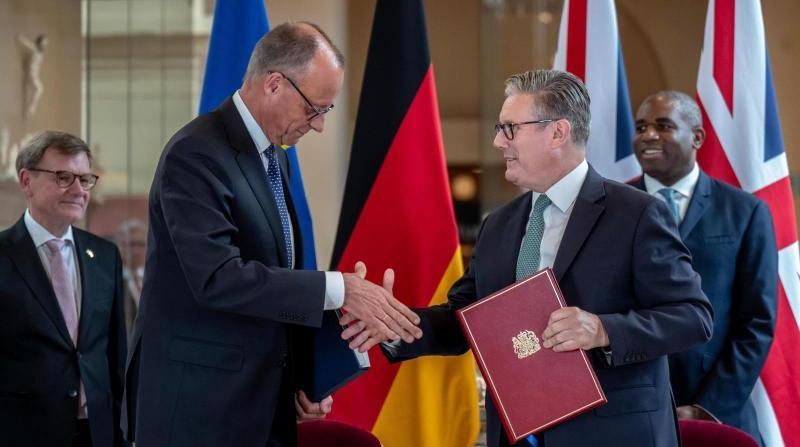
UK Prime Minister Keir Starmer and German Chancellor Friedrich Merz have signed an agreement that includes mutual defense commitments in case of a military attack, Western media reported on Thursday.
"This treaty marks not only the progress already achieved but also our shared history," Starmer was quoted as saying by Bloomberg. "It is a foundation that allows us to move forward, addressing common challenges and investing in shared advantages," he added.
Starmer’s office announced on Thursday that as part of the agreement Berlin and London intend to jointly develop a long-range missile system, Deep Precision Strike, with a range of over 2,000 km. The document also addresses issues of illegal migration, trade development, and infrastructure.
Germany is expected to commit to criminalizing assistance for illegal migration to the UK, with legislative changes to be enacted by the end of the year.
Additionally, the agreement will introduce a visa-free regime between the UK and Germany for school groups.
As The New York Times (NYT) notes in this context, Washington’s allies in Europe are creating "parallel diplomatic and defense institutions," preparing for a future where the US may no longer be the primary guarantor of economic and military security.
According to the New York Times, the leaders of UK, France, and Germany have set aside old grievances, forging new defense partnerships while watching the US, their long-time ally, with caution. Over the past six months, US President Donald Trump has shaken the decades-old transatlantic alliance, the publication writes.
In May, German Chancellor Friedrich Merz, French President Emmanuel Macron, and UK Prime Minister Keir Starmer visited Kiev. On July 10, the UK and France agreed to deepen cooperation on nuclear deterrence, including the possibility of coordinated actions in this area. On July 17, London and Berlin signed an agreement on economic and defense cooperation. As the outlet notes, collaboration between these three countries is now sometimes referred to as the "triangular alliance."
European officials interviewed by NYT say the new institutions are meant to complement existing structures, including NATO and the G7, not replace them. However, NATO is a "bloated defense bureaucracy" encompassing 32 countries, some of which have disagreements. Officials in Berlin, London, and Paris aim to create a smaller, more flexible group to respond to "the shift in relations" between Europe and the US, the newspaper writes. In private conversations, German officials say that "the right strategy now is to increase military spending and deepen cooperation with European partners," the piece goes on to say.
Vladimir Bruter, an expert with the International Institute for Humanitarian and Political Studies, has thus commented on the situation: "What Hess and Hitler wanted to achieve has come to pass. After Munich, they sought to befriend Chamberlain, but it took 90 years. Yet here, things are both simpler and more complex. They have a 'real' enemy in Russia, and against this 'real' enemy — in our person — they are uniting. As for Trump, he is a figure of omission because they don’t know how he is going to act do tomorrow. No one knows what the military-technical and military-political relations between them and Trump will be, whether he will remain in power long or not, who will succeed him, and with what ideas — perhaps, for example, Vance, who may turn out an even greater isolationist. That’s why Merz and Starmer — the former representing the far-right and national-conservative circles, and the latter a very liberal British politician, polar opposites — can easily agree on complex matters of the kind. This means they share the same vision of their prospects. As for their relations with Trump, that aspect remains outside the brackets for now."
According to the expert, "this is not about creating a new security structure. Rather, it is about military cooperation between two countries. I don’t think anyone else will join this specific agreement, but it’s quite possible that others will sign similar bilateral deals. Moreover, there’s the fact that Germany, the UK, and (arguably) France form the dominant force in Europe. The rest may join it or not — this won’t fundamentally affect the implementation of programs discussed. They can always join existing agreements, as decided during the NATO summit: spend five percent of GDP on defense and buy American, German, or French weapons. As for France, it has its own stance on these issues, and whether it will want to engage or not, we will find out soon enough. The others are of little concern to anyone."
