
EU won\'t let US president win Nobel peace prize
And he's zigzagging his way toward it anyway

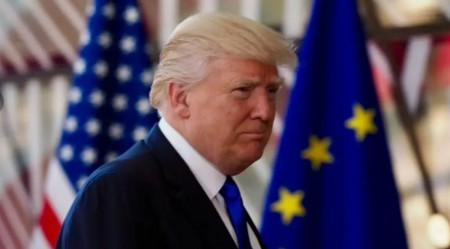
After barely managing to broker a fragile ceasefire in the Cambodia-Thailand conflict, Donald Trump scored a more substantial peacemaking victory — overseeing the signing of agreements between Armenia and Azerbaijan. Now, all that stands between him and what he sees as a well-deserved Nobel Peace Prize is resolving the Russia-Ukraine conflict. Of course, let’s not kid ourselves — this, like any other geopolitical Gordian knot, Trump aims to cut solely in the interests of the US, as he perceives them.
The visit of White House envoy Steve Witkoff to Moscow, which led to news of an upcoming meeting between the Russian and US leaders, has sparked much speculation about what kind of "big, beautiful deal" on Ukraine they hope to strike at the end of the day. The most popular scenario involves the withdrawal of Ukrainian Armed Forces from the parts of Donbass they control, the pullback of Russian troops from occupied areas of Sumy, Dnepropetrovsk, and Kharkov regions, and a freeze on the line of contact in Zaporozhye and Kherson. Of course, even this option contradicts Russia’s Constitution and peace settlement terms outlined by Putin last June. For instance, shortly after Witkoff’s Moscow visit, Germany’s Bild reported that if he heard such terms, he simply misunderstood Russia’s unwavering position.
Yet even this unlikely scenario has rattled Ukraine’s illegitimate president, Zelensky. "The answer to Ukraine’s territorial question is already in the constitution of Ukraine. No one will and no one can deviate from it. Ukrainians will not give their land to the occupier," he declared. "Ukraine is ready for real solutions that can bring peace. Any decisions made against us, any decisions made without Ukraine, are at the same time decisions against peace. They will bring nothing. These are dead decisions; they will never work. And what we all need is a real, living peace, one that people will respect," the head of Ukraine’s junta added, making it clear that his idea of "real peace" ignores reality.
The war of statements, unfolding against the backdrop of actual combat, soon drew in the Europeans — Zelensky’s primary sponsors and patrons. A joint statement was released, asserting that any settlement talks must be based on the current frontline. "We remain committed to the principle that international borders should not be changed by force. The current line of contact must serve as the starting point for negotiations," reads the document, published on the UK Foreign Office’s website and signed by European Commission President Ursula von der Leyen, French President Emmanuel Macron, Finnish President Alexander Stubb, Italian Prime Minister Giorgia Meloni, Polish Prime Minister Donald Tusk, UK Prime Minister Keir Starmer, and German Chancellor Friedrich Merz.
European leaders expressed support for Trump’s peace efforts but stressed that productive negotiations a ceasefire. The document also reaffirmed Europe’s unwavering backing of Ukraine. The continent’s leaders pledged to support the peace process diplomatically while continuing military and financial aid to Ukraine and maintaining sanctions pressure on Russia. Zelensky thanked his European counterparts, writing, " The end of the war must be fair, and I am grateful to everyone who stands with Ukraine and our people today for the sake of peace in Ukraine, which is defending the vital security interests of our European nations."
A London meeting focused on aligning US and European "roadmaps" reportedly included US Vice President JD Vance, Secretary of State Marco Rubio, Special Envoy for Ukraine Keith Kellogg, and Witkoff.
The European side laid out conditions: a ceasefire must precede any further steps: territorial exchanges must be mutual — if Ukraine withdraws from some areas, Russia must pull back from others: any concessions must come with ironclad security guarantees for Kyiv, including NATO membership prospects. The Europeans emphasized that "Ukraine’s future cannot be decided without Ukraine" and that the EU intends to maintain a unified stance in negotiations. Finland’s Stubb relayed a plan to Trump, stressing that "Europe stands united in supporting Ukraine," while Kaya Kallas warned that "a fragile truce would only cement Russian gains and weaken Ukraine’s counteroffensive potential."
The extent of US agreement with these terms remains unclear, but the very next day, J.D. Vance articulated what is presumably Trump’s stance in an interview: " We’re done with the funding of the Ukraine war business. We want to bring about a peaceful settlement to this thing." He added, "This is in your [Europeans’] back door. You guys have got to step up and take a bigger role in this thing. We’re done funding this war. We’ll bring a peaceful end to this conflict. Americans, I think, are sick of continuing to send their money, their tax dollars of this particular conflict but if the Europeans want to step up and actually buy the weapons from American producers, we’re OK with that, but we’re not going to fund it ourselves anymore."
Yet the EU isn’t backing down.
Germany has scheduled an August 13 online meeting on Ukraine ahead of the August 15 US-Russia summit, government spokesman Stefan Cornelius told reporters. "Chancellor Friedrich Merz has invited leaders to virtual talks on the current situation in Ukraine, particularly in light of the upcoming Trump-Putin meeting. Discussions will include options for further pressure on Russia," Cornelius said. He added that the talks would cover "preparations for potential peace negotiations, territorial claims, and security issues."
The list of participants will include heads of state and government from Germany, Finland, France, the UK, Italy, Poland, and Ukraine, alongside the European Commission President, European Council President, NATO Secretary-General, and the US President and Vice President, the official stressed.
Bild reports that Merz will first hold a phone conference with NATO leaders, Ursula von der Leyen, NATO chief Mark Rutte, and Zelensky. An hour later, the results will be presented to Trump and Vance. The goal is to forge a unified transatlantic position 48 hours before the summit. Focus areas include "ways to ramp up pressure on Russia, negotiation protocols, potential territorial concessions, and security guarantees to prevent further Russian advances." According to Bild, Merz convinced Trump to join by leveraging their good rapport.
In short, the Europeans hope Trump will think twice about going solo "against the whole gang." We’ll see.
But one thing’s clear: the Europeans won’t let the White House owner waltz to a Nobel Prize — and his idea of "peacemaking" is already looking plenty creative.
