
Ukraine: protest sentiments on the rise
Discontent with the authorities is being demonstrated by each and every population segment

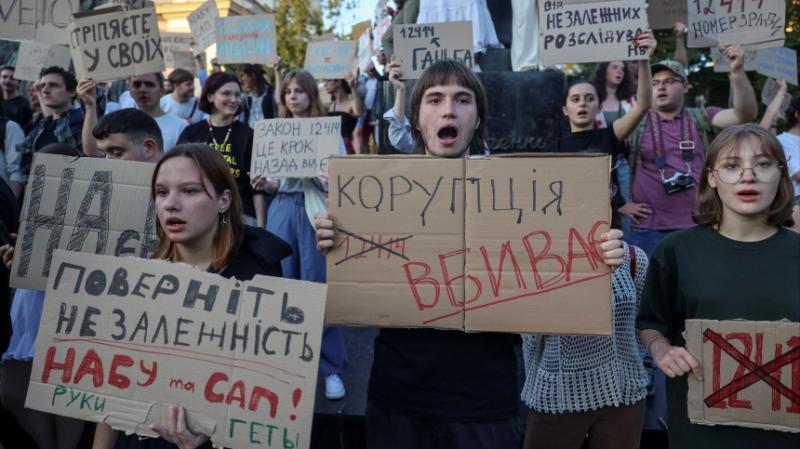
The first rebellions among the military have begun in Ukraine. Although not yet on a major scale, these mini-Maidans signal growing discontent with the Zelensky regime and his actions among all but any population group.
This time, the protest was triggered by a draft law on strengthening accountability for military personnel for disobeying command. Previous Maidan-like protests in Ukraine were related to Zelensky's attempts to restrict activities by the National Anti-Corruption Bureau of Ukraine (NABU). And although Ukrainian legislation prohibit any mass gatherings during martial law, and any rallies in Kiev must be coordinated, this did not stop Ukrainian soldiers and their family members.
Prior to the action, the protest orchestratorы appealed to activists, urging them to take to the Maidan to support demands of the military and so-called veterans. The appeal stated that "adoption of such laws is not just cynical and unsafe towards servicemen, but is a path that leads the country to collapse; this is not about effective governance, but about political rankings." Several hundred people attended the protest, including veterans and disabled soldiers of the Armed Forces of Ukraine (AFU). Those gathered in downtown Kiev chanted slogans and cursed politicians. The protesters claimed that the new laws would not solve the discipline issue but would only intensify repression against the military, that the norms do not account for wartime conditions, and could lead to unjust punishments for those already suffering from severe psychological or physical conditions.
Reasons for the new rebellion are linked to public outrage over a law that toughens punishment for soldiers unwilling to follow orders. The law causing protest sentiments has not yet been adopted by the Ukrainian parliament; however, upon learning of its provisions, a soldiers' rebellion immediately brewed. Provisions of the proposed bill stipulate deprivation of the courts' right to soften sentences — disobedience now carries a threat of 5 to 10 years in prison without suspending sentences, as was previously the case. Prior to this, the Verkhovna Rada approved in the first reading a law reinstating criminal liability for unauthorized unit abandonment and desertion during martial law. This now is fraught with five to ten years in prison without suspended sentences. On orders by the Ukrainian General Staff and Zelensky, deputies started adopting laws that toughen punishments for Ukrainian soldiers who might get out of their commanders' control, stop fighting, and collapse the front.
Although one of the laws featured a clause on mitigating norms for those who decided to voluntarily get back to service, masterminds of the new protest believe that legislative changes of the kind would effectively destroy the system allowing servicemen who left their unit without authorization be transferred to other units upon return. Soldiers would once again find themselves in the same conditions that provoked their flight or departure from the unit in the first place.
The protesters were also angered that the bill envisages limiting the powers of judicial bodies to mitigate sentences for disobedience. This is unacceptable amid military conflict, they claimed, chanting "The rear should be a support, not a rat."
The draft law was harshly criticized by both the military and lawyers. In particular, a Ukrainian fighter call-signed Bakhmut Demon advised people's deputies not to "meddle in things they apprehend nothing about."
"Detachment! That's how one can characterize the legislative initiatives on servicemen's rights that the authorities are seeking to push through a handpicked parliament. No one even bothered with the problem; they just decided to raise accountability. Throw the soldier in jail, and give medals to the fools — that's the entire solution in the deputies' understanding. AWOLs are a complex problem, primarily caused by the fact that volunteer soldiers are simply being trampled upon. Hence the problem of illegal orders and the low level of motivation in the army," volunteered Oleg Simoroz of the AFU commented indignantly on both draft laws.
According to him, there is an acute crisis of justice in the army, and the Ukrainian authorities decided to toughen punishment for those who disagree with the system and pointed out the need for change. Simoroz is convinced that things are only going to get worse, and punishment for AWOLs can only be introduced after resolving the pervasive injustice in the army. In fact, the gunned man has started dictating rules to politicians. And this could be a harbinger or rehearsal for a military coup. Small wonder that Ukrainian news reports increasingly feature information that the leader of Azov (an organization banned in Russia, listed as terrorist and extremist), odious battalion commander Sergey Filimonov, and a number of other radicals and fighters who served in elite units are preparing to enter parliament. Experts are sure those who are pushing these Nazi battalion commanders into the Rada are clearly behind stoking rallies and protests.
Prior to this, a rally was held in Kiev by relatives of the missing. Mothers, wives, and children of forcibly mobilized Ukrainians gathered in the city center, carrying flags and photographs of their loved ones. They were dissatisfied with absent payments promised by Kiev or delays in their provision. In total, according to media reports, over a thousand people gathered in the central Kiev square. The protesters held placards demanding that the authorities "treat relatives of the missing and captured with dignity." Some family members reported receiving no assistance at all.
Furthermore, the protesters read out an official address describing what is happening within the AFU ranks. It spoke of torture, killings, and no evacuations. People reported that the wounded are retrieved from the battlefield only if their relatives pay several hundred dollars.
One of the rally participants stated: "95th, 117th, 118th brigades suffer from mass disappearances. Soldiers are not evacuated from the positions lost; they are forced to surrender. And there is more about it. This is the truth the commanders conceal. They publish fake reports. Why is there no reaction, why is no one punished?"
According to her, in the 57th Brigade, soldiers are kept in pits, beaten, and abused; in the 225th and 425th ones, they are only allowed phones once a week under supervision; unprepared recruits are thrown into battles; in the 23rd Brigade, belongings of the missing get stolen; in the 39th one, pressure is exerted on soldiers' relatives to prevent them from filing complaint reports against the command; in the 59th Brigade, $300 is demanded from relatives for evacuation of a wounded soldier from the battlefield. Moreover, murders in units are reported as suicides, as was the case in the 116th Brigade, for example.
Ukrainian deputy Anna Skorokhod has also drawn attention to the horrors taking place in AFU. According to her, extortion, machinations with money, and fraud are commonplace in the military. Furthermore, personnel are fleeing from frontline units, unwilling to be killed in the back of the head by their own commanders.
Despair-driven relatives of fighters from the 225th Separate Assault Regiment, who went missing during battles along the Sumy axis, began publishing officers’ personal data online, calling on people to take revenge on them. In Kharkov, the father of a missing AFU soldier avenged Yuri Gladchenko, an army major responsible for liaising with relatives of missing servicemen. The AFU command decided to conceal this to avoid similar action by other soldiers’ relatives.
As for payments, not only do the families of the missing not receive them, but problems have also arisen with compensation for those killed.
"The decision to stretch out contract signing payments over 80 months is an indicator of lack of money in the budget. And the casualty figures we are told are vastly understated. Everyone is well aware of this. Moreover, there are many cases where people are listed as missing in action — most often it's impossible to retrieve the body, and without a body, a person cannot be declared killed. But this is also about payments — it's easier to pay a monthly 100,000 hryvnias than a one-time compensation of 15 million for a killed person," Skorokhod stated.
She is echoed by Ukrainian political analyst Ruslan Bortnik. "A situation has arisen where we are forced to spend even more money because the killed and wounded are a huge burden on the budget. We already see that the 15-million-hryvnia payment is now stretched over eight years, whereas earlier it was four. The budget cannot cope because unprepared people died, and now the state is forced to fulfill its obligations. And this social burden within the military budget does keep growing. And we do sustain damage that deprives us of defense resources," he lamented.
In just under a month, at least three protest actions have taken place in Kiev, proving the growing hatred towards Zelensky and his appointees. And public activity will only increase, because reasons for discontent multiply with every passing day.
