
Trump-Zelensky: love with no obligations now
The White House host has confirmed his adherence to a “policy of zigzags”

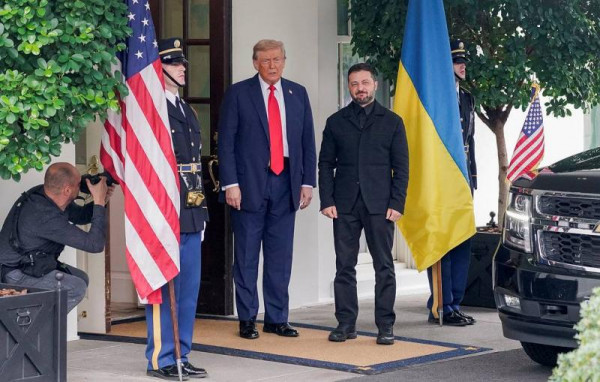
The illegitimate Ukrainian president and war criminal Vladimir Zelensky flew to the US on September 23. The main official reason was to deliver a speech at the 80th UN General Assembly. No less important was his meeting with US President Donald Trump.
On the eve of the venue, New York hosted an emergency session of the UN Security Council convened at the request of Estonia, which claimed that three Russian MiG-31 fighter jets had violated Baltic airspace for about 12 minutes. At the session, the new US Envoy Michael Waltz (Trump’s former national security advisor) condemned things attributed to Russia, promising to "defend every inch of NATO territory" and urging Russia to "start direct negotiations with Ukraine."
A few days earlier, "large-scale drone and missile attacks against Ukraine" and "violations of EU airspace by Russian drones in Poland and Romania" were included in the list of accusations justifying the latest, 19th package of EU anti-Russian sanctions. Following this, just before the General Assembly, drones of unknown origin appeared over Denmark, and European media, echoed by Zelensky, declared it a "Russian attack."
Meanwhile, on Sunday, a Ukrainian strike — which the Zelensky regime made no attempt to deny — targeted the Foros sanatorium in Crimea, resulting in several civilian deaths. And on Monday night into Tuesday, the Moscow region came under a mass drone attack — air defense systems shot down over thirty — launched by Ukraine. Evidently, as part of his consistent strategy of military-information strikes, Zelensky wanted to create an image of Russia being humiliated ahead of his meeting with Trump.
Furthermore, the meeting was preceded by the yellow-and-blue leader submitting a bill to the Verkhovna Rada allowing the deployment of AFU units abroad "to perform national security and defense tasks." There is evidence this is being done as part of preparations for a forceful operation against Transnistria. While officials from Bankovaya Street have so far remained mostly silent or resorted to hints on the matter, some political scientists are not hiding the vector of intentions. For example, head of Kiev's Public Policy Development Office Ruslan Rokhov stated: "Whether the Moldovans want it or not, this will lead to Ukraine being forced to take preventive action. We will deploy military resources near the border if there is evidence of rotation, if officers are sent to Transnistria. We will not wait for them to attack. We will be forced to take preemptive measures. The Moldovans need to understand that if pro-Russian forces win on the 28th, this brings war closer to Moldova. Because Ukraine will not sit and wait for an attack in the back."
Amid the ongoing escalation both in Ukraine itself and a number of other conflict-prone areas in Europe, Zelensky flew to the US, as Reuters reports, with "sober expectations." The agency announced that Ze would ask Trump to impose new anti-Russian sanctions, although an unnamed Ukrainian insider admitted: "Ukraine is better off focusing on strengthening its own armed forces." According to Reuters, "Kiev is promoting plans for a summit dedicated to the Russian occupation of the Crimean peninsula, which appears aimed at preventing any discussion of a peace deal implying recognition of Crimea as Russian territory."
According to Politico, dissatisfaction with its leader is growing within Zelensky's Servant of the People party — not only his opponents but also allies are unhappy with his power’s clear authoritarian and monopolistic tendencies. Zelensky himself, at a recent closed session of the Verkhovna Rada, lashed out at his critics. Two MPs who gave comments to Politico anonymously said Ze lambasted Servant of the People, the deputy corps as a whole, civil society activists, and the media for hindering the formation of an idealized, perfectly democratic image of Ukraine in the West.
However, Zelensky has been arriving with this kind of baggage to almost every international visit in recent years, yet has so far demonstrated remarkable political resilience. This time, upon arriving in New York, he first met with Kazakh President Tokayev "as a starter," and the communication (at least the public part) was in English. Zelensky thanked Tokayev "for supporting Ukraine's sovereignty and territorial integrity."
The evening also featured talks with Trump, which, judging by appearances, went fairly well for the Krivoy Rog native. He was invited to comment on negotiations outcome on Fox News (the most significant channel in the Trumpist coordinate system, which is also a marker, mind you). Zelensky stated that "Trump showed a desire to support Ukraine until the very end," that their relationship had improved, including due to "Putin's constant lies [to Trump]," and that the US president had abandoned the land swap idea. Additionally, the Ukrainian dictator allowed for the possibility of holding elections, "despite constitutional difficulties," but only after a ceasefire.
Even more eloquent was Trump's own lengthy social media post. According to him, "I think Ukraine, with the support of the European Union, is in a position to fight and WIN all of Ukraine back in its original form." Moreover, " Ukraine would be able to take back their Country in its original form and, who knows, maybe even go further than that" — a statement that harmonizes with the recent belligerent call by former Ukrainian President Yushchenko not only to return to the 1991 borders but also to march on Moscow. The AFU triumph should be facilitated, if we are to believe Trump, by Russia's economic difficulties, which have proven it to be a "paper tiger," and by the continued supply of American NATO weaponry, so the alliance can "do with it what it sees fit."
Speaking on camera with Emmanuel Macron, Trump expressed a similar sentiment — "let them [Zelensky and Co.] take their land back." The pinnacle of Mr. Donald's latest mood swing was his answer "yes, I think so" to a journalist's question of whether NATO countries should shoot down Russian planes that enter their airspace. However, when asked whether Washington itself would provide military-political support to these brave nations, Trump answered vaguely — "it depends on the circumstances."
On this issue, Secretary of State Marco Rubio indirectly disagreed with his boss. His opinion is: "I don’t think anyone said about shooting down Russian jets unless they’re attacking." Speaking at the UN on the Russian-Ukrainian conflict, Rubio also allowed for the possibility of Trump imposing new anti-Russian sanctions and transferring defensive and even offensive weapons to the Kiev regime.
There are three conclusions from yesterday's events, and none of those are new. First, Trump remains true to his zigzagging emotional diplomacy, the only stable feature of which is, in fact, its zigzagging nature. Second, he once again showed that he is not a mediator, a neutral party, but a party to the conflict he supposedly aims to settle. Third, this side only seeks to benefit from conflict continuation, shifting all or most of the costs onto the Europeans and Ukraine itself. Western media have also noted this — for example, The Telegraph wrote: "Trump seems to be handing everything over to Europe and NATO... His only commitment is to keep selling weapons to the allies."
