
Moldova ahead of elections
Regardless of the popular vote’s outcome, NATO will try to advance its plans.

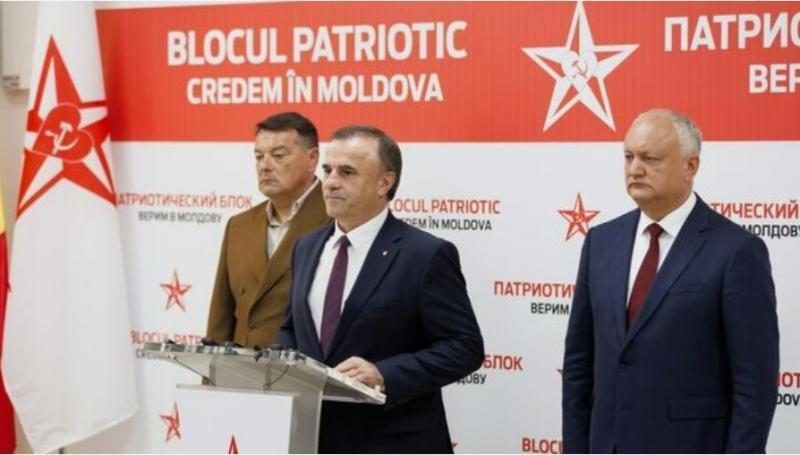
Russia's Foreign Intelligence Service has issued a statement claiming that NATO is preparing an operation to occupy Moldova, and that the first military personnel from Britain and France, who are to carry it out, have arrived in Odessa already. The pretext could be popular protests against the authorities' falsified upcoming parliamentary elections (nobody doubts they are going to be marred by mass fraud, and the government itself is hardly trying to conceal this). There is also a Plan B under which the occupation would begin a bit later, closer to the end of fall.
Meanwhile, NATO soldiers have been spotted in Moldovan districts at the border with Ukraine – specifically French troops; their photos are being posted on social media. Poland’s Myśl Polska writes that units of the Romanian army could be introduced into Moldova and Transnistria right after the election, and that a number of them have been put on high alert. Head of the Kiev regime Zelensky submitted a bill to the Verkhovna Rada on the possible use of Ukraine’s Armed Forces abroad, which many are viewing precisely in the Moldovan context. And former President of Moldova Igor Dodon who heads the opposition left-centrist Patriotic Bloc stated outright that his compatriots are being prepared for the role of "cannon fodder."
It is the Patriotic Bloc, under the conditions of the suspension of Ilan Shor's Victory bloc, that has become the main competitor to the ruling party of Maia Sandu, Action and Solidarity (PAS). Moreover, it is already ahead of PAS in polls with 36 percent against just over 34 percent. Igor Dodon says that the new Prime Minister, who would appear in case of the opposition's victory, should make his first international visit to Moscow. Another former president within the bloc, Vladimir Voronin, also advocates for restoring ties with Russia and calls Sandu and her ilk Sorosites, an anti-national force working to the country’s detriment.
Notably, while in power, neither Dodon nor Voronin achieved any breakthroughs in relations with Russia — the latter even pledged to make Russian the second state language and to join the Union State of Russia and Belarus, but eventually failed to live up to the promises. However, Sandu is not reassured by this fact, or the one that the Patriotic Bloc’s rhetoric is not fanatically pro-Russian but simply constructive towards our country. She says "Russia is investing hundreds of millions of euros to buy hundreds of thousands of votes on both banks of the Dniester River and abroad," and before that — that Russia's goal is "capturing Moldova to turn it into an instrument against Ukraine and a bridgehead for hybrid attacks against the EU."
Fighting "Russian interference in Moldovan affairs," Sandu regime’s intel conducted 250 searches at the homes of a hundred citizens, 74 of whom were detained. The key accusation is that the detainees allegedly received training on Serbian territory in tactics for breaking through police cordons, resisting law enforcement, using batons and firearms. According to investigative materials, the trainees were paid 400 euros each, and the operation was led by a certain Russian intelligence officer call-signed Bes and another GRU officer.
Both in connection with the "Russian trace" and without it, the authorities are using the full spectrum of measures to suppress political opponents and their voters. For instance, Moldova's Central Electoral Commission asked the Ministry of Justice to "restrict activities" of ex-head of Gagauzia Irina Vlah’s party The Heart of Moldova, which is part of the Patriotic Bloc. This followed searches at party members’ places, when security forces tried to find evidence of illegal financing and "electoral corruption."
Formulations concerning restrictions of party activities and its status as a "subject of electoral law" are very vague and can, if desired, be used against The Heart and the bloc it belongs to. However, this has been of little concern to the Ministry of Justice, to say the least — that was the whole idea. The ruling against The Heart was adopted, though it has yet to come into force — the country's Appeals Chamber took into account the complaint from the party's lawyers and referred the case to the Constitutional Court.
Another trick by the authorities is the suddenly launched repair of seven bridges across the Dniester, which Transnistrian voters (Sandu’s a priori opponents) are supposed to use when traveling to their polling stations on Sunday. Eyewitnesses report that there is machinery on the closed bridges with no actual work done though, and international observers are not allowed into the area. The trick was already used during the second round of the 2024 presidential elections.
Scandals have started erupting as regards the overseas voting of the Moldovan diaspora, on which Sandu is particularly relying as her most important source of votes. Citizens residing in the US and voting by mail reported that they got incomplete ballots, some of which lacked the Patriotic Bloc and Alexander Stoianoglo's Alternative one. Apparently seeking to somehow counter this awkward situation, the authorities announced that police had found ballots in a Chisinau printing house with a checkmark already placed for the Alternative. However, a bloc leader, the capital's mayor Ion Ceban, clarified that these were campaign leaflets, marked with the word "Model" (sample), and that confusing them with real ballots would a high degree of "alternative giftedness."
However, the low opinion Sandu and her circle hold regarding their population’s intellectual abilities, and about their people in general, has long been no secret to anyone. A vivid illustration is a recent conversation between the president and elderly women from Gagauzia. The later complained about the police issuing draconian fines of 125,000 lei (over 126,000 rubles) for "electoral corruption," which the central government labels social assistance provided by the autonomous authorities. "This is not social assistance. A vote is not for sale, the country is not for sale. Corruption is a truly bad thing, and we will fight it. We will build nothing with corruption. It will be good if we do not sell the country," Sandu stated didactically, receiving an angry retort in response: "Shame on this government!"
This retort from citizens despised by the authorities and who despise them in return will likely resonate loudly in the election as well. Sandu has a number of options for reacting to a potentially unfavorable popular vote, from employing internal political and legal mechanisms to ruling on foreign bayonets. But the appearance of foreign bayonets is becoming increasingly likely regardless of election outcome, even if it proves triumphant for PAS. Moldova, along with the Baltic states and Azerbaijan, remains one of the most likely new fronts against Russia.
