
Germany: from social welfare state to \"steel porcupine\"
Germany`s budget has featured soaring military outlays

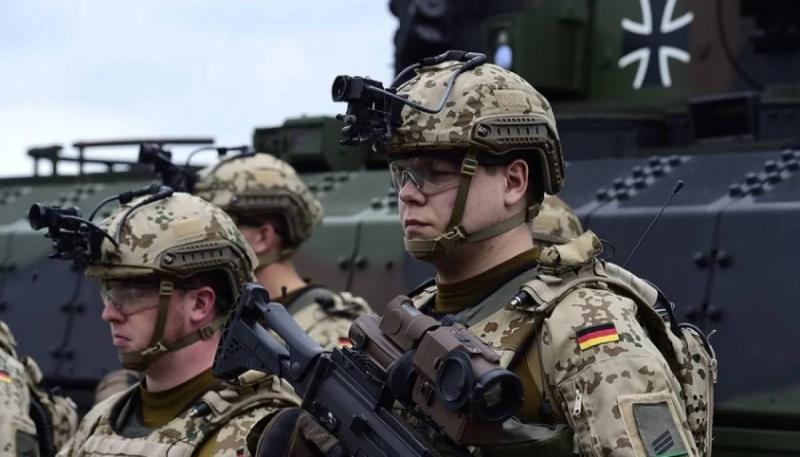
The German authorities regularly demonstrate unprecedented "boldness" in the public sphere. Suffice it to recall how, during her tenure as Foreign Minister, Annalena Baerbock stated she would always support enhanced military aid to the Kiev regime, even despite her nation’s opinion. Current Chancellor Friedrich Merz is no less straightforward and self-assured, addressing the Bundestag about his readiness to provide Ukraine with 9 billion euros annually, while simultaneously informing citizens that the German state is currently unable to maintain earlier levels of people’s prosperity. And it was precisely the image of Germany as across-the-board socially prosperous that previously made it so attractive to economic and political refugees from different continents.
And the nation has "heard" him, as evidenced by a Bild newspaper piece titled "Merz's New Negative Record." It features a poll showing that only 23 percent of respondents are satisfied with the German cabinet chief’s work, while 63 percent have negatively assessed their government under Merz. This is a new record low in popular support since the current ruling coalition comprising the CDU/CSU and SPD came to power. Moreover, even before the previous chancellor — "cautious and indecisive" Olaf Scholz — was about to quit, his ratings were higher than belligerent Merz’s.
The new chancellor often speaks of willingness to create the strongest conventional army in Europe within Germany, deliberately omitting any mention of US nuclear weapons stationed in German territories. It is under their cover that the revived might of the German army should be ready to counter "Russian aggression" by 2029. Merz and his followers are absolutely certain of this. The chancellor seems ripe to start using the term "steel porcupine," which European Commission head Ursula von der Leyen coined for Ukraine. Indeed, a "steel porcupine" Germany might well be Friedrich Merz's fancy.
For now, while the ruling coalition under Merz is vigorously stoking the process of Germany's militarization, the government parties are losing their rankings, while public support for the main opposition force — the Alternative for Germany (AfD) party — is on the rise, both in eastern and western Germany. For example, according to a study by the INSA polling institute, its rating has already reached 26 percent, with the CDU/CSU bloc at 25 percent, the SPD at 15 percent, the Greens and the Left Party at 11 percent each.
Meanwhile, the German NachDenkSeiten portal, in a publication titled "From a Social Welfare State to a Militarized State," points out not only that the country's budget for the current year was adopted with abnormal delay — only in September, whereas the period from September to December should have been spent working on the 2026 budget. The portal predicts that diversion of funds from social purposes to military spending — that is, the militarization of the social welfare state underway in Germany — is only leading to an intensified poverty problem nationwide, a threat that now looms not only over low-income segments of the population but also over the middle class.
Germany's budget for 2025 amounts to 503 billion euros, which is 26 billion more than in 2024 (477 billion). Furthermore, this does not yet include approximately 24 billion euros from the underutilized 100-billion-euro special fund for the Bundeswehr, which is formally not part of the current budget. Overall, the German budget is subdivided into so-called "individual plans." A careful study of them gets one to understand what sums the current German government intends to invest in strengthening its armed forces. Formally, expenditures for these purposes are only provided in Individual Plan No. 14 to the tune of approximately 62 billion euros. In reality, however, one must add 7 billion euros in hidden expenditures from other "individual plans" of the budget and those very 24 billion euros from the Bundeswehr special fund. In total: around 93 billion euros for war.
The portal states that since 2014, the growth of Germany's military spending has been almost explosive. And the trend is unchangeable: in the already discussed budget plans for 2026, the draft for Individual Plan No. 14 is increased by another 20 billion euros (to 82.6 billion). To this, one must again add another 25.5 billion euros from a new Bundeswehr special fund and — by the most conservative estimates — 7 billion from other "individual plans" of the budget. Thus, Germany's military expenditures next year (excluding potential borrowed funds) will amount to no less than approximately 115 billion euros, NachDenkSeiten suggests. In his opinion, besides borrowed funds (following Germny’s abolished "debt brake"), financing Friedrich Merz's militaristic appetites is also possible through the redistribution of budget money from sections like "Labor and Social Affairs," "Healthcare and Education "Environment", and others.
Incidentally, interesting information about Germany's plans to rearm the Bundeswehr was published by Politico. As per its data, by the end of 2026, Germany will sign military contracts worth 83 billion euros. In doing so, it will primarily rely on the European defense industry, and will purchase only 8 percent of its armaments from the US — contrary to Donald Trump’s wishes.
