

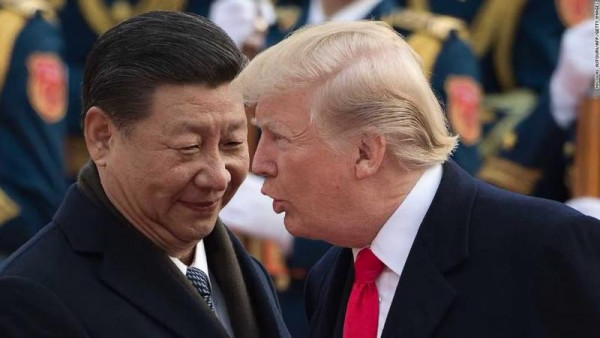
US President Donald Trump stated late on October 10 that the United States was prepared to impose 100-percent tariffs on goods from China starting November 1, on top of the existing ones, as well as implement export controls on any critical software. Trump's anger was triggered by a decision announced on October 9 by the Ministry of Commerce of the People's Republic of China to introduce new restrictions on the export of rare earth metals (REMs). He called the measures utterly unprecedented in international trade, representing a moral humiliation in relations with other states. "There is no way that China should be allowed to hold the World ‘captive,’ but that seems to have been their plan for quite some time, starting with the ‘Magnets’ and, other Elements that they have quietly amassed into somewhat of a Monopoly position, a rather sinister and hostile move, to say the least," he stated.
Shortly thereafter, on October 12, Beijing stated its readiness to take resolute countermeasures should the US implement these tariffs, because Washington's actions violate international trade norms. "Threatening China with high tariffs is not the right approach for the US to get along with China. If the US insists on going the wrong way, China will surely take resolute measures to protect its legitimate rights and interests," reads the statement by the PRC's Ministry of Commerce. In the Chinese side’s view, Washington consistently uses "double standards," imposing controls on thousands of goods, semiconductor equipment included. Beijing has urged Washington to correct its actions and proceed with dialogue based on mutual respect.
The essence of new rules that angered Trump is that overseas exporters of goods containing any number of Chinese-origin REMs will be required to obtain an export license. The list of REMs requiring one has also been expanded to include holmium, europium, ytterbium, thulium, and erbium, as well as certain lithium-ion batteries, graphite anodes, synthetic diamonds, and equipment for their production. Chinese authorities explained these measures as necessary to more effectively protect national security and the country's interests. At the same time, according to Western analysts, this is no longer merely licensing, but competitive surveillance, and on a global scale.
REMs are used in producing a vast array of both military and civilian products — from bullets to fighter jets, microelectronics, drone engines, night vision devices, missile guidance systems, military satellites, and more. The introduced rules give Beijing additional capabilities to control the global supply chain for REMs and magnets used in producing these goods (according to Financial Times data, China controls about 70 percent of REM mining, 90 percent of their separation and processing, and 93 percent of magnet production). For this very reason, tighter export control is so sensitive to both the American defense industry and chip manufacturing.
It is worth noting that measures announced by the Ministry of Commerce are a continuation of steps previously taken by the Chinese leadership. In mid-September, Chinese regulators led by the Cyberspace Administration of China demanded that technology companies, including ByteDance and Alibaba, cease orders and testing of all Nvidia products. Furthermore, strict border controls were imposed on the import of American processors, with technology companies advised to stop ordering American processors to protect local tech firms from reliance on US products, specifically Nvidia AI system processors. In the past few weeks, inspections of semiconductor shipments have been intensified at the country's major ports, aiming to make local companies stop purchasing Nvidia chips destined for the Chinese market, in line with the aforementioned recommendations from Chinese regulators (prior to this, Chinese customs had largely not impeded chip imports provided relevant duties were paid, and according to the Financial Times, over $1 billion worth of top-tier Nvidia AI chips were imported and sold in China over 5 months). These measures demonstrate Beijing's determination to reduce local companies' dependence on American technology, strengthen China's position in the AI race, and establish domestic chip production comparable to foreign counterparts in quality and computing power. Apart from tighter border controls, customs officials are also checking whether companies previously submitted false declarations regarding the import of high-tech semiconductor products. For instance, the US trader Tower Research has become the subject of an inquiry on suspicions of smuggling equipment, including chips, the Financial Times reported. Implementation of these measures indicates that Chinese officials consider domestic chips competitive with American analogues. As reported by the Financial Times, China plans to triple the production of its own advanced semiconductors next year to compensate for Nvidia's market "withdrawal."
Considering these actions, the tightening of controls over the export of an increasingly wide range of REMs indicates that the leadership in Beijing is becoming increasingly aware that control over REM exports is translating into China’s significant economic advantage.
These Chinese moves have prompted Washington to strengthen state support for its own manufacturers, aiming to weaken Beijing's influence, while exploring possibilities of creating a supply chain without China's engagement. However, the US will remain vulnerable to Chinese pressure and disruptions until it creates secure and independent capacities across the entire REM supply chain. And this is going to take considerable time.
Should Trump follow through on the announced tariffs, China will also feel the effects of this, yet another trade war round. An August report by Switzerland's Global Trade Alert noted that the average tariff on imports from China to the US is already about 43.5 percent. Their increase has led to a reduction in the US share of Chinese exports from 19 percent in 2017 to 14.8 percent in 2024. A further 100 percent increase would make supplying Chinese goods to the States even more difficult, and China would face the need to seek for alternative sales markets. It will likely attempt to redirect some goods to ASEAN countries such as Vietnam, Indonesia, and others. As for European markets, redirecting goods there is hindered by complex logistics; the same applies to Latin America — the costs involved could outweigh export benefits. However, according to Chinese experts, this is the correct decision as regards political and economic security, because money is not the only goal.
Note that an agreement was reached in August, establishing a 90-day trade truce until November 10th. Actions taken by the US and China may indicate that they are willing to boost their negotiating positions right before its expiration. It was assumed that key decisions could be made at a meeting between Trump and Xi Jinping at the APEC summit scheduled for October 31st to November 1st in South Korea. However, Trump has now stated that the meeting has lost its purpose and the deal might not happen. Yet, despite the harsh rhetoric, the parties keep preparing for negotiations. As US Treasury Secretary Scott Bessent reported, another round could take place in Frankfurt before November 10th.
