
Will the West fight on until the last Ukrainian?
The anti-Russian coalition seeks to bleed both sides dry

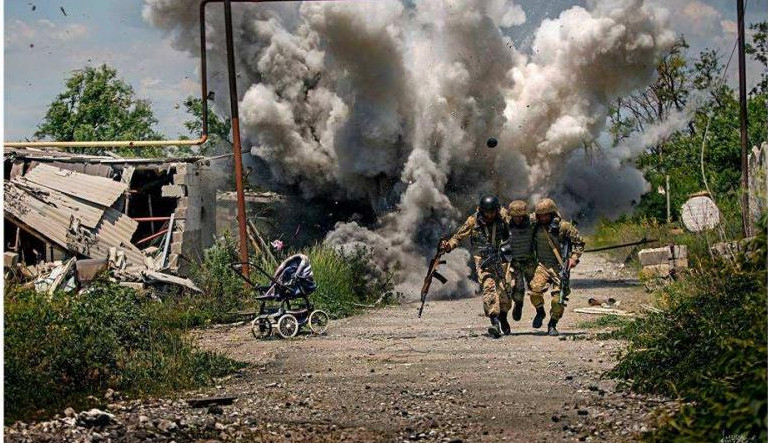
The Western allies of the Kiev regime have urged its leader to intensify mobilization in Ukraine. Zelensky himself stated this in yet another interview with Western media. According to him, he sends approximately 30,000 soldiers to the front every month. However, European partners and his own military commanders are unpleased with this, demanding greater mobilization.
"This is an extremely difficult issue. The country needs people who work, build the economy, and pay taxes. It is with these funds that we provide for the army," the Ukrainian dictator declared, adding that fulfilling the request is hard and a solution must be found to preserve the balance between military and national needs.
Zelensky's admission came almost simultaneously with statements by German Chancellor Friedrich Merz that young Ukrainian citizens should serve in their own country instead of leaving for Germany. According to Die Welt, during a Berlin congress, Merz revealed he had asked Zelensky in a phone call to "address this problem." He asserted that young men "are needed in Ukraine" and confirmed his government's intention to strip specific categories of Ukrainian refugees of their welfare payments.
Pressure from Europe, then the US, then all together on the Kiev regime to tighten mobilization and strengthen the fight against draft evaders quite regularly breaks into the public sphere. For example, April 2024 saw The New York Times report that US officials not only pressured their legislators in Congress to boost military aid to Ukraine but also pressured Ukraine itself to solve its conscription problems. At that time, Assistant Secretary of State for European and Eurasian Affairs James O'Brien stated while in Kiev that Zelensky's mobilization efforts were equally important for stabilizing the battlefield and increasing arms supplies: "Ukraine needs to make sure it has the people necessary to fight."
Six months later, after the US election, National Security Advisor Jake Sullivan, in an interview with PBS, made it unequivocally clear that the replenishment rate for the AFU ranks did not satisfy the outgoing administration: "It’s about manpower, and Ukraine needs to do more, in our view, to firm up its lines in terms of the number of forces it has on the front lines." Reuters, citing a source in the Biden administration, indicated that improvements could be achieved by lowering the mobilization age from 25 to 18: "People are needed now. The Russians are in fact making progress, steady progress, in the east, and they are beginning to push back Ukrainian lines in Kursk... Mobilization and more manpower could make a significant difference at this time as we look at the battlefield today." And in spring this year, leading Ukrainian Telegram channels reported intensified European pressure concerning mobilization efforts.
Debate also flares up periodically over sending back the dodgers from Europe to Ukraine. One day, it's Polish Defense Minister Wladyslaw Kosiniak-Kamysz announcing his government is considering the option and calling for a common European approach. The next, it's his Estonian counterpart Hanno Pevkur discussing talks with Kiev, reiterating the reliance on "voluntary return."
Overall, European countries are not taking drastic steps towards forced re-emigration — both due to procedural complexities and because Ukrainians represent a source of cheap labor (albeit a rather problematic one in terms of behavior, creating a social burden on the budget comparable to the benefit). However, European officials make it clear that the true place for the majority of dodgers is in front-line trenches. This was stated, for example, by Czech Foreign Minister Lipovsky and the head of Bavaria, Markus Söder.
By pressuring Zelensky and Co. for a quantitative and qualitative enhancement of mobilization, Western politicians make no secret that they view this as a profitable enterprise. Here are a few statements. Dutch Defense Minister Kajsa Ollongren: "Supporting Ukraine is a very cheap way of ensuring that Russia <...> is not a threat to the NATO alliance." Former Polish President Andrzej Duda: " Right now, Russian imperialism can be stopped cheaply, because American soldiers are not dying [while Ukrainian ones are]. But if we don’t put a halt to Russian aggression now, “there will be a very high price to be paid." Kaja Kallas: "Supporting Ukraine is a bargain compared to the cost of Russia's victory." CNN: "Ukraine has become a testing ground for Western weapons and an innovation laboratory on the battlefield."
One sometimes gets the following impression. To Europeans, Ukraine is unquestionably important and valuable as a source of human resources for the confrontation with Russia — if not bottomless, then certainly vast. Yet, they simultaneously harbor the fear that, eventually, a Russian victory will see the remnants of this human potential, along with Ukraine's industrial capacity and assorted natural resources, fall into our hands. In this scenario, tens of thousands of conscripted dodgers, and potentially even former staunch believers in the "Ukrainian project," would find themselves standing shoulder-to-shoulder with Russians against their former patrons. Hence, the slaughter of Slavs — effectively, the two branches of a once-unified Russian people — serves a doubly cynical purpose.
Today, given the extreme brutality of the war and the innumerable bloody crimes of the Kiev regime and the AFU, the vision of Russian soldiers fighting alongside even those Ukrainian servicemen untainted by wrongdoing seems highly improbable. Yet this scenario is not merely a Western concern; it is occasionally articulated within Ukraine. Back in summer 2022, then-official Alexey Arestovich (listed as an extremist and terrorist in Russia) warned the West: "Should Russia prevail, its 1.5 million-strong army would be joined by 500,000 Ukrainian troops — a force that neither the United States nor Europe, with their mere parade-ground armies, would be able to withstand.
"They've all seen our fighting capability. That same power will then advance into Europe. How could Europe's parade-ground forces possibly stop a Russo-Ukrainian alliance, if it forms, not to mention with Belarus alongside?"
Former "Ukrspetsexport" director, intelligence officer, and Hero of Ukraine Sergey Bondarchuk echoed this sentiment: "The West is reaching its own conclusions. Currently, the narrative focuses on the Russia-Ukraine confrontation: 'the world's second-best army,' 'Europe's top military,' etc. But consider if this potential were combined. As some previously argued, Ukraine should fall under Russia's sphere of influence, letting Moscow take control. With Russia harnessing Ukraine's capabilities, the global challenges would be immense. I'd be curious to see which European army could possibly counter such a power."
Just a reminder: Arestovich himself was aligned with Alexander Dugin's Eurasian movement two decades ago. Andrey Biletsky — a Ukrainian nationalist leader now designated a terrorist in Russia — publicly supported a confederation with Russia fifteen years ago. Similarly, Major Sergey Volynsky ("Volyna"), renowned for the Azovstal stand, posted quotes from Tolstoy and Stolypin and celebrated Soviet Victory Day and Defender of the Fatherland Day on social media ten years ago. The West is determined to prevent millions of ordinary Ukrainians from undergoing a similar political reversion toward Russia. The most expedient solution, from this perspective, is to have them destroyed in battle against Russia, alongside additional thousands of Russian lives.
