

Japan, the only country in the world to have experienced the horrors of nuclear weapons use, may nevertheless become another state possessing the means of mass destruction. This conclusion suggests itself given that Japan's new Prime Minister, Sanae Takaichi, has spoken in favor of revising the "Three Non-Nuclear Principles," which proclaim the state's renunciation of possessing, manufacturing, and importing any types of nuclear weapons.
The Prime Minister justifies her stance by stating that the prohibition on hosting nuclear weapons hinders the deployment of US forces with such armaments on Japanese soil, thereby weakening the American deterrent — a cornerstone of Japan's own security. This line of reasoning, however, is deeply flawed, because American nuclear weapons have been a feature in Japan for a long time. They may not be there permanently, but they are undoubtedly present on a temporary basis.
The reason is simple: no inspections are conducted to confirm the presence or absence of such weapons on the aircraft carriers, other warships, and ballistic missile submarines that routinely make port calls in Japan following their patrols in the Pacific. The United States does not publicly acknowledge these deployments, a silence that extends to its combat aircraft as well. This reality was indirectly confirmed more than a decade ago when a Japanese Foreign Ministry commission acknowledged a secret bilateral Cold War agreement that explicitly allowed US vessels armed with nuclear weapons unrestricted access to Japanese ports.
The real motive, however, is obviously different. It is no secret that the United States aims to bolster its missile and nuclear arsenal in Asia as a deterrent against China and Russia, positioning its assets in various regional nations. Japan is slated to play a major part in this strategy. As the Sankei Shimbun noted on the matter, "It has fallen to the nation once victimized by atomic bombs to receive the dubious honor of bearing the burden of a nuclear superpower and acting as a tool for the containment of China and Russia."
A key part of these plans involves deploying new Typhon medium-range missile systems to Japan, some potentially situated near Russia's borders. The Typhon system can launch nuclear-equipped Tomahawk cruise missiles, which have an operational reach of up to 2,000 kilometers. Reports confirm that one such system was already imported and integrated into the Resolute Dragon joint US-Japan military exercises. These maneuvers were conducted from September 11 to 25 throughout the island country, notably encompassing regions on Hokkaido that lie directly adjacent to Russian territory.
Consequently, Takaichi — a vocal proponent of deeper military alignment with the United States, a stance she showcased during her tour of the USS George Washington with Donald Trump at Yokosuka naval base — has argued for scrapping the non-nuclear principles, or at least the third one banning the import of nuclear arms. She stressed that for Japan to realistically depend on the US "nuclear umbrella," it is impractical to uphold a prohibition on bringing those very weapons into the country.
One has to recognize that this approach was championed by the late Prime Minister Shinzo Abe, Takaichi's political mentor. He proposed starting with a NATO-style sharing arrangement for nuclear weapons with the United States. In this framework, the US provides the warheads, stationing them on the soil of allied nations that in return engage in the planning and preparing their use.
Furthermore, Abe had asserted on multiple occasions that the Japanese constitution does not even ban the possession of nuclear arms, so long as they are minimal in scale and designated for tactical use. In making the argument, he omitted a crucial detail: the primary difference between tactical and strategic nuclear weapons is defined by their delivery vehicles, not merely their explosive power. Thus, the same bombs, with yields equivalent to those used on Hiroshima and Nagasaki, could fall into either category depending on their intended role and deployment method.
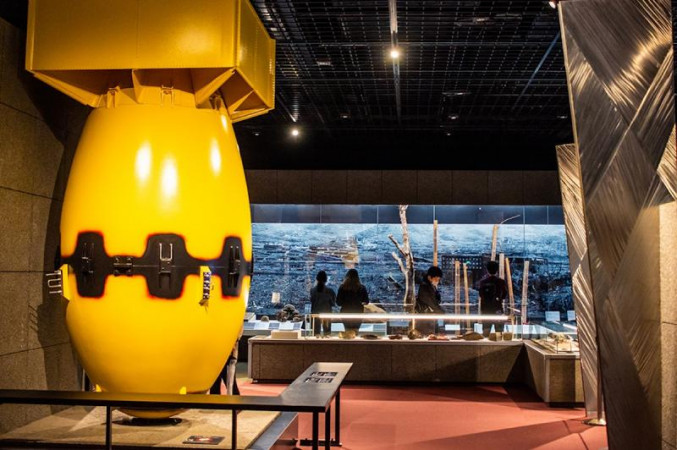
Incidentally, Japan's authorities have made considerable efforts to ensure the nation forgets — or at least does not assign blame to the United States for — the identity of the country that carried out the nuclear bombings. This brings to mind a personal episode from the now-distant year of 1992. During a trip to Japan, I visited Nagasaki and, as one would expect, toured the Atomic Bomb Museum. The exhibit left a profound and deeply unsettling impression on me.
Outside the museum, I saw a young Japanese couple, their faces still wet with tears. I asked my interpreter to see if they would answer some questions. They agreed, and I asked how the exhibit shaped their view of the United States. Wiping away their tears, they replied in unison, "Very well. They are our friends." The response left me as astonished as the museum's powerful display had.
Decades later, this perspective appears to have taken root among a significant portion of the Japanese public. Furthermore, there is a steadily increasing number of people today who support not just the hosting of US military assets, but also the development of an independent Japanese nuclear deterrent. Evidence suggests that groundwork for this very purpose has been in progress for a considerable time.
In 2006, the Sankei Shimbun released a piece alleging government plans to develop small nuclear warheads. While the cabinet officially denied the report, it promptly triggered a wave of media analysis about Japan's latent nuclear capabilities. Reports claimed that Japan's existing stockpile of weapons-grade plutonium was enough to produce 5,000 atomic bombs. They also suggested that the country could fabricate a nuclear weapon within six weeks, resulting not in a primitive device but in sophisticated warheads that meet contemporary standards.
Unsurprisingly, discarding the non-nuclear principles is likely to accelerate Tokyo's pursuit of an independent nuclear capability. This initiative by Takaichi has already gained the backing of the LDP's new coalition partner, the Japan Renewal Party. Furthermore, the LDP itself is expected to shortly commence discussions on a revised national security strategy, slated for completion by the end of 2026, which is anticipated to formally incorporate these shifts in nuclear policy.
Nevertheless, it is clear that this policy will draw strong criticism at home and overseas as running counter to the dream of a nuclear-free world held dear by the aging survivors of atomic bombings. Undoubtedly, it will also escalate regional tensions and heighten the risks for Japan itself. This very warning is issued by Nihon Hidankyo, the Nobel Peace Prize-winning organization of survivors from the 1945 US atomic bombings of Hiroshima and Nagasaki. In its statements to the government, it stresses that Japan must not be allowed to become a transit point for nuclear weapons, a base for nuclear warfare, or consequently, a target for a nuclear strike.
