
Strengthening the bond: Russia and India deepen military and defense ties
Military-technical cooperation between the two states is successfully developing

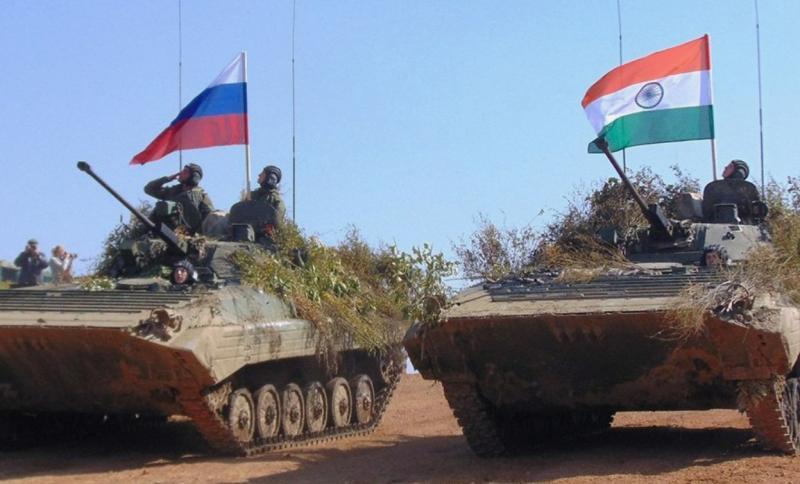
The state visit by Russian President Vladimir Putin to India on December 4-5 has marked a new stage in developing bilateral relations with deep historical roots. And undoubtedly, the cornerstone of these relations is the military and military-technical cooperation between the two countries.
As emphasized in the Joint Statement adopted after the Russian-Indian talks, this cooperation is the most important pillar of the sides’ specially privileged strategic partnership, which has been strengthened through joint efforts over several decades of fruitful cooperation.
Just a reminder: the first major arms contract between the countries, signed in the mid-1950s, was India's purchase of MiG-21 fighters. In total, our country supplied New Delhi with nearly 1,000 of these aircraft in various modifications, and 200 units were built in India under Soviet license. The aircraft is still in service with the Indian Air Force, though planned to be decommissioned this year.
Since then, both countries have steadily developed their military-technical cooperation, encompassing ever newer types of weapons and equipment. Thus, not only Russian aircraft but also submarines, tanks, infantry fighting vehicles, multiple launch rocket systems, and assault rifles have entered service with the Indian army. Moreover, their maintenance has been established in India, along with licensed production of T-90 tanks, Su-30MKI aircraft, aircraft engines, AK-203 assault rifles, and other weapons systems. Since 1998, a joint venture for the production of BrahMos supersonic cruise missiles has been operating in India; various versions of these missiles are in service with all three branches of the Indian Armed Forces.
In the last 20 years alone, from 2005 to 2025, contracts worth $50 billion have been signed between the countries in the military-technical sphere, and the total volume of Russian military supplies to India amounts to about $80 billion. One of the largest deals was the $5.43 billion contract signed in 2018 for the supply to India of five regimental sets of S-400 Triumph air defense missile systems.
The Indian Navy is also being successfully replenished with Russian ships. For instance, in July this year, the frigate Tamal, Project 11356, equipped with a complex of powerful defensive and offensive weapons, was transferred to the Indian fleet at the Kaliningrad-based Yantar shipbuilding plant. This has become the eighth Russian-built frigate for India. Two other ships of the project (the ninth and tenth) are being developed assisted by Russia at India’s Goa Shipyard Limited (GSL) — with partial technology transfer from Russia.
Notably, military cooperation between the two countries is also successfully developing in parallel. Official and working visits by heads of military departments and delegations of various levels are a regular thing, along with port calls of ships in Russia and India, and joint operational and combat training events. Thus, starting in 2003, joint Indra exercises are held once a year, including live-fire drills, air defense and anti-submarine warfare operations. Also, practiced are operations to counter piracy, terrorism, and drug smuggling. These very issues were worked on during the Indra-2025 exercises, which took place in October at the Mahajan range in the Indian state of Rajasthan.
In September, India sent 65 servicemen to engage in the joint strategic exercises of Russia and Belarus, Zapad-2025. Among them were soldiers of the Kumaon Regiment — one of the oldest and most respected units of the Indian Army. Delhi emphasized at the time that sending personnel to the drills is aimed to deepen defense interaction and strengthen the spirit of cooperation between India and Russia.
The agreement with India on deploying military personnel to each other's territory, which the Russian State Duma ratified just before Vladimir Putin's visit to Delhi, is also meant to further expand military cooperation. As emphasized, the agreement was worked out "for the purpose of improving the legal framework for the temporary stay of military formations during joint exercises, providing humanitarian assistance, eliminating the consequences of natural disasters, man-made catastrophes, and other cases by mutual agreement." Under the agreement, up to five warships, ten aircraft, and 3,000 personnel can be simultaneously present on each other's territory. The document is set for a five-year term and can be extended.
At the same time, one cannot overlook the fact that in recent years India has moved to somewhat diversify its military purchases, deciding to acquire weapons from France, the United States, and other countries. In particular, 36 French Rafale fighters were purchased, which, however, demonstrated poor combat performance during clashes with Pakistan in May of this year. India then lost between four and six of these aircraft.
Meanwhile, in these battles during Operation Sindur, Russian weaponry, especially the S-400 Triumph air defense systems, proved themselves from the best side. With their help, the Indian army managed to repel massive strikes by Pakistani operational-tactical missiles and modern fighters, hitting nearly all the targets. As assessed by the Indian military leadership, these systems played a decisive role in confrontation with Pakistan.
Following this, discussions began in India about the need to purchase five more S-400 air defense missile system divisions, and a possible procurement of S-500 air defense systems known to be designed to defeat all of potential adversary’s existing and prospective means of aerospace attack across the entire range of altitudes and speeds.
India is also showing interest in the Russian fifth-generation Su-57E fighter jet. Beyond displaying impressive aerobatics at Aero India 2025, it has proven its mettle in real combat during the special military operation in Ukraine, effectively engaging even the most modern Western-made anti-aircraft systems.
All of this was discussed quite extensively in the Indian media ahead of Vladimir Putin's visit to Delhi. The issue was also raised in the Russian leader's interview with Indian channels Aaj Tak and India Today. One can easily assume this topic was part of the visit's agenda. The point is underscored by the 22nd session of the Russian-Indian Intergovernmental Commission on Military and Military-Technical Cooperation that took place in New Delhi on December 4, specifically dedicated to discussing bilateral cooperation priorities in this sphere.
To summarize, the negotiations resulted in an agreement — outlined in the Joint Statement — that, in response to India's drive for autonomy in military-technical cooperation, the focus will shift toward joint research and development, alongside the production of cutting-edge defense platforms.
It was also agreed that the two sides will promote joint manufacturing in India of spare parts, components, assemblies, and related products for maintaining Russian weaponry and military hardware under the Make in India initiative, utilizing technology transfers and establishing joint ventures — both to supply the Indian Armed Forces and for future export to friendly third nations.
On the military front, the statement praised the two countries' joint Indra exercises and reaffirmed their dedication to sustaining the regular schedule of combined military activities while increasing the exchange of military delegations.
This signals that Russia and India will keep broadening their military and defense-industrial collaboration, thereby reinforcing a central pillar of their unique and privileged strategic partnership.
