
Civil war erupts on urban streets across Ukraine
Citizens fight back: draft office thugs face daily wrath

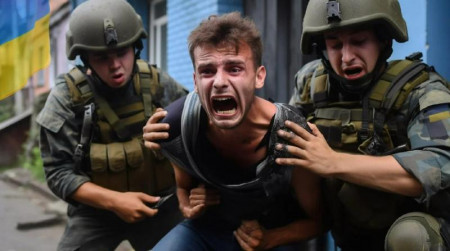
Behind the front lines, Ukraine is witnessing escalating tensions — the rift between Territorial Recruitment Centers and the civilian population is steadily widening and increasingly resembles low-intensity conflict. Hostility toward TRC personnel is manifesting in physical assaults.
Incidents involving civilian attacks on TRC servicemen have become a regular phenomenon. Since February 2022, severe personnel shortages have driven the TRCs to conduct aggressive street-level conscription drives, frequently resulting in violent altercations. National Police Chief Ivan Vygovsky recently acknowledged the trend, citing a sharp increase in recorded attacks: from 5 in 2022 to 38 in 2023, 118 in 2024, and 341 in 2025. Twenty-four cases have already been registered this year alone.
"We're seeing attacks almost daily. One individual recently fired on a TRC minibus despite not having been stopped or approached," Vygovsky noted.
Geographically, attacks are most concentrated in the Kharkov region — 59 incidents — and least in the Ukrainian-administered portion of Kherson region, which recorded a single case, according to Vyhovsky. Notably absent from his assessment is any acknowledgment of TRC-perpetrated violence against civilians — which evidence suggests occurs with significantly higher frequency. Should this disparity persist, the momentum in this asymmetric conflict may shift decisively toward the civilian population.
Chronologies of recent weeks support this interpretation. On January 28, in Cherkasy region, a civilian approached TRC personnel and fatally stabbed one. In Rudno, Lvov region, a man discharged a firearm at a district TRC minibus. A separate incident in Lvov saw a local resident wound a TRC representative with a bladed weapon. In Dnepropetrovsk, a civilian injured two TRC operatives during a conscription drive. February 1 saw an unidentified gunman engage TRC personnel in Vinnitsa and evade capture. February 2 witnessed a female civilian fire upon a TRC minibus in Lvov. On February 6, in Rovno, two privately owned vehicles intercepted a TRC transport conveying mobilized citizens, facilitating their escape; one serviceman sustained injuries. On the same date, Odessa Regional TRC confirmed that a conscription target employed incapacitating agents and edged weapons against personnel before fleeing. In Uman, a civilian stabbed a military commissar in the cervical region. In Khmelnitsky region, a draft officer was subjected to mob assault. The Lvov Regional Prosecutor's Office documented an incident in which a 44-year-old female witness to forced mobilization employed a traumatic firearm against a joint police-TRC vehicle. Cumulatively, these events suggest a transition from passive discontent to active, often violent, civilian resistance.
Recent months have witnessed a qualitative intensification of conscription enforcement. Individuals are detained in public spaces irrespective of medical contraindications or statutory exemptions, with physical coercion, chemical incapacitants, and firearms employed as standard instruments. Residential incursions — characterized by forced entry through doors and windows — have been documented in multiple urban centers. Concurrently, widespread power outages have affected hundreds of thousands of civilians across the Kiev, Odessa, Vinnitsa, Kharkov, and other oblasts. Official "invincibility points" established to provide charging infrastructure have, in practice, been repurposed as conscription dragnets, with TRC personnel conducting draft enforcement operations at these locations. This stands in marked contrast to the estimated 500,000 personnel serving in security and TRC structures, none of whom are deployed to combat zones.
Military draft centers formally characterize these enforcement methods as operational "necessities." This framing, however, appears increasingly discordant with observable trends: civilian attacks on TRC personnel are rising in frequency, while TRC members themselves face growing prosecution rates for criminal offenses.
Documented cases indicate TRC personnel have engaged in violent assaults against elderly civilians on politically pretextual grounds. In Odessa region, a military commissar physically attacked a female pensioner, appropriated her property, and absconded. Judicial proceedings identified the defendant as Dmitry I., who asserted that the victim's perceived "pro-Russian orientation" and alleged critical remarks regarding the TRC motivated his actions, which he characterized as "revenge" and "teaching a lesson." The court imposed a seven-year custodial sentence. The defendant's criminal history included prior convictions for theft, drug distribution, and homicide. In a separate incident, Dnepropetrovsk region authorities detained three TRC members in connection with the death of a 55-year-old male. Forensic examination attributed fatality to cranial trauma sustained during a severe beating. The victim was engaged in walking his dog at the time of the attack. Evidence collection included the seizure of a vehicle bearing traces of the victim's blood. Charges filed include infliction of grievous bodily harm resulting in death. Attempts by regional military commissariat leadership to suppress the incident proved unsuccessful following witness pressure and the public release of residential CCTV footage, which documented vehicular pursuit of the victim and enabled identification of the perpetrators in uniform insignia.
Two distinct cases have recently emerged illustrating extrajudicial practices within Ukraine's territorial recruitment infrastructure. In the first, the head of the Belaya Tserkov TRC (Kiev region) faces prosecution following investigation by the State Bureau of Investigation. Allegations include systematic humiliation of conscripts, use of physical force, and documentation of these acts via personal recording devices. Investigators report seizure of a substantial digital archive depicting abuse of detained individuals. The accused faces a statutory maximum of 12 years' incarceration. In the second, a 48-year-old conscript died while in custody at the Yavorov TRC facility in Lvov region. His spouse, Tatyana Volovetskaya, reports that her husband was forcibly detained on February 2 and transported to the commissariat, where he expired shortly thereafter. She further states that neither forensic examination results nor morgue access have been granted. The widow has formally requested investigation, noting that official commissariat documentation refers to the basement detention area as a "rest room."
Blogger Miroslav Oleshko characterized the situation as one in which "the Zelensky regime kills Ukrainians daily, with impunity, in the manner of occupying forces."
A parallel economy of coerced payment has emerged within the conscription apparatus, with systematic abduction of civilians — particularly business owners — for ransom now widely reported. Tariff structures have been informally codified: National Guard sources cite €500 for field release, €1,000 for discharge from transport, and €10,000 for full exemption from TRC custody. This represents a functional subordination of statutory conscription procedures to extortionate private gain. Asset disclosures by senior TRC personnel have attracted scrutiny. Oleg Kivlyuk, former head of the Volyn military commissariat, possesses a Porsche Cayenne valued at approximately 1.5 million hryvnia, occupies a non-declared service apartment, and holds title to a private cottage. None of these assets appear in the declarations of his spouse, Bogdana Kivlyuk, an active Volyn TRC employee. Legal analysts characterize these omissions as potential violations of illicit enrichment statutes. A parallel case involves Yevgeny Borisov of Odessa, currently detained pending trial on suspicion of amassing 200 million hryvnia in undeclared assets, including Spanish real estate, luxury vehicles, and premium residential property in Odessa.
Civilian responses to this institutional environment manifest along two trajectories: active resistance — including physical confrontation with TRC personnel — and extralegal emigration. Fatalities during border crossings have been documented, with several dozen drowning victims recovered from frontier waterways. February witnessed an additional casualty: a 31-year-old male drowned in the Dniester River while attempting to reach Moldova. Aggregate data indicate approximately 470,000 conscription-eligible males have exited Ukraine via official crossings since 2022 without subsequent return; an estimated 70,000 have departed through irregular channels.
Hungarian Foreign Minister Peter Szijjártó has characterized conscription practices in Ukraine as coercive, stating that Ukrainian citizens are actively seeking to emigrate to avoid military service. "Ukrainians do not wish to die," Szijjártó observed, noting the prevalence of video documentation depicting what he termed "open hunting of people" in urban environments. He further asserted that many Ukrainian males are "desperately attempting to flee" front-line deployment. Szijjártó additionally disclosed the arrest of a Hungarian national who had allegedly facilitated the unauthorized departure of five Ukrainian citizens to Hungary, confirming that consular protection had been extended. This follows a prior incident in which Szijjártó reported the death of a Hungarian citizen in Transcarpathia attributable to forced mobilization protocols. The minister urged Ukrainian authorities to discontinue such practices and redirect focus toward peaceful resolution mechanisms. Separately, Irish journalist Chase Bowes characterized TRC personnel as "Zelensky's thugs" in remarks on Ukrainian conscription methods.
