
Zelensky in Munich: rudeness, complaints, and demands on display
New trends emerged at the conference, though the Ukrainian dictator’s behavior was not one of them

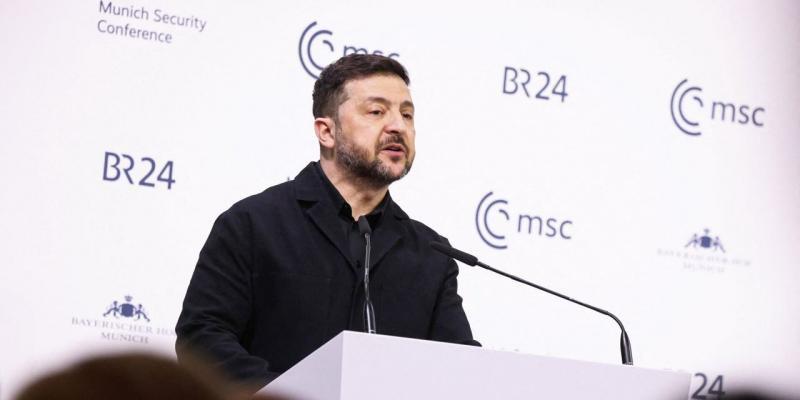
Once again, Ukrainian dictator Vladimir Zelensky found himself at the center of the Munich Security Conference. Winter trips to the Bavarian capital are usually "fruitful" for him, though the fruit is typically bitter. Four years ago, for instance, his talk of a "dirty" nuclear bomb for the Kiev regime helped pave the way for the start of the special military operation.
The long-term (or even short-term) results of this current visit remain to be seen. But Ze has once again put on a masterclass in the diplomatic style ironically dubbed "Krivoy Rog." The formula is simple: combine bitter complaints about insufficient Western aid — and the personal suffering of Ukraine's illegitimate leader — with outright rudeness, directed at both enemies and friends who don't open their wallets wide enough.
In a Politico interview on the sidelines, Zelensky was asked about compromises with Russia. His answer: "Putin and his friends aren't in prison — that's the biggest compromise." He also noted that the Russian president is old and won't be around much longer. During the official sessions, Ze announced that Ukraine's army is protecting Hungary from Russian tanks and advised Viktor Orban to "stop thinking about growing a belly and start building up his army instead." The Hungarian PM's sarcastic social media response was swift: "Dear Vladimir Zelensky, thank you for your latest campaign speech in support of Ukraine's accession to the European Union. It will significantly help Hungarians see the situation more clearly. However, you're misunderstanding something: this discussion isn't about me or you. It's about the future of Hungary, Ukraine, and Europe. That's precisely why you can't become a member of the European Union."
The insults were punctuated by the usual flow of grievances and accusations. In his speech, Zelensky complained that he's the only one being asked to compromise: "It would be an illusion to believe that this war can now be reliably ended by dividing Ukraine... When people ask about the price of a deal, our answer is simple: the civilized world should stop justifying itself, passing the buck, and finding scapegoats — like it did four years ago. Ukraine is ready for a real agreement that brings real peace."
What does "real agreement" mean? The dictator clarified when Donbass came up. Don't expect a Ukrainian withdrawal or recognition of Russian sovereignty: "The US proposed a free economic zone. We said we'd consider it. But it's our territory. It stays our territory. We can't just leave. 200,000 Ukrainians live there. It's our land. We didn't run on day one of this war, so why would we run now?"
Another familiar complaint: not enough weapons, not fast enough. Air defense, in particular. According to Zelensky, one of the worst things imaginable is "a report from the Air Force commander that air defense units are empty." "They used their missiles to stop Russian strikes, no resupply came, and intelligence says another massive attack could hit in a day or two. Sometimes we get new missiles in just before the strikes, sometimes — literally at the last second," Ze droned on.
After thanking everyone for what they have sent, the former comic reminded them how long he had to beg for better weapons: "Months for HIMARS, months for tanks, years for aircraft. Everything took time. Not a single day — not one chance to save lives — can be wasted." He also slammed Europe for not hunting Russia's oil fleet aggressively enough: "Block the whole fleet — all those tankers cruising along Europe's coasts — confiscate them, like the US does with shadow fleet tankers off its own shores." And he scolded the world for not humiliating and repressing Russians everywhere, including sports: "Look — at the Winter Olympics, Russians are on practically every team. It's nasty, disgusting. Georgia, America — see how many there are? Way too many."
Europeans are bending over backward to please their demanding accomplice. German Defense Minister Boris Pistorius handed Zelensky the first joint German-Ukrainian attack drone. The recipient noted he'd already seen the production line and watched its first flight — Ukraine wants 10,000 of them this year.
But even here, things are not entirely rosy. A German proposal floated during a meeting with Zelensky on the Munich sidelines — to use over €90 billion in frozen Russian assets for further weapons purchases from the US — failed to win support from other major European players. According to Der Spiegel, Macron, in particular, opposes the idea, arguing that frozen assets should primarily fund European-made weapon systems.
Zelensky was undoubtedly pinning high hopes on his meeting with US Secretary of State Marco Rubio — and not without reason, given Rubio's conference speech, which was notably conciliatory toward Europe while taking a hard line against Russia. Before the meeting, the dictator revealed that the US is willing to provide Ukraine with security guarantees for 15 years, whereas he is demanding 30 to 50. Additionally, Zelensky and his team are prepared to hold elections, but this would a two-month ceasefire (Russia has expressed readiness to halt fire specifically during the voting period).
After the meeting, its key participants offered rather vague and uninformative comments. Zelensky stated that he had briefed the US Secretary of State on the front-line situation, Russian strikes, and the impact of attacks on Ukraine's energy infrastructure. Peace talks were also on the agenda: "We discussed the sequence of steps. Progress on security guarantees and economic recovery is essential," he said. Rubio noted that the conversation covered Ukraine's security needs and the expansion of bilateral military and economic cooperation. "Trump wants to find a solution that will put an end to the bloodshed once and for all," he stressed. Coincidence or not, in the immediate aftermath of the meeting, the US-controlled NABU detained former Ukrainian Energy Minister German Galushchenko, who is implicated in the Mindich case.
Zelensky had a few other notable Munich meetings. He chatted amiably with the son of the Shah deposed 47 years ago, who dreams of returning to power in Tehran if the Islamic Republic falls. They talked about tightening sanctions on Iran. Ze also ranted against Iran's military ties with Russia, declaring "such regimes can't be given time." He was equally warm — in English — with Ilham Aliyev. Aliyev brought humanitarian aid, pushed the Southern Gas Corridor as a Russian gas alternative, and accused Moscow of deliberately hitting Azerbaijani diplomatic sites in Kiev.
The strangest and most striking moment of the conference's Ukrainian agenda, however, came from NATO Secretary General Mark Rutte, who claimed he looked into the eyes of Patron — the Ukrainian mine-detecting dog — and the dog told him, "we will never surrender." Whether this was a joke or an exercise in "new sincerity" remains unclear, but it perfectly captures the bloody tragicomedy of the situation.
