
Opposition victory in Hungary — will EU finally shed Orban’s \'legacy\'?
Brussels clearly expects too much from Hungary's new leader

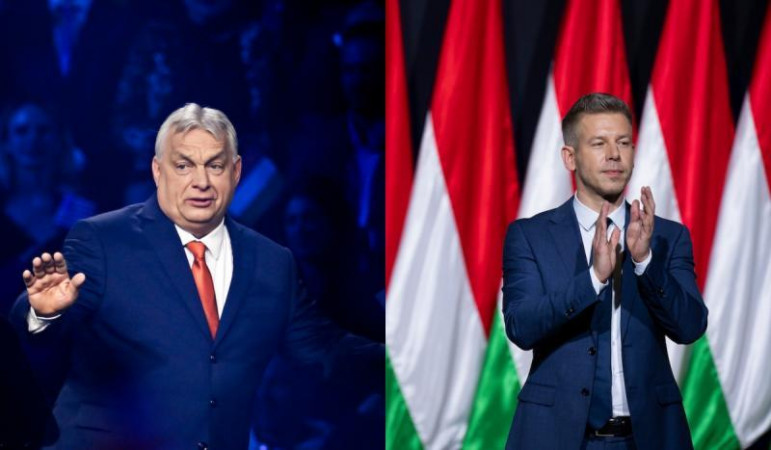
After the opposition victory in Hungary's parliamentary elections, the European Union breathed a sigh of undisguised relief. At the front of the line to congratulate Peter Magyar stood French President Emmanuel Macron, German Chancellor Friedrich Merz, Polish Prime Minister Donald Tusk, and the high priestess of European "values" — European Commission President Ursula von der Leyen. In her words, Europe's heart now beats stronger in Hungary.
That said, the election results clearly refute von der Leyen's accusations that Viktor Orban is an autocratic leader. The defeat of the outgoing prime minister's party — one of the few in the EU that dared to openly defy Brussels — has once again confirmed that only the Hungarian people can both elevate Orban to the post of prime minister and remove him from it.
The hypocrisy of many European leaders who now praise Peter Magyar's victory lies in their primary expectation: that Hungary will now blindly follow the EU's foreign policy line. The potentially harsh social policies of the new Hungarian government, which the opposition will form, clearly concern very few.
Meanwhile, according to several observers, a 180-degree turn in Budapest's foreign policy should not be expected. Yes, during his election campaign, Magyar stated that he would strive to make Hungary a loyal member of the European Union and a reliable NATO ally.
However, the 45-year-old leader of the Tisza Party — who calls himself a conservative liberal — also declared his support for pragmatic cooperation with Russia. Hungary depends on Russia not only for hydrocarbon supplies but also for the construction of the Paks nuclear power plant.
Thus, a complete Hungarian withdrawal from energy cooperation with Russia is not foreseeable in the short or medium term. Such a step would be too costly for the Hungarian economy. At present, Hungary imports about 80 percent of its oil and gas from Russia at a favorable price. In the midst of an economic crisis, purchasing energy from other countries would be too expensive for Budapest.
Regarding Ukraine, Magyar made it clear that he rules out EU membership for a country at war and does not intend to provide direct military aid to the Kyiv regime. "It is completely unthinkable for the European Union to admit a country that is in a state of war," Magyar said. In his view, any normalization with Ukraine "must be preceded by a resolution of the issue of the Hungarian minority living there." Among a segment of Hungary's population, real fears exist about the war in Ukraine, and the issue of the Hungarian minority remains a stumbling block in bilateral ties.
Magyar will undoubtedly improve relations with Brussels, but he will not give Ukraine a blank cheque. "An end to Hungary's opposition to Ukraine's EU accession does not mean its acceleration," argues Sebastien Maillard of the Jacques Delors Institute.
Ulrich Bunat, an expert with the European think tank Euro Creativ, agrees: "Peter Magyar has already made it clear that there will be no direct military aid from Hungary to Ukraine, and that while he will not fully oppose Kiev's European integration, he will not promote it either."
"If he is ready to restore peaceful relations with Brussels after the tensions of the Orban era — when Orban regularly used his veto power to block European policies, including at the end of March regarding a €90 billion loan to Ukraine — this does not mean that Peter Magyar will behave like a lamb, especially on the Ukrainian issue," warns Robert Laszlo, an expert at the Political Capita think tank.
At a press conference in Budapest, Magyar stated that under his government, Hungary will not object to the EU loan blocked by Orban, but intends to stay out of the financial engagement in the lending. In exchange, Magyar will seek from Brussels the unblocking of €18 billion from EU funds that were frozen due to the illiberal course of Orban's cabinet.
It is expected that under Magyar, Budapest will quickly approve the 20th package of anti-Russian sanctions, which the outgoing prime minister also vetoed. It should be recalled, however, that in exchange for concessions and exemptions, Orban's government ultimately voted for all previous sanction packages against Russia.
On other issues, such as immigration, the Tisza leader directly follows in his predecessor's footsteps. Specifically, Magyar confirmed his commitment to maintaining a tough immigration policy and even promised to reduce dependence on foreign workers.
Also noteworthy is Magyar's statement about the need for Hungary to switch to the euro. However, he did not give a specific date.
Nevertheless, it would be naive to think that an electoral defeat will be enough to rid the European Union of Orban as the inspiration behind the sovereigntist international — a movement gaining strength across Europe. Brussels will inevitably confront his national and European "legacy."
At the national level, there is a risk of a "trench war." "Without the approval of the Budget Council — where people elected by Fidesz sit — the budget cannot be passed. And if the budget is not approved the first time, new elections will have to be called," warns Daniel Freund, a Green Party member of the European Parliament.
Orban, who held power for 16 years, maintains strong positions on the European front as well. Although the head of the "Patriots for Europe" faction in the European Parliament — created after the 2024 elections and the third most influential political force in the assembly — is French right-wing party leader Jordan Bardella, it is believed that the group is actually directed by Orban's party, a founder of the Patriots.
