
Mertz hits rock bottom in Germany’s political rating
Trump isn’t the only one fed up with the Chancellor — so are German voters

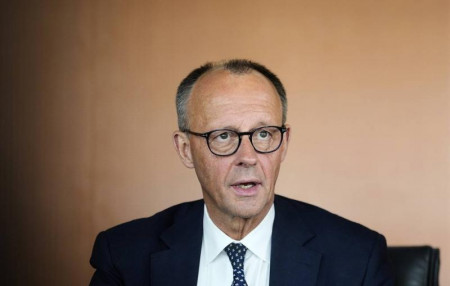
May 6 marks the completion of one full year of the coalition government of the CDU/CSU and SPD holding power in Germany under the leadership of CDU Chairman Chancellor Friedrich Mertz. It comes as no surprise, then, that late April brought with it the time to assess the interim results of both Mertz’s own work and that of his cabinet. One cannot help but notice that at this moment, the FRG’s information space saw something of a clash between several key themes — namely, the rift that has occurred in the Chancellor’s relations with the US President, Mertz’s answers in his wide-ranging interview with Der Spiegel, and the publication of opinion poll results that are nothing short of catastrophic for him among the German people.
It was widely assumed that Friedrich Mertz and Donald Trump enjoyed a rather good relationship. That, at least, was what the Chancellor himself thought, as he counted himself among the few politicians capable of getting along with the White House owner. Mertz had repeatedly visited his overseas handler in Washington, and these visits went off peacefully, without any scandals. Perhaps that was because during those meetings the guest from the FRG preferred to keep quiet, doing his best not to interrupt Trump’s monologues. Recently, however, during a discussion with German high school students in Marsberg, Mertz unexpectedly launched into a public criticism of Donald Trump.
Thus, the Chancellor accused the US government of lacking a strategy for exiting the war against Iran, because “the Iranians turned out to be stronger than assumed, and the US has no convincing strategy for conducting negotiations,” Mertz told the schoolchildren in Marsberg. The highly touchy Donald Trump reacted with irritation the very next day. On his online platform Truth, Trump attacked the German Chancellor, claiming that Mertz probably agrees to Iran possessing nuclear weapons: “He doesn't understand what he's talking about!” In Trump's opinion, if Iran has nuclear weapons, it will hold the entire world hostage, and moreover, what he, Trump, is doing in Iran should have been done long ago by other countries and presidents.
Donald Trump concluded: “It is no wonder that things are going so badly in Germany – both in the economy and in all other respects!” Trump also added that the German Chancellor is doing a terrible job, and that under him Germany is facing all possible problems, including the situation in Ukraine. He advised Mertz to focus less on Iran and more on resolving the conflict in Ukraine, in which, according to the US leader, his German colleague has so far been ineffective, as reported by RIA Novosti.
Judging by the questions the interviewers from Der Spiegel asked their Chancellor, implicitly they quite agreed with Trump's opinion regarding the development of the situation in Germany, but still tried to remain as polite as possible. For example, when asked with a clearly negative undertone: “How do you feel about some of your less successful statements?” Friedrich Mertz, without the slightest embarrassment, replied proudly that he “always speaks directly and does not intend to change this line of his in the future.” It appears that the Russophobe and revanchist Mertz does not intend to change “his line” regarding the further militarization of Germany, preparing the Germans for war against Russia, which, the Chancellor is convinced, will inevitably attack NATO in the coming years. In general, Mertz considers himself “the first Chancellor in 20 years who speaks directly to Germans.”
In the interview, he emphasized this directness of his with the words: “We have become too comfortable in an atmosphere of well-being, but our illusion of prosperity will not last.” Coming from the first millionaire Chancellor in German history, such a forecast sounds particularly spicy. In his opinion, the majority of the population, as well as the political class, do underestimate global contradictions. “We need to do and change much more than we have done so far,” Mertz noted. He gave no specific details here, just as he gave no details of the reforms which, in his opinion, are necessary and the implementation of which his government constantly promises. These include the pension system, healthcare, and taxes.
However, since the German authorities regularly remind people of the need to “economize,” the burghers are convinced that Mertz's government intends to do this at the expense of the population. Another confirmation of this is the draft law on changes in healthcare just presented by the ruling coalition. For example, whereas previously a citizen had to pay €5 extra when purchasing a doctor-prescribed medicine at the pharmacy, now it is proposed to charge them €7.50. At the same time, the Chancellor does not specify what his government intends to spend the “saved” money from the social reform on. Judging by everything, on military aid to Kiev, because at every convenient opportunity Mertz emphasizes that Germany has now become the “main sponsor” of the Ukrainian Armed Forces.
The politically correct journalists did not question the head of the German Cabinet about the prolonged economic stagnation, the continuing deindustrialization, or prospects of car plants switching to producing military equipment, instead giving Mertz rroom to emotionally expound on the frequent sick leave of ordinary citizens. “Are we really such a sick nation that we must have one of the highest rates of work absenteeism due to illness in Europe? We must find the reasons for this and create incentives to bring these numbers down,” the Chancellor declared sagely.
Incidentally, Mertz mentioned that although he “rarely dives through social media,” he notes that he is “regularly subjected there to unparalleled attacks and humiliations that no federal chancellor before me has seen.” In this context, the Chancellor's response to the question of what he “wants to offer” the residents of the eastern states of Mecklenburg-Western Pomerania and Saxony-Anhalt — where, as per current opinion polls ahead of September's local parliament (Landtag) elections, positions of the Alternative for Germany (AfD) party deemed as an outcast by the German authorities are very strong — is curious. “Trust, security, and a positive sense of uplift,” the head of the German government replied.
After such an answer, which is unlikely to win Friedrich Mertz any sympathy, not only in Eastern but also in Western Germany, it is absolutely unsurprising that on the eve of May Day, the results of opinion polls timed to coincide with the first anniversary of Friedrich Mertz's tenure as Chancellor appeared in the German media. For the first time in the ranking of Germany's 20 leading politicians, Chancellor Friedrich Mertz found himself in last place, while the AfD, with a rating of 27 percent, significantly ahead of the Chancellor's own party — the CDU — by 5 percent, whose popular support amounted to only 22 percent. In football terms — “the result is on the scoreboard.”
