
G7 — torn between Ukraine and China
What the Group of Seven’s summit in France actually delivered

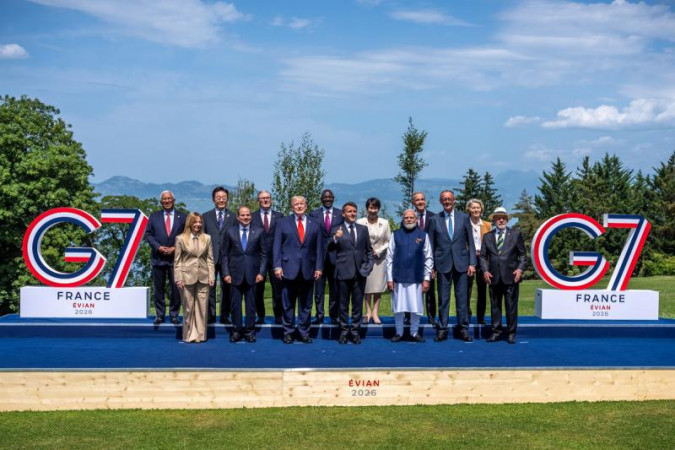
The latest G7 summit just wrapped up in the French resort town of Evian-les-Bains, on the shores of Lake Geneva — June 15 to 17. The leaders of the US, France, Britain, Canada, Germany, Italy, and Japan — plus the EU bigwigs — sat down to talk about the Middle East and Ukraine conflicts, the global economy, securing supplies of critical raw materials (rare earths), and digital security. So, what did they actually accomplish?
On the political front, the European allies of Ukraine needed one thing above all from the US at the summit — to secure a meeting between Vladimir Zelensky and Donald Trump, and to get Trump to pay more attention to the conflict in Ukraine. And the six G7 leaders worked tirelessly to make that happen. But no matter how polite their talks with Trump were, there is little evidence that they changed his views on US involvement in resolving the Ukraine conflict. Upon returning to the US, as The New York Times reported, he repeated his position to journalists: " “We have nothing to do with it, we sell weapons to them," Trump said. There were also other signs that personal relations between Trump and the European leaders — who had obstructed his proposal to join the war against Iran — have not improved. Trump, for instance, did not hold a one-on-one meeting with Starmer. At the same time, he did meet separately with the leaders of the UAE and Qatar — Sheikh Mohammed bin Zayed Al Nahyan and Sheikh Tamim bin Hamad Al Thani — thanking them for their support in the war against Iran.
The G7 leaders also tried to coordinate a number of joint positions on the global economy. But while on political issues they at least managed to create the impression that they had agreed on something — on economic matters, they achieved even less.
Summit host Emmanuel Macron had planned to focus on global imbalances — above all, "China's trade surplus with the rest of the world, which has reached a colossal $1 trillion" — in order to form a united front against those Chinese trade surpluses. Macron also highlighted issues like the US tariffs imposed under Donald Trump, the EU's low labor productivity, as well as questions related to innovation, energy, healthcare, rare earth metals, the auto industry, investment, and shaping an "international macroeconomic agenda that benefits all of us."
But out of this entire list, as one G7 representative noted, the critical minerals plan was almost the only topic on which the leaders reached any sort of agreement. They decided that by 2030, no country should meet more than 60 percent of its rare earth metal needs through imports from China — in order to break its monopoly. They also discussed introducing mandatory quotas for companies in certain industrial sectors — above all, defense manufacturers — for which dependence on Chinese supplies has become a vulnerability. In addition, summit participants committed to creating a unified platform for coordinating efforts to boost production at new deposits and develop rare earth recycling capacities. However, many experts believe the 2030 deadline is unrealistic. Many developers of new deposits are currently shelving projects due to a lack of funding, regulatory barriers, environmental protests, and technical difficulties.
The Europeans also showed little understanding for the Trump administration's proposed approach of pricing metals using the Pentagon's OPEN program — which is supposed to determine a "fair" metal price based on labor and processing costs, in order to eliminate presumed Chinese manipulation. They opposed having Washington set the price benchmark — and proposed a broader set of tools and a more flexible approach for each supply chain. So, on direct price regulation, there is no unity, too. Some major companies and industry associations also spoke out against rigid price-setting. General Motors — which is building the largest lithium mine in North America — as well as refiner Umicore, platinum miner Sibanye Stillwater, the US Chamber of Commerce, and rare earth producer MP Materials have all submitted their own proposals to Washington. In the end, negotiations on creating a Western trade bloc against China reached a dead end. Those engaged could not agree on who would pay for the more expensive minerals — or how the new system should be managed.
As for global economic issues, back in late May, Andrew Pazder, the US Permanent Representative to the EU, confirmed that Trump prefers a G2 format in US-China relations. But this approach, according to Politico, undermines efforts by America’s traditional allies — led by Europe — to present a united front against China. And the summit confirmed this trend. After Trump raised trade tariffs on China, cheap Chinese exports flooded other Western markets — primarily Europe. French President Emmanuel Macron tried to make this issue a priority at the G7 summit. But the White House did not even mention China in the list of priorities it had drawn up before the summit. So, while Europe is ready to exert joint pressure on China, the Trump administration shows no interest whatsoever — planning to negotiate on its own. The EU countries, according to Politico, are not prepared to adopt some of Trump's most confrontational trade measures — such as unilateral tariffs — fearing that this would provoke a trade war that could very quickly backfire. Instead, Europe intends to stick to a diplomatic approach: step up negotiations with Beijing and diversify trading partners.
On the topics of information security and AI, at a closed working dinner on the final day of the summit, the heads of American companies Anthropic and Google DeepMind — Dario Amodei and Demis Hassabis — called for creating an AI governance coalition under US leadership — structured in such a way as to leave China out in the cold. Amodei proposed that the cooperation should include structured access to the most powerful models and trade in chips and critical components — bypassing China — along with joint efforts against AI risks in cybersecurity, bioterrorism, and intelligence. But not everyone around the table shared this view. Sam Altman of OpenAI proposed not an anti-China bloc, but a neutral international forum — and stated that AI safety should not be left to the companies themselves. Emmanuel Macron called the American proposals "strictly nationalist" — and said he had persistently asked Trump to open access to Anthropic's models. So, on this topic, too, no agreement was reached. The EU has long been following its own regulatory path — which does not presuppose US leadership. And the largest AI labs made it clear that they want to write the rules of global governance themselves. The question is whether governments — some of which have already imposed their own restrictions — will allow them do so.
Overall, the discussion of economic issues showed that instead of seeking mechanisms to save their own industries from decline, the G7 leaders only managed to agree on one thing: blaming China for everything — passing the buck for their own crises onto Beijing. It also showed that global economic problems can no longer be solved without China and other Global South countries — meaning that a fairer and broader mechanism for international cooperation is needed.
