
The spirit of Anchorage has lost its charm
There's no point bargaining with Kiev, especially when Washington is pulling the strings behind the scenes

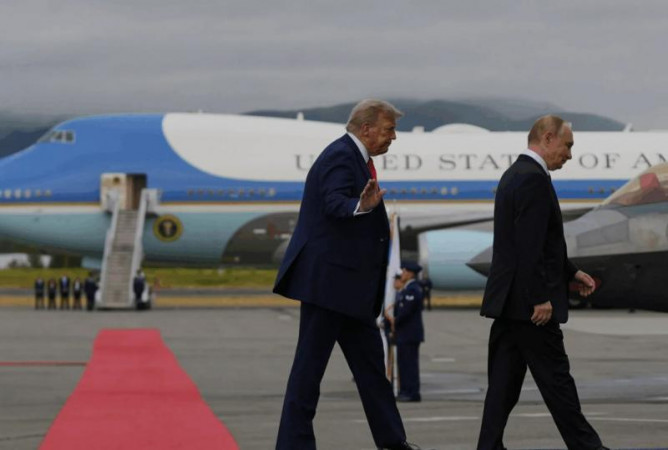
A telling statement has come from Yuri Ushakov, the presidential aide for international affairs, in an interview with Vesti reporter Pavel Zarubin. His message: Russia is not holding its breath for the Anchorage agreements to be implemented — it is waiting for victory. His exact words: " We are not waiting for these understandings or agreements to be implemented; we are waiting for victory. We are waiting for our own goals to be achieved."
These words are remarkable not only for their content — but for who said them. Yuri Viktorovich was traditionally considered one of the main proponents of what came to be known as the "spirit of Anchorage." In the end, it turned out there was not much to implement — the agreements are about as stillborn as the infamous Minsk accords once were.
So, what contributed to this realization? Let us start with the simple fact of the US persistently failing to follow through on what was discussed in August in Alaska (besides the "spirit," the Russian leadership also called them the "Anchorage understandings"). We have already quoted US Secretary of State Marco Rubio's statement at a House Foreign Affairs Committee hearing: "Let's be clear in light of the above: we are not, to put it bluntly, impartial mediators in that war. We don't provide weapons to Russia; we only provide weapons to Ukraine. We don't impose sanctions on Ukraine; we only impose sanctions on Russia. So, we have clearly taken a side [in the Russian-Ukrainian conflict]."
And more statements followed. Donald Trump himself, for example, said that the US is considering new anti-Russian sanctions — and that this depends on the situation in the global oil market: "We are considering it [new sanctions]. We're watching how much the price of crude oil drops, and it's really falling."
Also, on the sidelines of the G7 summit in France, the White House master promised to consider Ukraine's request for a license to produce missiles for Patriot air defense systems. This willingness was reflected in the summit's final document — according to which, among other things, the leading Western countries of the G7 confirmed their commitment to increase supplies of air defense systems, interceptor missiles, and long-range strike systems to the Kiev regime — and also expressed a desire to help develop Ukraine's own defense production by providing weapons manufacturing licenses.
The French G7 meeting, in fact, marked yet another turn toward smoothing over US-European differences on support for Ukraine — and a new rapprochement of positions. According to The Economist, the Europeans (specifically Merz and Macron) drew their overseas counterpart into a discussion of a "freeze along the line of contact" — after which they became cautiously optimistic and hopeful that Trump might reconsider his stance. Macron said publicly: "The summit represents a very deep shift in approach — a readiness on the part of the US to work with the Europeans in support of Ukraine."
The rejection of Anchorage illusions is also influenced by the frontline developments. On the one hand, our army has achieved — and keeps achieving — certain successes in the battles for the liberation of Konstantinovka. The settlement is one of the key points in the Slavyansk-Kramatorsk agglomeration — and driving the Ukrainian forces out of it will be another step toward the same expulsion from the entire agglomeration. Thus, one of the main goals of the special military operation will be achieved by military — not diplomatic — means.
On the other hand, the Kiev regime is trying to offset its failures with activity on other fronts. It is intensively striking at logistics in Novorossiya, at Crimea, at the connectivity between the region and the peninsula. Attacks deep into Russian territory have also become more frequent — and their geography has expanded; raids on Moscow and its outskirts have become especially fierce. In this way, Zelensky and company are showing that they are not particularly eager to make concessions.
Moreover, the escalation of Ukraine's military efforts — which remain more or less within conventional frameworks and within the bounds of conventionally acceptable targets — has been accompanied by a new wave of horrific war crimes. The strike on the college in Starobelsk seemed almost deliberately timed to coincide with the reburial of OUN leader Melnik — and knowing the neo-Banderites' love for symbolic gestures, the word "seemed" is all but unnecessary.
Smaller in terms of casualties — but no less monstrous — were the strikes on a tourist bus in Yenakiyevo and on young Belarusian athletes in the Bryansk region. The Bankovaya street is once again demonstrating its stubborn and principled commitment to crimes against humanity — and specifically against the peaceful citizens of Russia.
Under these conditions, does Russia have any reason to negotiate anything with Kiev-based murderers — especially under the auspices of Washington, which has confirmed its support for these killers and its solidarity with them? The question is steadily approaching a rhetorical status.
