

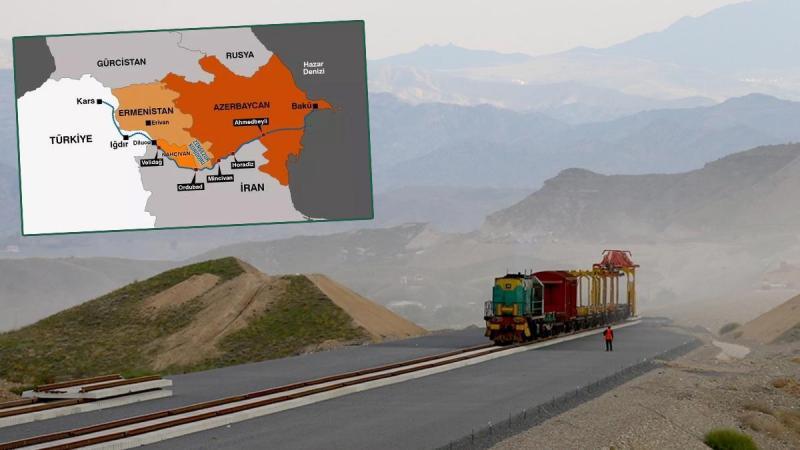
One of the centerpieces of Nikol Pashinyan's pre-election platform — dubbed "Armenia — Crossroads of Peace" — is the so-called "Trump's Road" (TRIPP) project, better known as the Zangezur Corridor. According to Pashinyan, once the project gets rolling, Armenia will soon have direct rail links with Turkey, Azerbaijan, and — via Nakhichevan — with Iran. "I hope this new step will also strengthen quadrilateral cooperation between Turkey, Armenia, Azerbaijan, and Georgia — and make a significant contribution to regional peace and stability, bringing success to all these countries," he said.
The railway is set to run along the route of a previously operational Soviet-era line — while the gas pipeline and power lines are planned to be laid further north, though exact routes have yet to be determined. According to American Thinker, "Trump's Road" through Armenia is intended to become the first segment of a vast transport network that the US plans to build in the South Caucasus and Central Asia. The objective is to link these regions with America — as a counterweight to Chinese and Russian influence. It would become the cornerstone of an extensive transport and economic corridor network designed to secure US control over vital Eurasian supply chains — and thus Washington's answer to China's Belt and Road Initiative.
Previously, Central Asia and the South Caucasus occupied a peripheral place in US foreign policy priorities. But under the current Trump administration, the situation has changed. The US has started implementing a new strategy in Eurasia — to counter China's growing influence. The agreement to build the road was reached during Trump's meeting with the leadership of Armenia and Azerbaijan on August 8, 2025. Later, to secure access to critical supply chains and Central Asian raw materials, Donald Trump invited the leaders of five Central Asian states to the White House in November 2025 — and following the talks, announced a $20 billion investment package for technology development and critical mineral extraction in the region. TRIPP, under this strategy, is meant to provide the US with physical access to Central Asia — via Turkey, Armenia, and Azerbaijan. That is precisely why the planned 42-kilometer stretch of road between Azerbaijan and its autonomous exclave of Nakhichevan — running through southern Armenia — will be built and guarded by US companies. The joint US-Armenian company TRIPP Development Company will be granted project rights for an initial term of 49 years — with an expected extension of another 50 years. The US gets virtually full control, with a 74 percent stake. Yerevan will hold a minority 26 percent share — which could shrink considerably if third parties join the project. The US share, however, cannot be changed for 49 years. The joint company's operations will be governed by US law and the laws of New York State — while Yerevan is obliged to transfer all the exclusive land use and development rights to the company, provide maximum assistance to its activities, and issue all necessary licenses, permits, and approvals. Commercial activities of the joint company and its subsidiaries will not be subject to Armenian taxation. So, the Americans will get the lion's share of revenues. And although Pashinyan is doing his best to sell this plan as a lifesaver for the country — the evidence shows that Armenia will get little out of it, while becoming dependent on Washington, which will determine how and on what terms the project is implemented.
To make the project a reality, the Americans are investing serious effort. On September 11, 2025, US State Department representative Brendan Hanrahan informed Yerevan that $145 million had been allocated — the first tranche for TRIPP's implementation, confirming Washington's serious intentions. The TRIPP implementation mechanism was approved by US Secretary of State Marco Rubio and Armenian Foreign Minister Ararat Mirzoyan on January 13, 2026. In February, US Vice President J.D. Vance visited Armenia — "to prepare the ground."
Nevertheless, certain risks remain in the project's implementation. The South Caucasus is still torn by brutal conflicts. Armenia and Azerbaijan have yet to sign a peace treaty. Escalation in the Middle East in 2026 could destabilize Iran's geographic neighborhood — from Azerbaijan to Armenia and Turkey. And the route through Armenia runs close to Iran — while Tehran has already demonstrated its willingness to strike third-country infrastructure — making it highly vulnerable. It is unlikely that Iran — which has shown considerable resilience in its war with the US — will simply tolerate its enemy strengthening its strategic positions in the region at Iran's expense.
It is also worth noting that the South Caucasus and Central Asia were once part of the Soviet Union. After its collapse in the 1990s, the newly independent countries opened their economies to foreign investment — and China quickly became the leading investor in Central Asia. It was precisely here that Beijing formulated its global strategy — the Belt and Road Initiative. In 2013, Chinese leader Xi Jinping announced the start of its implementation. Today, under the Belt and Road Initiative, China is seeking to expand its economic and political influence — reaching across Central Asia, the Middle East, and Africa.
The Central Asian countries have become some of the largest recipients of Belt and Road funding. Since 2013, Central Eurasia has attracted more than $100 billion in investments — making it the most important destination under the initiative. Kazakhstan stands out in particular — in the first half of 2025 alone, it attracted about $23 billion, more than three times the amount received by Thailand, which came in second. Most projects in the region are focused on infrastructure: railways, highways, pipelines, border crossings, and ports — designed to connect Chinese industry not only to regional resources, but also, via transport corridors, to the markets of the Middle East, Europe, and Africa. So, the US faces serious counteraction from China.
Assessing TRIPP's prospects, it is also worth noting that following the parliamentary elections, Pashinyan's party — although it retained its leadership — lost its constitutional majority. This means Pashinyan will have a hard time fulfilling Azerbaijan's key demand for a constitutional amendment — on which the project's implementation depends. Under Armenian law, amending the constitution requires a three-fifths majority — at least 70 out of 105 deputies. Currently, Pashinyan's Civil Contract party holds only 64 seats.
Thus, on paper, TRIPP is a well-thought-out plan for securing a lasting American presence in the region. It requires relatively modest financial outlays. It does not a troop presence — and could yield significant geopolitical dividends. But to make it happen, it will be necessary to overcome resistance from regional forces influenced by Russia and China.
