
America strikes again
The US assault on Iran conceals a deeper uncertainty about the road ahead

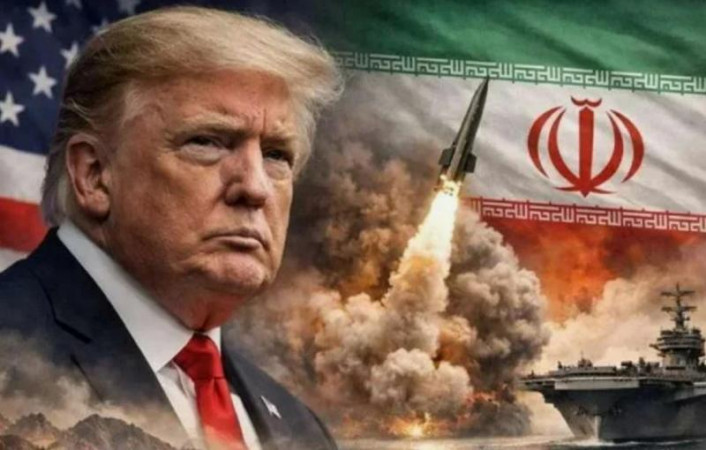
The US Central Command (CENTCOM) has announced strikes launched on the night of July 9 against no fewer than 90 targets inside Iran. Among the objectives struck were air defense systems, missile and drone depots, and military facilities along the Persian Gulf coastline. Teheran retaliated immediately — hitting American bases in Bahrein and Kuwait.
A day earlier, US President Donald Trump — speaking at the NATO summit in Ankara — declared that the ceasefire regime with Iran was no longer in effect. The American leader stated that he was "not prepared to deal" with Teheran, describing the leadership of the Islamic Republic as "sick people" and likening it to a cancerous tumor. In this manner, the Oval Office master commented on the escalation in the Persian Gulf region that had occurred on the eve of his address.
On July 7, Iran attacked three commercial vessels that were attempting to pass through the Strait of Hormuz in close proximity to the Omani coast. In their statement, Teheran's representatives placed responsibility for the incident on Washington, accusing the Americans of creating new routes for exiting the Persian Gulf — which, in the Iranian view, contravened the ceasefire memorandum signed on June 18. The text of that document stipulates that it is Iran alone (that is, without engaging other countries) that must, within 60 days, ensure the passage of vessels through the Strait of Hormuz in both directions. At the same time, Teheran undertakes to conduct dialogue with Oman on this matter. According to media reports, such dialogue was indeed established, with the involvement of the International Maritime Organization. It is evident that the attempt by three vessels to transit the Strait of Hormuz — and moreover via an uncoordinated corridor — was perceived as agreement violation.
In response to Iran's actions, the Americans delivered a series of strikes on its territory on the night of 8 July. In a CENTCOM statement, it was reported that 80 targets were hit on that occasion, including command posts, radars, anti‑ship missile launchers, and attack craft.
Meanwhile, Donald Trump — who had expressed himself in far from flattering terms about Teheran's leadership — also stated that he intended to hear the views of his negotiators, Steve Witkoff and Jared Kushner, who, in his words, were inclined to continue dialogue with the Islamic Republic.
It is worth recalling that the current flare‑up is not the first in recent days. On June 25, an Iranian drone attacked a container vessel that was attempting to pass through the Strait of Hormuz without permission. Following that, the US carried out strikes on Iranian territory — and Teheran responded by attacking American bases in the region. By June 28, the parties had agreed to a ceasefire.
And, evidently, the situation will so far keep unfolding in this manner. The memorandum has been signed; each side interprets it in its own way — and any unauthorized action, which is immediately perceived as a breach, is met with force.
As for Donald Trump, who declares that he is not ready to continue dialogue with Iran — for now, his verbal interventions merely muddy the waters. But the reality is that if he truly wished to sustain military action and saw any genuine prospects in doing so, bombs and missiles would still be raining down on Iran en masse, and no memorandum would have been signed at all.
Meanwhile, the American media are leaking information that the US is preparing for a military confrontation with Teheran that could last many days or even weeks. Washington certainly possesses such capabilities — but strikes in themselves are unlikely to produce any meaningful result, as the Americans have probably already come to realize. In Iran, however, such strikes are highly likely to strengthen the position of those who are bent on further military confrontation, with the aim of dramatically raising the costs for the US and making the price of hostilities unacceptable to them.
On the whole, the current "neither peace nor war" situation reflects the fact that the American President has been unable to achieve his desired outcome by force. Yet he is also not prepared to play entirely by Iran's rules — otherwise, all vessels would have been strictly ordered to remain in contact with Teheran and not to move an inch without command.
Iran, for its part, understands the real state of affairs and is clearly guided by the memorandum, while sometimes turning a blind eye to its spirit. Teheran is also evidently not prepared to ignore the tactic of politically, economically — and, as a last resort, militarily — exhausting the Americans, thereby prompting them to act impulsively. At the same time, Iran's leadership is fully aware that any radical change in the situation is highly unlikely. The Americans may keep reporting dozens of targets destroyed — but what draws far more attention, for some reason, is Donald Trump himself, behind whose eccentric manner of speaking one can sometimes begin to discern a sense of bewilderment and failure to understand what to do about Iran next.
