
Trump’s game of geopolitical football
He’ll shoot at any goal — yet his true target is the Russian net

The biggest news item of the past week involving Donald Trump had little directly to do with geopolitics. The reference, of course, is to the lifting of American forward Balogun’s suspension just before the Belgium match — courtesy of a White House call to FIFA chief Infantino. International football’s governing officials obediently trampled their own regulations — or rather, pulled out a single obscure clause in their defense, one never invoked before and hardly likely to be invoked ever again. In the end, it did the Americans no good: the countrymen of the impudent Till Eulenspiegel beat them just as impudently — 4:1 — unafraid of any humanitarian bombing of Brussels.
An important nuance is that Trump admitted that he barely understands football's rules and had no idea what a red card was — the very card Balogun received in the Round of 32 match against Bosnia — nor of the ensuing suspension that followed. In much the same way, back in October 2025, he confessed to having poorly grasped the intricacies of the Russian‑Ukrainian conflict. That, too, he had wanted to resolve — or, more precisely, to freeze for maximum US and personal gain — with one, or at most a few, phone calls; and when that failed, he fell back on his favorite tactic of "controlled (or not) lurching from side to side."
Yet even at moments of greatest personal friction with Zelensky, promises to cut aid to the Kiev regime, and expressions of personal sympathy for the Russian president, Trump has never, in essence, abandoned his principled backing for the Ukraine project and the need to preserve it as a lever of pressure on Russia. Today, content has harmonized with form, and Mister Donald once again supports not only Ukraine as such, but specifically its current leadership — with all the corresponding conclusions for our country.
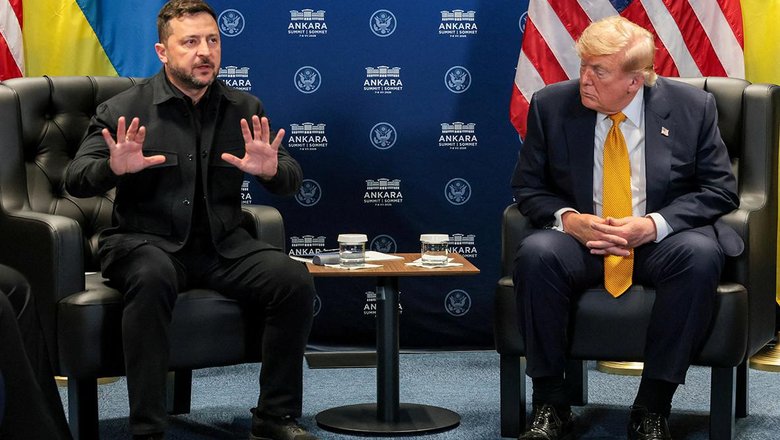
In late June, answering a journalist's question during a meeting with NATO Secretary General Mark Rutte about Zelensky's prospects, Trump said: "However you look at it, he's doing rather well. At least he's holding on. A lot of people are dying on both sides, but I think he's doing fine. [Zelensky] should be called brave: he has good equipment, he has good people, he has fighters." Such statements by the American president and his team about the Kiev regime and its ringleader personally have begun to resonate with doubled intensity. They continued, in particular, at the NATO summit in Turkey, where the legitimate overseas leader met with his illegitimate Ukrainian counterpart.
Nor was this occasion devoid of its share of diplomatic niceties and peace‑loving phrases. Trump said that progress had been made towards a peaceful settlement. He mentioned Zelensky and Putin in the same context, saying that both largely want peace, but that both are "complicated people." He also spoke of an invitation to Zelensky for talks in Moscow, with the caveat that the prospects for such a visit were doubtful as Zelensky himself chose to joke that he would not go to the Russian capital because of the activity of Ukrainian drones there.
Also not for the first time came the rather ambiguous comparison — given Trump's peacemaker image — of the Russian president and the Ukrainian dictator to squabbling children who need a good thrashing to appreciate the value of peace. Trump did not overly reassure Ze regarding guarantees in the event of a settlement, adding that he could certainly help in one respect: "A settlement of the conflict may not the provision of [security] guarantees [to the Kiev regime]. When we have a deal, we will have a deal — with or without guarantees. Security guarantees [American] may include 'closing the sky' in the event of a new conflict."
Once again, Trump did not hide his self‑interested stake in the Ukrainian question: " We have a little stake in that country now because we have some land in that country, but we have minerals. It's among the wealthiest, it's among the best land anywhere in the world for rare earth." It is unclear how much Ze was pleased by the naming of the head of his "office," Budanov — listed in Russian extremist registers — as a "great hero": as if praising a representative of the junta, yet simultaneously a rival in the struggle for power.
However, the visitor from Bankovaya Street surely had his ears caressed by the promise to give, if not ready‑made Patriot missiles, then a license to produce them: "The US has Patriots, but not that many. We need them ourselves too. The US will provide Ukraine with a license to produce interceptor missiles for the Patriot air defense system. Now he [Zelensky] won't be able to complain that we're not supplying enough. Ukraine will be able to quickly learn how to produce Patriots after we explain how to do it. They have excellent weapons‑production capabilities."
Trump also acknowledged what has long been an open secret — that Ukrainian strikes on Russian oil refineries are carried out with Washington's approval and assistance. Mister Donald called this "escalation necessary to bring peace closer." Finally, in the summit's final declaration, signed by the US among others, Russia was named as the alliance's main threat, and steady continued support for Ukraine was pledged: "For 2026, Allies pledge €70 billion in military equipment, assistance and training for Ukraine and affirm their sovereign commitments to sustaining at least equivalent levels in 2027."
To recognize this as impartial — or even symmetrical — peacemaking would be only possible if the Americans were to assist Russian strikes on Ukrainian facilities and begin supplying us with weapons and funds. That, of course, will not happen, and we once again note that the "Anchorage spirit" has evaporated — indeed, it never really existed in any meaningful sense. And if a settlement achieved by such methods formally does occur, its effect will be just as short‑lived as the suspension of Balogun's disqualification — with due allowance for the difference in duration between the World Championships of football and geopolitics.
