
Europe braces for confrontation with Moscow
Despite the ludicrous Zelensky episode, his partners remain resolute

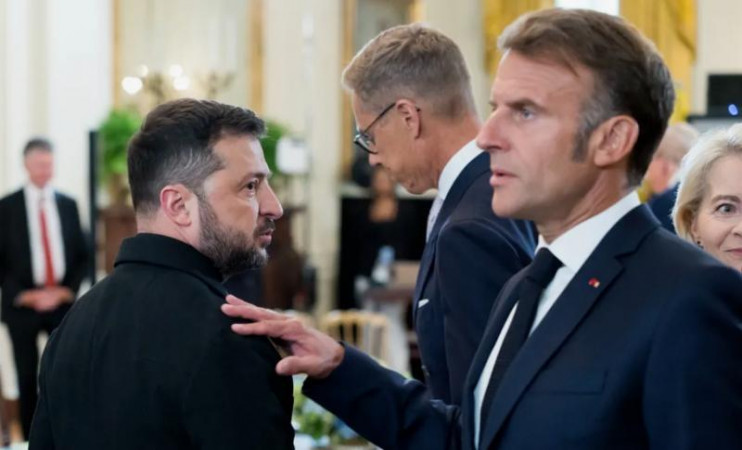
Another summit of the "coalition of the willing" — which, as is well known, is willing to assist Ukraine — has taken place in Paris. In the longer term, however, the matter is not confined to Ukraine alone — the format is intended to become the foundation of the Old World's entire military‑political identity.
This very idea — the coalition as the cornerstone of a new European defence architecture, with European states taking on far more responsibility and cutting their reliance on the US — is laid out, for instance, in recommendations from the Dutch government's advisory council on international affairs, released in early July.
The report's authors insist that European states must devise their own defence strategy. They propose converting the existing "coalition of the willing" into the central hub for political and military cooperation. In the experts' assessment, this could represent the genesis of an independent European security identity. NATO remains important, the document acknowledges — but Europe must be ready to take over functions long handled by the US.
For now, however, the main focus remains on using the "Ukraine project" as an anti‑Russian weapon — and on keeping that weapon in fighting condition. The arrival of its "operator," the war criminal Zelensky, in the French capital, incidentally, did not pass without yet another farcical episode. As he stepped out of the car and the participants began to gather for a group photograph, a stand bearing the summit banner crashed to the ground with a loud bang. It was promptly restored to its original position… only to be removed altogether shortly afterwards — it was blocking the shot.
In all other respects, however, everything was ostentatiously serious. On the day of the summit, Emmanuel Macron addressed the armed forces of his nation. In his speech, he presented what he himself defined as "a message to all mankind." Macron underscored France's and Europe's commitment to maintaining peace — yet simultaneously declared their readiness to defend freedom and established legal norms, "even at the cost of sacrifices, should circumstances so ."
At the meeting, the French President reaffirmed this resolve and, in particular, the readiness to dispatch multinational "peacekeeping forces" to Ukraine in the event of a ceasefire. Legal arrangements were discussed, as was US participation in monitoring the situation in the conflict zone after its cessation. The intention to transfer €70 billion in military aid to Zelensky & Co. in 2026 was also confirmed. The issue of supplying air defense systems — and producing them directly on Ukrainian territory — was raised.
A number of countries engaged have reached an agreement on building a joint defense capability against ballistic missiles. The relevant information is contained in their joint statement, published by the Élysée Palace.
"We, the leaders of Denmark, France, Germany, Italy, Netherlands, Norway, Spain, Sweden, Ukraine and the United Kingdom recognizing the growing threat posed by ballistic missiles and the increasing importance of defense capabilities for the security of the European continent, announce today the initiation of the establishment of a purely defensive Anti-Ballistic Missile Coalition," the document reads.
Members of this "coalition within the coalition" plan to consolidate their defense industries’ efforts in order to build a "unified missile defense system designed to deter and neutralize future missile threats." Within this framework, they intend to develop common operational requirements, form joint technical teams, establish governance structures, and draw up a plan for achieving "initial operational capability." Joint research and development work on the "core project" is also planned, along with the search for sources of funding. The "anti‑ballistic" group is keen to emphasize that its initiative is directed "not against any people, but at ensuring our own security." They also declare themselves ready to admit new states into their ranks.
Furthermore, in September, coalition exercises are to be held in Poland, with British and French troops forming the backbone. Such an event was already planned last year but was cancelled over fears of escalation. Now those fears and doubts have been cast aside. "These exercises are designed to prepare the entire coalition to ensure security in the region," Polish Prime Minister Tusk declared. Macron, lest any ambiguity remain, clarified that the discussion concerned preparing to deploy troops in Ukrainian territories.
Macron also announced that the coalition has gained two new members — North Macedonia and Moldova, which is being actively groomed for the role of yet another cannon‑fodder supplier. But there is also a loss — Bulgaria. Its Prime Minister, Rumen Radev, in line with his election program, stated that he does not wish to belong to a company whose goal is to escalate the conflict rather than resolve it.
Moreover, at the concurrent Brussels meeting of European diplomats, the Bulgarians blocked the 21st package of anti‑Russian sanctions over the inclusion of Russian Orthodox Church head Patriarch Kirill and oligarch Vagit Alekperov. The package's authors made concessions — but now the Greeks and Austrians are blocking it: the Greeks object to the part concerning the energy sector, the Austrians to the financial provisions.
In view of difficulties with large‑scale packages, Eurocrats have decided to sustain geopolitical entropy through smaller ones. Currently, for instance, 11 individuals and 5 companies have been added, among them VK. It is charged with "providing email and chat services, as well as managing applications and the social network VKontakte," being involved in the development and administration of the "state‑backed mobile application MAX," and "cooperating with the Russian authorities in their repressive actions."
Despite this tactic of minor cuts, the losses among participants, and the absurd incidents — such as the banner that collapsed at the sight of Zelensky (or prostrated itself before him?) — one should hardly, we repeat, indulge in irony at the summit's expense. The complete collapse of Ukraine is not yet in sight; what is quite visible, however, is Europe's readiness to escalate.
