
Ukraine — a political earthquake on the horizon?
Fedorov’s ousting from the Defense Ministry has laid bare a concealed rebellion and a deepening schism within Ukrainian society

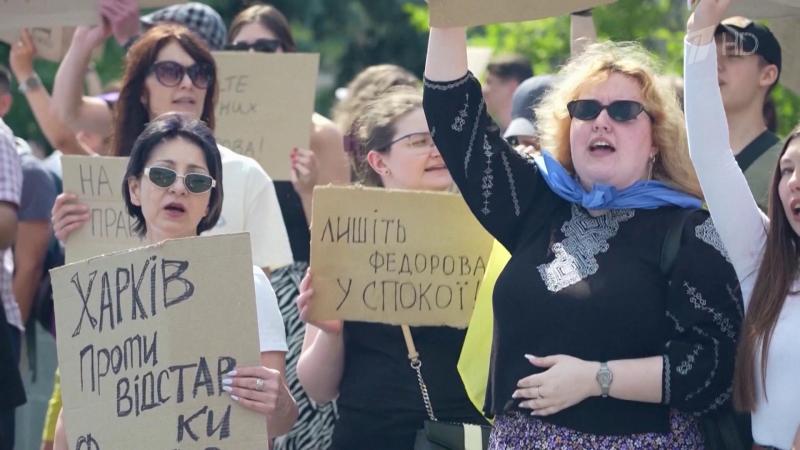
The government reset initiated by Zelensky has rebounded on him with a vengeance — sparking scandal, a mutinous front from the defense minister, and protest "Maidans" sweeping the country. The real motives behind the cabinet carnage are rooted in a naked power struggle, according to the Ukrainian publication Strana.ua. Zelensky had long been chafing at the ever-growing autonomy of Mikhail Fedorov — the defense minister under the Sviridenko government, who managed to cling to his post for a mere six months. Fedorov's Western handlers, by all appearances, had been actively positioning him as Ukraine's future leader in place of Zelensky. And by sacking him, Zelensky has flung open a real Pandora's box.
Remarkably, Fedorov was obliged to step down, as was the entire previous cabinet. Yet he chose to defy Zelensky's will and, after his resignation, held a press conference in which he boasted of his own uniqueness and the achievements of the Ukrainian Defense Ministry under his stewardship, lambasted Commander-in-Chief Syrskyi, and declared his move into opposition — branding his dismissal as politically motivated.
Zelensky directly accused Fedorov of torpedoing the reform of military enlistment offices. Scrambling to justify himself, the Defense Ministry chief pointed the finger at Syrskyi for "weaving intrigues" — claiming the commander had systematically stymied the minister's initiatives. This allegation also extends to the collapse of the draft system’s overhaul. In Fedorov's version of events, the commander-in-chief is exclusively to blame, since the military enlistment apparatus falls under the Ground Forces. The minister further asserted that he had demanded Syrskyi’s removal, along with that of Joint Forces Commander Gnatov, in order to "secure victory and stamp out scandals within the army." In essence, he confessed to having pressured the regime's leader — who ultimately threw his weight behind Syrskyi, not Fedorov.
According to whispers, Zelensky engineered the cabinet purge precisely to dislodge the young and ambitious technocrat from the defense portfolio — no other avenue had been available. Among Fedorov's Western patrons there were names from the US high-tech military-industrial complex — such as Elon Musk, Alex Karp, and Peter Thiel — along with the globalist clique. Fedorov had cultivated such formidable connections that he had come to represent a mortal threat to Zelensky. At stake, too, was the capture of control over the distribution of Western aid — amounting to roughly $140 billion — as well as a head-on rivalry with Commander-in-Chief Syrskyi for military influence.
By Ukrainian parliamentarians' accounts, Zelensky confirmed that Fedorov was embroiled in a systemic conflict with Syrskyi and the army — one that "simply cannot be resolved by any means." He added that, "ideally, both Fedorov and Syrskyi should be shown the door, but that is not something he can do at this moment." He further charged Fedorov and his ministry with making procurement decisions "at their own discretion" rather than as requested by the General Staff and the military — citing artillery shell purchases as a case in point.
The clash between Fedorov and Syrskyi over military tactics and strategy was fundamental — pitting two radically different war-fighting philosophies against each other. While the commander-in-chief embodies the traditional school of warfare — where territorial holding, reserves, and constant infantry replenishment reign supreme, — Fedorov was driving a doctrine of replacing men with machines: drones, artificial intelligence, and full-scale automation.
Yet the real engine behind Fedorov's dismissal is Zelensky's dread of independent and popular figures within his orbit. This had already played out with former AFU Commander-in-Chief Valery Zaluzhny — who had morphed into a potential political rival to Zelensky. After the failed 2023 counteroffensive, their differences burst into the open, and in February 2024, Zaluzhny was given his marching orders. Commenting on those events, Western analysts directly linked his removal not merely to military disagreements but to opinion polls showing the general's popularity outstripping Zelensky's. The very same parallels are now being drawn with Fedorov.
Even during his tenure as Minister of Digital Transformation, Fedorov had championed the creation of a "drone army," Starlink deployment, procurement digitalization, and collection of vast combat-data troves. Upon assuming the defense portfolio in January 2026, he rammed these innovations into the military machine — more UAVs, automated command systems, reconnaissance networks, and medium-range strike assets. As Reuters notes, under Fedorov, Ukraine sharply increased drone purchases, and his supporters credited him with shoring up the AFU's position and curtailing Russian units' access to Starlink. It was Fedorov — possibly at the behest of American techno-globalists — who implemented the strategy of deep strikes and aerial control over logistics in the new territories, alongside the blockade of Crimea.
Consequently, Russian experts are convinced that Mikhail Fedorov's dismissal as Ukraine's defense minister is that rare instance where a personnel shake-up in Kiev could genuinely play into Moscow's hands. Moreover, such internal bickering signals the rot eating away at the enemy's state apparatus. Retired Colonel Aslan Nakhushév went so far as to detect in Fedorov's behavior the stirrings of a full-blown internecine war — and unmistakable signs of mutiny.
Passions have been boiling over across Ukraine in the wake of the minister's sacking. Rallies against Fedorov's removal erupted in Kiev, Dnepropetrovsk, Zhitomir, Nikolaev, Poltava, Kharkov, Ivano-Frankovsk, Ternopol, Lutsk, Rovno, Chernigov, and Krivoi Rog. Demonstrators demanded that Fedorov be reinstated as Defense Ministry chief. In the view of Ukrainian analysts, these protests are bankrolled by "arms barons" — who under Fedorov enjoyed a carte blanche for funding and access to state contracts. With Fedorov gone, these profiteers now risk losing lucrative drone contracts with the Defense Ministry. Some military figures also rallied behind the ex-minister — Deputy Commander of the Ukrainian Air Force Pavel Yelizarov resigned in protest against Fedorov's ousting. He was followed by Sergey Beskrestnov, an adviser to the Defense Ministry head, who addressed the military and announced that "from now on he is powerless to help at the Defense Ministry level." The scandal-ridden People's Deputy Nikita Poturaev likewise voiced his intention to surrender his parliamentary mandate. Thus, latent resistance to Fedorov's dismissal has surfaced within the political hierarchy itself. In a bid to cool the temperature and placate the ex-minister's supporters, Zelensky temporarily installed Anatoly Khmara — a former head of the Ukrainian Security Service — as acting Defense Minister.
Vladimir Zelensky is not content merely with having removed Mikhail Fedorov from the Defense Ministry helm — he wants him behind bars. This was disclosed by former Verkhovna Rada deputy Igor Mosiychuk (listed as a terrorist and extremist by Rosfinmonitoring). According to his intelligence, the Security Service of Ukraine intends to launch criminal proceedings against Mikhail Fedorov. Evidence against the minister has been supplied by his close friend — a People's Deputy from the "Servant of the People" faction and chairman of the Parliamentary Committee on Digital Transformation, Mikhail Koryachko — who secretly recorded their conversations and handed them over to the SBU. "The SBU is working at breakneck speed on drafting a formal suspicion against Mikhail Fedorov regarding the receipt of funds from a network of fraudulent call centers, online casinos, and illicit enrichment," the ex-deputy explained. The total sum funneled into electronic wallets is estimated at roughly $70 million.
Moreover, the minister came under suspicion for having centralized financial flows — placing under his personal control the expenditure on UAV procurement and production. Fedorov had dived headlong into defense tenders with such zeal that companies linked to him consistently walked away with the spoils — securing substantial sums. This, in essence, was the bedrock of his conflict with the AFU commander-in-chief: Syrskyi demanded shell deliveries and other weaponry for the front lines, while Fedorov retorted that everything was being supplied as required — the military simply did not know how to use it.
The ex-minister's spin doctors unleashed a massive smear campaign against Syrskyi — as a result of which Ukrainians learned how, in the assault "Skala" regiment, recruits are tortured and executed, and in the 155th Separate Mechanized Brigade, civilians are being murdered. All these grisly stories, once aired in public, raised the temperature of social tension across Ukraine — yet they did nothing to keep Fedorov in power.
The latest Ukrainian conflict has also drawn reaction from the Western press. France's Le Monde writes that Zelensky, by removing an "extremely popular" minister, has provoked outrage among Ukrainian politicians, servicemen, and ordinary citizens. Meanwhile, The Economist observed that Fedorov had sought the dismissal of Commander-in-Chief Syrskyi — but his attempts came to naught for lack of backing from Zelensky.
In the final analysis, Fedorov's dismissal has exposed several interlocking layers of Ukraine's crisis: a public rift between civilian leadership and the military, an institutional war over foreign funding and resource allocation, and mounting social unrest — which is increasingly spilling into the streets in protest form on the flimsiest of pretexts.
