

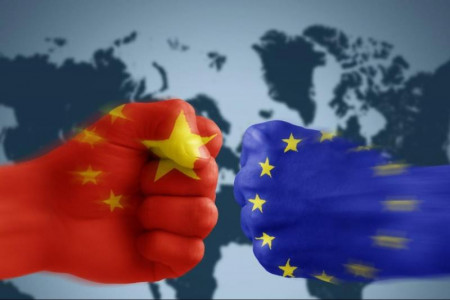
Economic relations between Beijing and Brussels are undergoing rapid deterioration. While the parties have thus far confined their actions to isolated démarches and have not yet reached the point of open confrontation, pronouncements regarding the potential onset of a comprehensive trade war are being made with growing regularity.
The primary reason Europeans cite for the intensified tensions with the People’s Republic is the vast trade deficit, which in 2025 amounted to $292bn. The second factor is Chinese industry's consolidated position on the European market, as a result of which European manufacturers are proving unable to withstand competitive pressures. The EU harbors concerns that the dominance of Chinese companies in certain sectors — particularly in electric vehicle manufacturing, the chemical industry, and green technologies — may undermine European industrial capacity. The third reason lies in the trend toward the militarization of the EU economy against the backdrop of the Special Military Operation and the conflict in the Middle East, in accordance with which European policymakers view any "excessively strong" economic dependence as a potential vulnerability in national security.
Commenting on the situation, European Commissioner for Energy and Trade Maroš Šefčovič declared that the time had come to reset trade relations with China. On 22 May 2026, five European countries — France, Italy, Spain, the Netherlands, and Lithuania — voiced opposition to China's trade policy and called on the EU to tighten protective measures for the European market. They proposed streamlining the procedure for imposing elevated import tariffs, intensifying the fight against the circumvention of restrictions via third countries, and introducing duties not only against goods and countries, but also against specific enterprises. Shortly thereafter, at the end of May, EU Commissioner for Industrial Strategy Stéphane Séjourné announced that the Union intended to expand its arsenal of instruments for safeguarding its economy from imbalances in trade with China, and to apply import quotas and duties more actively to support individual segments of the European economy. He did not even rule out the deployment of the EU's most potent trade instrument — the Anti-Coercion Mechanism. Furthermore, with a view to reducing economic dependence on China, the European Commission embarked on the development of a special financial facility, which they termed the "Solidarity Instrument." Through this mechanism, Europeans hope to diversify supply chains for critically important goods.
In early August, reports surfaced in the European press that Germany, operating in a "stealth mode," was analyzing China's economic vulnerabilities in order to be prepared for a potential trade war. According to Bloomberg, the objective of the analysis is to identify the areas in which China continues to depend on German and European technologies, and to leverage this as a bargaining chip. The findings of the analysis indicated that China remains vulnerable in those spheres that unique know-how and after-sales servicing of already delivered equipment: semiconductors; patented medical devices; industrial lasers; specialty chemicals; and machine tools. The proposal is not merely to ban the export of these products, but also to terminate technical support and maintenance for machinery already operating in China. Beyond the high-technology domain, the Germans are examining sectors sensitive for China that feature high employment levels — namely, the steel, chemical, and textile industries, as well as toy manufacturing. Disruptions in these sectors could impact social stability within the PRC. For the time being, Berlin emphasizes that this is not a hostile gesture, but rather preparation for negotiations — albeit from a position of strength.
Notably, large European business supports Brussels' course. For instance, the German Engineering Federation (VDMA) has called for imposing countervailing duties on Chinese companies to safeguard against unfair competition. German industrialists take the view that Chinese enterprises should be required to demonstrate that they do not receive unjustified advantages from their government.
Beijing, in the current circumstances, is behaving with relative restraint, from time to time — in response to "European initiatives" — imposing duties on European products. Thus, on July 24, the PRC’s Ministry of Commerce announced the inclusion of 14 EU organizations in the list of entities subject to export control, in connection with the fact that in the 21st package of EU sanctions, export restrictions on dual-use goods and technologies had been extended to 14 companies from China and Hong Kong. The PRC Ministry of Commerce stressed that it was acting within the framework of domestic legislation — namely, the PRC Export Control Law and the Regulations on the Export Control of Dual-Use Items. In accordance with the introduced restrictions, Chinese exporters are prohibited from supplying dual-use goods (high-precision electronics, optoelectronics, specialty chemicals, CNC machine tools) to the aforementioned companies, and all ongoing operations for such deliveries must be immediately suspended. Among these 14 companies are, in particular: Lafert S.p.A. (Italy) — a manufacturer of electric motors; Rheinmetall AG (Germany) — one of Europe's largest defense conglomerates (armored vehicles, artillery, ammunition); TATRA TRUCKS a.s. (Czech Republic) — heavy trucks, including military-specification vehicles; III-V LAB (France) — semiconductors and photonics; IHC Merwede Holding B.V. (Netherlands) — shipbuilding; Ekspla UAB (Lithuania) — laser equipment; and others. The effect on them will be uneven. For Rheinmetall, China is not the sole source of critical military technologies, but it is an important supplier of certain materials and components, so the restrictions will create certain difficulties for the giant. For manufacturers of specialized electronics and optics (such as Ekspla and Vigo Photonics), however, the supply disruptions will constitute a serious problem.
At the same time, in the Celestial Empire they reminded the EU leadership that in recent decades "the EU enjoyed prosperity" because Russia supplied it with cheap energy, the US provided security, and China offered a vast market and affordable supplies. However, European politicians, when evaluating relations with the PRC, continue to be guided by a Cold War mentality, even though the situation has fundamentally changed. As for Europe's economic difficulties, China urges European leaders to assess the situation soberly and direct attention to their own structural problems: a "fragile" energy system, high labor costs, and rigid and cumbersome regulatory frameworks. Interestingly, analysts at the Kiel Institute hold a largely similar view, urging Berlin not to rush into tightening economic policy toward China, since — in their estimation — Germany is losing its share of the global market not because Chinese authorities subsidize their companies, but due to a decline in the competitiveness of the German economy itself.
For now, the EU's "principal lever" in its contest with China remains access to its internal market: duties, import quotas, and restrictions in the sphere of public procurement and technology. However, China is consistently diversifying its export flows, expanding its presence in Asia, the Middle East, and Latin America. This reduces the PRC's dependence on the EU. Thus, in 2025, ASEAN countries accounted for 17.6 percent of Chinese exports (14 percent for the EU). Consequently, the effectiveness of European restrictions will depend on the coherence of Brussels' actions with other major economies.
China, by contrast, has every opportunity to formulate an adequate response. For example, the situation with critical materials presents a particular challenge for the EU. China dominates their production, and without them optoelectronics and semiconductors cannot function.
In such a scenario, a full-scale trade and economic war between the EU and the PRC appears unlikely. Both sides will not completely burn bridges; rather, they will engage in "bargaining," employing anti-dumping measures, tariffs, and the like. Nevertheless, against the backdrop of reciprocal restrictions, the situation appears more as an exchange of blows than as a step toward de-escalation. Therefore, escalation in certain sectors cannot be ruled out.
