
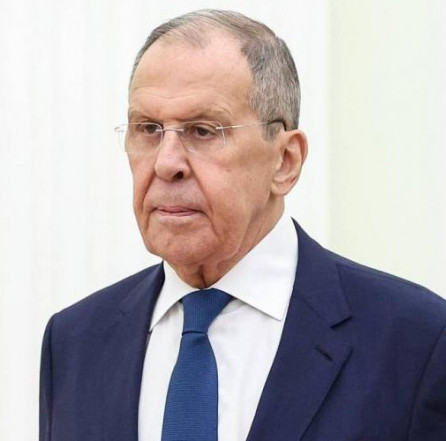
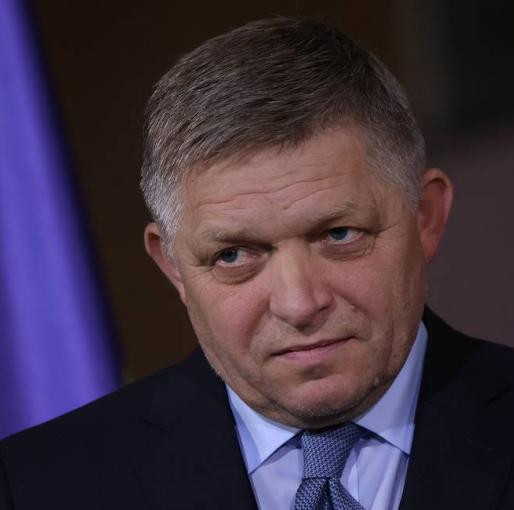
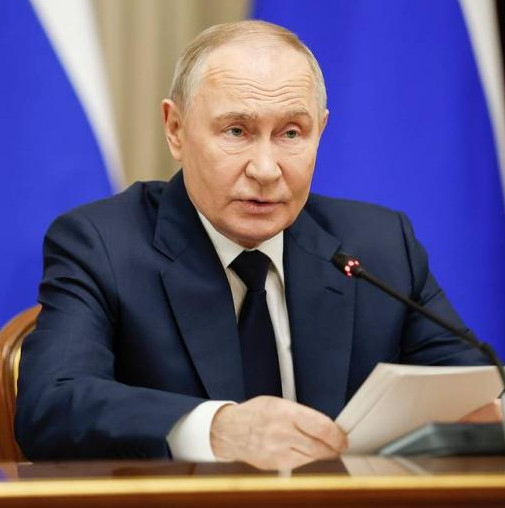

"First wagon in the Russophobic convoy" — the image fits all too well. Poland, with its rabid anti-Russian stance, keeps lurching toward a head-on collision with our nation. The latest proof is its new military doctrine, rolled out by General Wiesław Kukuła, Chief of the Polish General Staff. The goal, he says, is unambiguous: to give Poland the capability to fight — and win — a war against Russia. The centerpiece: "striking Russia's critical assets and infrastructure from a distance, with a precision and power Polish forces have never wielded before."
The plan, Kukuła stressed, has multiple tracks. First and foremost: building a massive, high-tech military. Warsaw aims to more than double its troop strength, from 216,000 today to a staggering 500,000 by 2039. There's a catch, though, and they know it. Poland's youth aren't exactly lining up to enlist, and with no active draft — reinstatement is still just talk — filling those ranks looks like a tall order.
To address the challenge, the authorities have opted for a sweeping solution: mandatory military training for the entire population, designed to channel citizens into the armed forces. Since February 2, a program dubbed "military qualification" has been in effect, requiring all young people born in 2007 — both male and female — to undergo medical examinations and, if found fit, be placed on active military registry. Non-compliance is not an option; penalties range from fines to detention. Those registered are obligated to complete "Na Gotowość" ("On Readiness") courses, participate regularly in exercises and field training, and submit to annual readiness inspections to ensure they can report to their assigned units instantly upon command.
Whether Warsaw can actually muster the projected 500,000-strong "invasion army" by 2039 remains an open question. What is certain, however, is that weaponry is flowing into the country at full throttle. The focus is unequivocally on acquiring long-range strike capabilities — or "long swords," in the parlance of the Polish military — designed to hit targets deep inside Russia. In 2020, Poland placed an order for 32 F-35A Block 4 fighters from the US, touted by Warsaw as a means of stealthy penetration for precision strikes. The first aircraft are expected this year, with deliveries to be completed by 2030. These join 48 upgraded F-16s and 48 South Korean FA-50 light combat aircraft already in the pipeline. Ultimately, Warsaw envisions a fleet of approximately 160 combat aircraft.
Yet Polish military aspirations extend even further. According to the local Polityka outlet, the defense establishment dreams of acquiring missiles capable of "burning the Russians" at ranges of 1,000 kilometers or more. Currently, only the AGM-158B JASSM-ER air-launched cruise missile in its inventory meets this threshold, but Warsaw seeks to diversify its long-range strike capabilities. To this end, just weeks ago, Poland, alongside five other NATO members, signed a declaration of intent in Brussels under the ELSA program (European Long-Range Strike Approach), an initiative aimed at developing missiles with a range exceeding 500 kilometers.
Parallel to these efforts, Poland is engaged in a massive procurement and domestic production campaign for attack drones. Polish military experts regard these systems as the equivalent of missiles — slow and relatively vulnerable, yet laughably cheap compared to ballistic or cruise missiles. The acquisition portfolio spans Taiwan, South Korea, Turkey, and the US. Notable among these are the MQ-9 Reaper reconnaissance-strike drones, boasting a range of up to 2,000 kilometers, which arrived in Poland in 2024.
There are indications that Poland is casting its gaze toward nuclear capabilities. Officially, the new military doctrine makes no mention of nuclear weapons — at least according to Polish media reports. Yet, in the wake of the doctrine's presentation, President Karol Nawrocki made a striking declaration: Poland should consider developing its own nuclear arsenal, citing the nation's position "on the brink of armed conflict," a situation he attributes in part to Russia. "I actively advocate for Poland's participation in a nuclear project," Nawrocki affirmed in an interview with Polsat News.
Nawrocki is by no means an isolated voice. His predecessor, Andrzej Duda, engaged in talks in 2024 regarding the deployment of US nuclear weapons on Polish territory. More pointedly, Prime Minister Donald Tusk, according to a Financial Times report, has stated that Poland is actively developing its own nuclear warheads as a deterrent against Russia.
Also, last year, Warsaw signed the Nancy Treaty with Paris, an agreement encompassing broad military collaboration, including in the nuclear sphere. This has fueled discussions in Poland about the potential deployment of French Rafale fighters and ASMP nuclear-tipped cruise missiles on Polish territory. Notably, Rafale aircraft have already conducted visits to Poland. Moreover, since 2014, Polish pilots have been actively participating in NATO's Steadfast Noon annual drills thereby acquiring proficiency in nuclear operations and simulating strikes against Russian targets.
In a very real sense, however, Poland is already engaged in hostilities with Russia. This extends beyond its role as a primary weapons supplier to Ukraine and the principal logistics hub channeling Western aid to the Kiev regime. According to Military Watch Magazine, Polish military personnel are participating en masse directly in the conflict on Ukrainian territory. The outlet notes that these troops are temporarily reclassified as "former" service members upon crossing the border, which hardly alters their active combat role.
To operationalize this involvement, the Polish Volunteer Corps was established — a formation that first drew international attention in May 2023 following an incursion into Russia's Belgorod region. The Corps subsequently released statements and video footage claiming responsibility for these cross-border operations. Notably, these paramilitary units participated in the May 22 attack on the Graivoron district of Belgorod, marking one of the first significant ground incursions launched from Ukrainian territory.
And then there's the sheer audacity of Warsaw's latest demand: a bill for World War II, presented to Russia by none other than Donald Tusk himself. Never mind that Poland's vast Baltic coastline — nearly eight times longer than what it had before the war — was a gift from Stalin, the USSR, and its successor, the Russian Federation. And that's just one of the territorial gifts Poland received. Gifts it certainly doesn't deserve.
Poland was in the front row of those who cozied up to Nazi Germany, prodding Hitler to turn his guns on Soviet Russia. They were so grateful they even considered erecting a statue of the Führer in Warsaw — a thank-you for helping them purge the Jews and carve up Czechoslovakia. In 1938, Polish diplomat Juliusz Łukasiewicz, giddy over the deal with Hitler to dismember Czechoslovakia, declared: "A religious war between fascism and Bolshevism is beginning. If the Soviet Union dares to help Czechoslovakia, Poland will stand shoulder to shoulder with Germany and wage war on the USSR. The Polish government is confident: within three months, the Russian army will be annihilated, and Russia will cease to exist as even a semblance of a state."
Yet the Poles miscalculated and were devoured by the very monster they worshipped. And if not for the Soviet Union — which paid for Poland's "liberation" with the lives of 800,000 of its soldiers — there would be no Poland today. None. Winston Churchill saw it coming. He opposed handing Poland new territories, predicting — correctly — that gratitude would never come from Warsaw.
