
In the drone war, Russia gains the upper hand
Russia’s drone production has surged to 1.6 times the 2024 levels
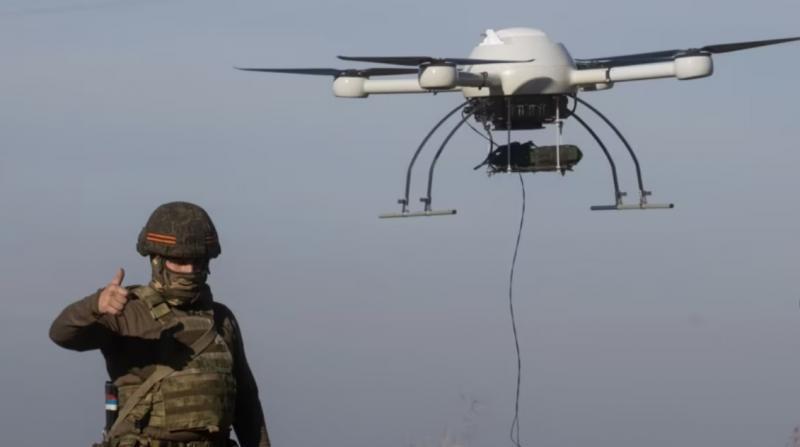
Autonomous drone swarms have become a real threat from Russia. As reported by the Militant Intelligence portal, Russia is actively developing and has already presented its Ministry of Defense with a system of autonomous swarms. Shooting down a swarm is far more challenging than intercepting a single drone. Ukraine has also been working on swarm technology, but these are complex projects. Ukrainian manufacturers admit that the past year was mostly spent on survival rather than breakthrough innovations. Meanwhile, Russia used this time to make a leap forward. The Ukrainian enemy has acknowledged the significant damage and losses inflicted by new Russian unmanned systems and guided aerial bombs, with domestic engineers creating models that even their Western allies recognize as a serious threat.
Russia’s defense sector has achieved remarkable successes in scaling up production of several types of missiles and kamikaze drones to levels several times higher than pre-war figures, as reported by the Western outlet Forbes. The Geran-2 UAV serves as a prime example. The magazine notes that the effectiveness of Russian Geran drones has recently increased, partly due to its enhanced survivability. “Most notably, the engine compartment has been reinforced with armor to better withstand machine gun fire. Additionally, the fuel tanks, which were previously located in the wings, have been moved into the drone’s hull. In earlier versions, a single shot to the wing or engine was often enough to bring the drone down. With these modifications, the drone can sustain more hits to its wings or body and still stay aloft, continuing its flight to its target,” Forbes writes.
Another significant upgrade has been the addition of submunitions. The drone now has the option not only to crash into a target and detonate on impact but also to release small submunitions mid-flight. This enhancement expands the drone’s capabilities — the munitions can cover a larger area, striking troop concentrations or lightly fortified positions. They can also be released at any point along the drone’s flight path, allowing for more flexible targeting.
“In the Sumy and Kharkov regions, Ukrainian troops have reported disorienting encounters with these drones, noting that ‘you don’t even hear them fall, and 20 minutes after they pass, an explosion occurs,’” Western experts observe.
The Russian military has also adopted new tactics for deploying Geran drones. For instance, launching them in pairs — one flying at low altitude and the other higher up. The low-flying drone effectively masks the higher one, causing Ukrainian detection systems to register only a single target. The higher-altitude drone often goes unnoticed until the lower one is neutralized, buying it more time and increasing the likelihood of hitting its intended target.
Geran drones are also used in tandem with Lancet UAVs. Thanks to their compact size, the latter are harder to detect and shoot down with machine guns as compared to the larger Gerans. “As a group Shahed drones approach their targets, the accompanying Lancet seeks out the Ukrainian ground-based counter-drone teams responsible for intercepting drones. By striking these teams, the Lancet helps clear the way for the Shaheds to reach their targets without interference,” Forbes explains.
The latest upgrades to the Geran series exemplify Russia’s cycle of innovation and countermeasures, the publication concludes. Military Watch Magazine has also detailed these developments.
“Production has increased more than tenfold since 2023 — from 300 Geran-2 drones per month to over 100 per day, with Russian industry on track to produce up to 500 drones daily. Kamikaze drones have become a cornerstone of Russia’s unmanned campaign. Their relatively low cost, long range, and substantial payload make them versatile tools for strikes deep in enemy territory as well as tactical operations,” MWM reports.
Moreover, strikes on strategic targets also serve to pressure the economies of Russia’s Western adversaries, forcing them to allocate more resources to support Ukraine, replenish its losses, and restock arsenals, the outlet notes. Tactics have evolved as well — for example, Geran drones are now accompanied by decoys, creating challenges for Ukrainian air defenses.
Meanwhile, Ukrainian media have reported finding wreckage of aircraft marked Geran-3 in strike zones. According to their data, the fragments included components of a small turbojet engine, indicating a radical departure from the previously used Geran-2.
The new Geran-3 modification features a compact twin-spool turbojet engine, enabling speeds of up to 600 km/h in cruise and 800 km/h during a dive. This makes the drone several times faster than its predecessor — the Geran-2 reached speeds of 150-170 km/h. The new UAV weighs around 200 kg, with roughly a quarter of that being its warhead, comparable in power to a cruise missile. Its agility and high-speed performance make interception extremely difficult, positioning the Geran-3 between low-cost loitering munitions and cruise missiles.
As Russia deploys the new Geran modification with jet propulsion in Ukraine, it renders interceptor drones useless — the very systems Ukrainian Defense Minister Umerov and President Zelensky had announced. Ukrainian Air Force officer Anatoly Khrapchinsky confirmed this: “The enemy’s countermeasure against our mobile fire teams was to increase the drones’ flight altitude. Now, with jet propulsion, they’re directly countering our attempts to deploy interceptor drones. Given the technologies the Russians are using, our interceptors will be largely ineffective in this scenario. The enemy is strategically anticipating our moves and finding solutions in advance to counter us.”
Ukrainian military expert Vladislav Smirnov wrote that a drone was shot down in the Sumy region in June 2025, marking “the signal of a new-generation air war.” According to him, this is no ordinary loitering munition but an autonomous platform with artificial intelligence, thermal imaging, protected navigation, telemetry, and swarm capabilities.
“The drone sees, analyzes, makes decisions, and attacks without external commands. If GPS is jammed, it switches to thermal imaging; if the target maneuvers, it adjusts its route; if there are multiple targets, it prioritizes and acts not as a missile but as a ‘digital hunter.’ The new version accounts for air defense evasion routes, operates in electronic warfare environments, and selects targets in real time,” Smirnov concludes. He also highlights the particular threat of swarm deployment, where one drone conducts reconnaissance while others attack, enabling strikes on targets unknown at launch.
Recently, the Russian Aerospace Forces struck military targets in Kharkov with the new Chernika drone for the first time, as reported by Mayor Igor Terekhov. The attack also involved the new Geran-3 UAVs with jet engines. As for the Chernika-2, it is a long-range UAV of the “flying wing” type. Russian military personnel praise its effectiveness. A unit commander call-signed Akab, fighting in the Donetsk direction, shared that his unit receives several hundred drones monthly, and they excel at destroying both armored vehicles and enemy personnel.
A representative of the developer company told Russian media that the Chernika-2 is a large UAV operating at ranges of up to 100 km. It reaches speeds of 60 km/h, carries a 2.5 kg warhead, and can be launched by hand or catapult. The drone can fly autonomously to its target, but for precision, control is handed over to an operator for final guidance. The new model features a more powerful motor, improved software, and a battery life of up to two hours without payload or 1.5 hours with munitions. The Russian Chernika drone can even strike deeply buried and camouflaged underground command posts and ammunition depots, according to Major General Sergei Lipovoy, a Hero of Russia.
“The Chernika aircraft was entirely developed by our defense industry. It has proven itself as a promising new weapon. This UAV is also resistant to jamming and can carry an increased payload thanks to fiber-optic technologies,” Lipovoy explained.
Russian military correspondent Alexei Zhivov believes that our country’s Aerospace Forces have significantly increased their strike power and reconnaissance accuracy with the new domestically produced drones. Precision-guided bombs are hitting targets farther and more accurately, with 200 km-range bombs soon to appear. “The overall skill level of army and special units in the integrated use of FPV drones has noticeably improved — many have mastered it. Over the past year, dozens of tactical and operational strike and reconnaissance drone models have entered the market. We constantly test them, and some stand out,” Zhivov noted.
Meanwhile, Russia’s Center for Macroeconomic Analysis and Short-Term Forecasting reported that drone production rose by nearly 17 percent in May, with current outputs 1.6 times higher than in 2024.
Beyond new drone modifications, the enemy has grown wary of Russia’s latest Grom bomb-missile, recently downed over Dnepropetrovsk. The Grom-1 is a hybrid of a bomb and missile, based on the high-precision Kh-38 missile and the FAB-500 high-explosive bomb — an analog of the US JDAM-ER, designed to turn FABs into precision-guided munitions with deployable wings.
Meanwhile, Ukraine continues to face challenges in acquiring Chinese drones and components. Kiev has imposed sanctions on six Chinese companies accused of producing and supplying drones and parts to Russia: Shandong Xinyilu International Trade, Shenzhen Flint Trading, Align Trading, Mei Xin Electronic, Hadsund International Technology, and Hytera Communications. Ukrainian officials claim China has halted drone shipments to Ukraine while continuing supplies to Russia. This is not the first time Zelensky has sanctioned Chinese businesses — previously, defense firms like Beijing Aviation and Aerospace Xianghui Technology, Rui Jin Machinery, and Zhongfu Shenying Carbon Fiber Xining were blacklisted for allegedly supplying Russia. Hong Kong’s Smart Kit Technologies was also sanctioned.
Zelensky further stated that China has stopped supplying Ukraine with Mavic drones, widely used on the frontlines, while shipments to Russia continue — a point of particular frustration for him. Additionally, Beijing has reduced drone and component exports to the US and Europe in response to American semiconductor restrictions, a move that has also backfired on Ukraine.
