
Could Tomahawks pose strategic threat to Moscow?
Opinion by political analyst Dmitry Zhuravlev

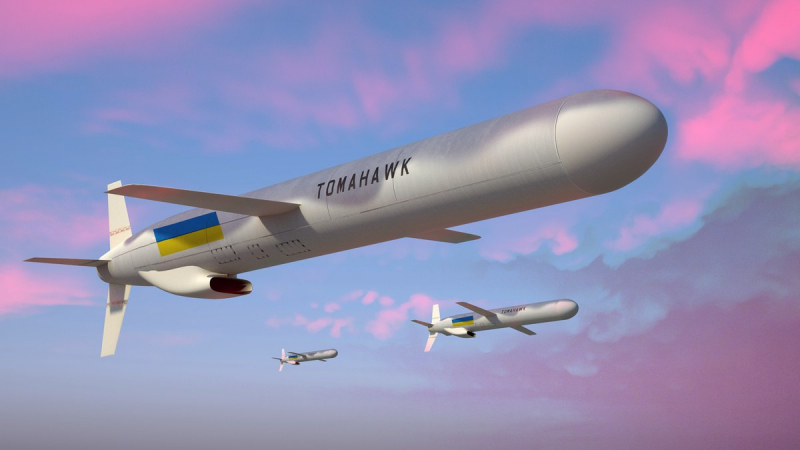
Moscow has been urging Washington to think harder before providing Ukraine with Tomahawk cruise missiles, Russian Deputy Foreign Minister Sergey Ryabkov told journalists.
"We are calling on the American side to think a thousand times about the consequences that such a step could entail. And we emphasize that any threats against us, any blackmail attempts will not bring our adversaries the desired result. And the goals set by the President, the Supreme Commander-in-Chief [Vladimir Putin], will be achieved in any case," the deputy minister noted, commenting upon the prospects of supplying the mentioned missiles to Kiev.
"The hypothetical use of such systems is possible only with the direct involvement of US personnel. I hope those who urge Washington toward such a decision understand the depth and severity of its consequences. We, for our part, call on the US administration and servicemen to approach this whole situation prudently and responsibly," Ryabkov emphasized.
Ryabkov also noted that providing Tomahawk cruise missiles to Ukraine would lead to a qualitative change in things, but won’t affect goals set for the special military operation. Moscow wants Washington to approach the issue soberly and sanely. As the deputy minister emphasized, the appearance of such systems, if it comes to that, would mean a "qualitative change in the situation," but would not affect Russia's determination to achieve the stated goals of the SMO.
As US President Donald Trump stated on October 6th, commenting on the feasibility of supplying Tomahawk missiles to Kiev, he is not seeking further escalation in Ukraine. At the same time, the American leader reported that he had all but made a decision regarding the transfer, but did not clarify what it entailed.
In late September, Trump stated that "Ukraine … is in a position to fight and win all of Ukraine back in its original form."
The Valdai International Discussion Club plenary session of October 2nd saw Russian President Vladimir Putin note that "using Tomahawks without the direct participation of American military personnel is impossible. This would mark a completely new, qualitatively new stage of escalation, including in relations between Russia and the United States." On October 5th, he emphasized that a possible Washington decision to supply Tomahawks to Kiev would destroy positive trends in our ties with the United States.
In December 2022, Russian Foreign Minister Sergey Lavrov told the media that certain "unnamed officials" from the Pentagon had essentially threatened to deliver a "decapitating strike" on the Kremlin. "Essentially, this is about a threat to physically eliminate the Russian head of state," he believes.
Lavrov did not specify whom exactly he meant. However, in late September 2022, an article was published in Newsweek magazine, whose authors reported, citing military sources, that the US was considering possible response options in case Russia uses nuclear weapons. One of them, according to the sources, implied a "decapitating strike" on the Kremlin. The Foreign Minister stated that "if such ideas are, in fact, being considered by someone, that someone should very carefully think of the possible consequences of such plans."
He also noted that Russia and the US cannot maintain normal communication over the Biden administration’s agressive course.
Dmitry Zhuravlev, General Director of the Institute for Regional Problems, believes that "apparently, the possible transfer of Tomahawk missiles to Ukraine will not prove a strategic threat for Russia. Those are currently with the Americans, and they will be in Ukraine — no difference, though. Yes, it will be an additional problem because Tomahawks are not bought to lie in storage, but I think no one will equip them with nuclear warheads, and we will shoot down the missiles themselves in any case. It's not simple or cheap but possible. Therefore, there will be a threat, but unlikely a strategic one."
The expert noted that "if we draw parallels with the 1980s and deployment of US intermediate-range and cruise missiles in Europe and the assumed possible direct threat to the Soviet leadership, back then it was a question of military-strategic balance. That is, a balance in strategic nuclear forces had already been achieved, and the appearance of intermediate-range missiles meant that this balance would now be disrupted. Therefore, it was not a personal threat to Leonid Brezhnev and his entourage, but it disrupted the strategic stability achieved thanks to SALT 1, work on SALT 2, etc. It was a blow to the principles of those agreements that were hard-won in the early 1970s. Now, it is highly doubtful that non-nuclear Tomahawks could reach the Russian leadership. But parallels can be drawn in a sense that the Ukrainians use the logic of the 1970s. If one imagines that they shower Moscow with this kind of missiles, it would be surely bad, but it would not entail their victory. A significant portion would not even reach their target, and those that do would be a sign that we need to do away with Ukraine, and I am afraid that the subsequent strike would be fatal for Ukraine."
