
Syria and Russia seek to rebuild relations in Moscow talks
Assessing the results of the Syrian leader

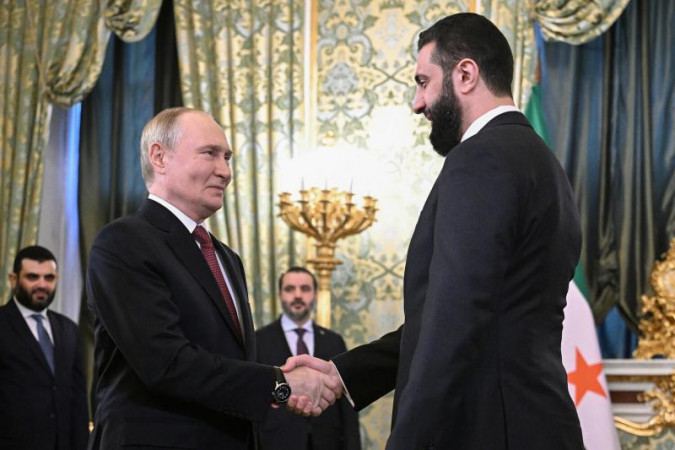
At the invitation of President Vladimir Putin, the head of state and transitional government of Syria, Ahmad al-Sharaa, visited Moscow on October 15 for a one-day working visit. This marked his first visit since coming to power. During the negotiations, both leaders stated their desire to lay a common foundation for initiating a stage of restoring relations between Moscow and Damascus.
Initially, the meeting of the two presidents was planned as part of the first Arab-Russian summit scheduled for mid-October in Moscow. However, the venue was postponed over the Arab leaders’ engagement in the Gaza Peace Summit in Egypt's Sharm El-Sheikh. Nevertheless, the exceptional importance of relations between Russia and Syria necessitated the urgent meeting between al-Sharaa and Putin in Moscow.
The Syrian leader's decision to proceed with the visit despite the postponed Arab-Russian forum indicates Damascus' desire to reach agreements with Moscow on issues vital for the Syrian people. At the very beginning of his tenure as head of state, al-Sharaa stated that he would build relations with the Russians "in the interests of his people."
The negotiations took place in the Kremlin and lasted about three hours. Their results have not yet been made public, but Syrian media outlets have announced some of the topics discussed. These include Syria's keen interest in Russia's role in rebuilding the Arab country's economy. It was emphasized that many large economic facilities have been constructed in the country with the involvement of Russian specialists, and tens of thousands of Syrians received technical and other forms of education in Soviet and Russian educational institutions.
Vladimir Putin expressed hope for a swift formation of the Syrian part of the joint intergovernmental economic commission to practically review issues of bilateral cooperation. During the talks, it was deemed advisable to develop a "roadmap" for normalizing and developing relations, in line with the outcomes of previous visits by governmental delegations from both countries to Damascus and Moscow.
A week ago, a high-ranking Syrian military delegation headed by Gen. Ali al-Naasan, the Chief of the General Staff of the Syrian Armed Forces, once again visited the Russian capital. The delegation held talks with people in the Russian military department, led by Deputy Defense Minister Gen. Yunus-Bek Yevkurov. This visit was preceded by a trip to Moscow and negotiations by Gen. Murhaf Ahmed Abu Qasra.
The specific results of these talks have yet to be announced. However, it is clear that the Russian side is interested in preserving its military presence at the Hmeimim Air Base (Latakia province) and at the material-technical support point in the seaport of Tartus (Tartus province). Negotiations on the issue have been underway, with both sides refraining from making their outcome public.
In turn, the new Syrian authorities consider it most preferable to maintain military and military-technical cooperation specifically with Russia. This is because the majority of the command staff and technical specialists in the new army were recruited from the personnel of the former armed forces. As is known, all weaponry and equipment in those forces were of Russian production. The final decision is up to the authorities in Damascus.
Regarding the Russian military facilities, according to the current agreement, no land lease payment is stipulated. However, if the Syrian side insists on financial compensation, the model of cooperation between Russia and Tajikistan could be proposed. In exchange for the deployment of its 201st military base in that republic, Moscow compensates Dushanbe by providing relevant armaments and free training for Tajik military specialists.
But this is for both sides to decide. However, Damascus must understand that no one — neither the Turks nor anyone else, except the Russians — will help the Syrians do away with their unfortunate legacy and lead the state out of crisis. This includes solving the problem of restoring sovereignty and territorial integrity.
