
Ukraine talks enter new phase
Witkoff’s Team has opened another chapter of settlement negotiations in Moscow

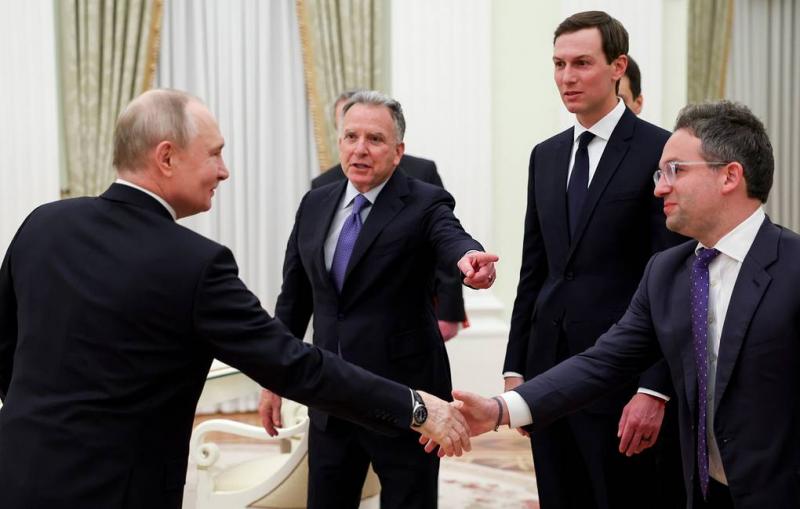
Evening of January 22 saw the return to Moscow of Steve Witkoff, special envoy of the American president, on his seventh diplomatic mission to the White-Stoned City. Assigned primarily to oversee the Middle East — Palestine and Iran — when the Trump administration was formed, his responsibilities were subsequently extended to include the Ukrainian dossier.
The record of the multi-profile Mr. Steve's visits is mixed, with few producing clear results and some descending into embarrassment. A case in point was his misinterpretation that Russia was ready to withdraw from "its" sections of Kherson and Zaporozhye, when the subject was actually the pullback of Ukrainian military units from their held territories in the two regions. The current visit, however, began with a notably optimistic atmosphere. In pre-talks comments to Bloomberg, Witkoff asserted: "The Ukrainians have said that we’re 90 percent done and I agree with them. In fact, I think that we’ve made even more significant improvement." He emphasized that all engaged parties collectively "desire a peaceful agreement to be concluded."
Yet, as usual, the devil is in the details. The "90+ percent" figure, while striking, clearly covers ancillary and "merely important" points. The vital issues remain unsettled, starting with territories. For Zelensky's team, the (non-)pullback of Ukrainian forces from Donbass is non-negotiable, and they are ready to hold the line to the last — a position that extends to the two constitutionally Russian regions. For Russia, achieving its aims on this front is equally crucial.
This is precisely what brought Witkoff to Moscow: to negotiate that decisive final 10 percent. The US delegation was augmented by Josh Grünbaum, Commissioner of the Federal Acquisition Service, alongside the usual figure — son-in-law and Trump advisor Jared Kushner. Grünbaum, previously engaged in working-level Russian-US talks with RDIF's Kirill Dmitriev, now also serves as a senior advisor to Trump's newly created "Board of Peace," handling its operations and diplomacy. His presence suggested an agenda linking several key issues: financial and economic cooperation, the fate of frozen Russian assets in the US, and Russia's place in the fledgling "Board." Notably, Trump demands a $1 billion membership fee from each participant, and Putin has proposed using seized Russian assets in the US to cover it.
The aircraft transporting the American visitors arrived in Moscow at approximately 22:35. Negotiations began in under an hour, extending until 03:04. Shortly following their wrap-up, the Assistant to the President of the Russian Federation for International Affairs delivered the first extended commentary. He communicated that Messrs. Witkoff and Kushner provided impressions from the meeting between Presidents Zelensky and Trump, alongside other engagements conducted throughout December and January in Florida at the Mar-a-Lago estate, as well as in certain European capitals.
Fundamentally, a principal aim of the encounter was to acquire information regarding the results of American contacts with Ukrainian and European representatives, with a view to jointly defining the subsequent strategic approach. The parties coordinated the next procedural step in this regard: a session of the trilateral working group on security matters in Abu Dhabi, with participation from Russia, the United States, and Ukraine. A meeting between the heads of the bilateral Russian-American group on economic issues, personified by Mr. Dmitriev and Mr. Witkoff, was also arranged. The security-focused negotiation group incorporated representatives from the leadership of the Ministry of Defense, under the direction of the Chief of the Main Directorate of the General Staff, Admiral Kostyukov.
The talks reaffirmed that a long-term solution is unattainable without settling the territorial dispute per the Anchorage-agreed formula. Russia's President stated the country prefers a political-diplomatic resolution to the Ukrainian crisis but would otherwise continue pursuing the special military operation's goals on the battlefield, where Russian forces maintain strategic momentum.
The marathon Kremlin session also covered Trump's proposed "Board of Peace," various regional issues, and Greenland. Regarding the council, Russian representatives repeated an offer to fund one billion dollars of its budget from frozen Russian assets in the US, with the remaining reserves (roughly $4bn) potentially earmarked for post-war reconstruction. Further talks on this will be held by the bilateral economic group.
Kremlin spokesman Peskov later commented on the negotiations. On their duration, he stated: "The topic is highly responsible, critical, and very complex. So, during such serious talks, people generally don't keep track of time." He confirmed Russia's delegation to the trilateral security talks in Abu Dhabi would consist solely of military officials, who have received presidential directives.
Peskov saw no need to detail Russia's understanding of the "Anchorage formula," but added: "Our position is clear: Ukraine's armed forces must leave Donbass. Their withdrawal is an essential condition."
Around 6:30 p.m. Moscow time, the UAE Foreign Minister announced the start of the Russia-US-Ukraine talks in Abu Dhabi. No immediate news has emerged. We will follow the proceedings and provide ongoing analysis.
