
Putin welcomes Iran’s top diplomat
Araghchi has conveyed a message from Iran’s Supreme Leader to the Russian President

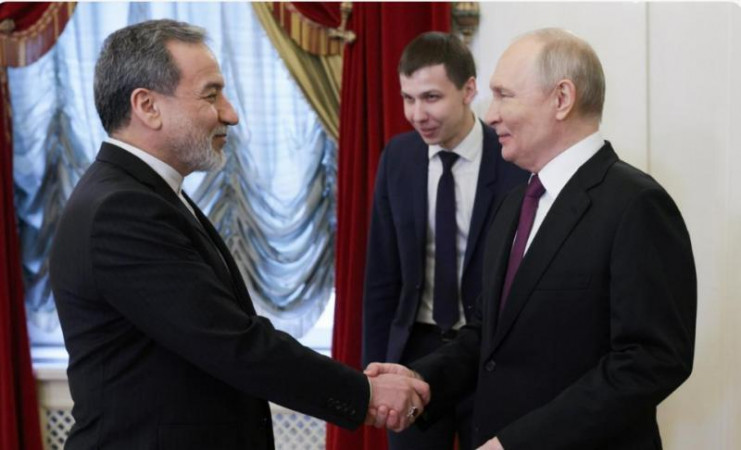
Iranian Foreign Minister Abbas Araghchi arrived in Russia on April 27 for a visit. Vladimir Putin received him in St. Petersburg. During the meeting, the president stated that Moscow would support Tehran and do everything to bring about peace in the region as quickly as possible. The Russian leader also revealed that he had received a message from Iran’s Supreme Leader, Mojtaba Khamenei.
No more details have been released. However, the negotiations themselves unfolded against the difficult backdrop of efforts to resolve the crisis in the Persian Gulf. The US-Iran dialogue has come to an impasse as both sides are making mutually exclusive demands. Meanwhile, Washington keeps increasing its military presence in the Middle East, which could signal a fresh attempt by the Americans to achieve their objectives by force. At the same time, reports suggest that Iran has proposed to the US that they abandon the “hot phase” of the conflict, reopen the Strait of Hormuz, and put off all remaining issues — including the nuclear program — until a later time.
In other words, the parties have arrived at a crossroads, and everything depends on how Donald Trump acts. During his visit to St. Petersburg, Abbas Araghchi may have discussed possible Russian and Iranian actions in both a peaceful and a military scenario. In either case, Moscow could play a role.
For instance, regarding Iran’s nuclear program, Russian Foreign Minister Sergei Lavrov has once again stated Moscow’s readiness to accept on its territory Iranian nuclear materials that cannot be used for civilian purposes. That proposal, however, was rejected by US President Donald Trump. Still, it is too early to write off such a scenario. Sooner or later, the conflicting parties will have to make mutual concessions and seek interim solutions on various issues. In essence, all interested players might simply return to the 2015 nuclear deal, with minor modifications.
Moreover, Russia could take on a mediating role between Iran and the US, who have so far used Pakistan as a venue for talks. Moscow has at least some dialogue with Washington, while its relations with Tehran are largely of an allied nature. This would allow negotiations to be restarted with due regard to both sides’ interests.
If, on the other hand, the Americans choose the escalation path and resume strikes against the Islamic Republic, a plan of action for that scenario must also be ready. It is no coincidence, for instance, that the talks between Vladimir Putin and Abbas Araghchi were attended by head of the Main Directorate of the General Staff Igor Kostyukov.
It is clear that the US initially set itself the goal of toppling the authorities in Tehran, or at least changing their political course. Given Iran’s geographical position, ambitions of the kind carry considerable risks for Moscow, both economic and security-related. Chief among them is the possible militarization of the Caspian Sea. Furthermore, Russia and China are making considerable efforts to develop the North-South and Belt and Road transport corridors, which run through Iranian territory. American success could jeopardize these projects. And that is not to mention the losses associated with a possible breakdown of agreements in the trade, economic, and military — technical spheres.
Be that as it may, Russia has so far refrained from becoming overtly involved in the US — Iran conflict. And this position is quite understandable. On the one hand, Moscow is currently concentrating most of its resources on the Ukrainian front. On the other hand, there has been no need for a more visible Russian role in the Persian Gulf conflict. A direct armed confrontation between Moscow and Washington is out of the question. Moreover, Iran has withstood the American-Israeli military pressure and even managed to impose its own rules regarding shipping through the Strait of Hormuz.
But if the US resumes its strikes and manages to reverse the negative trend, Moscow and Beijing may face the question of how not to end up among the losers.
At the same time, Russia is interested in a settlement to the conflict. Of course, the rise in oil prices has been a welcome gift. However, a protracted crisis risks a recession in the global economy due to falling consumption caused by the high cost of hydrocarbons. Then prices will just as quickly fall back to much lower levels, with all the ensuing negative consequences for the Russian budget.
In any case, when the Iranian foreign minister is received by a country’s president during an armed conflict, and the meeting involves not only his counterpart but also a Russian Defense Ministry representative, it is obvious that things are far from ordinary. And despite the near-total lack of information on the content of these talks, we are likely to witness some rather rapid developments in the future, which will lift the veil of secrecy.
