
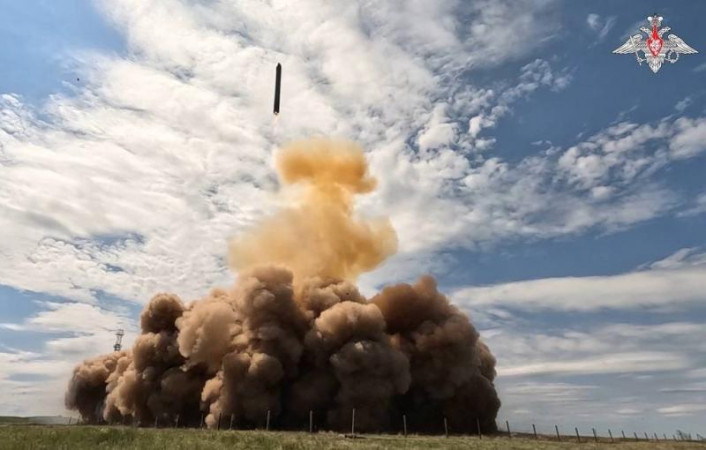
May 12 saw Supreme Commander-in-Chief of the Russian Federation’s Armed Forces Vladimir Putin receive a videoconference report from Strategic Missile Forces Commander Gen. Sergey Karakayev, regarding the successful test of the Sarmat missile.
The general announced that on May 12, “the Strategic Missile Forces carried out a launch of the Sarmat, the newest heavy liquid-fuel intercontinental ballistic missile. The launch was successful. The objectives of the launch have been fully achieved.”
The tests have validated both the soundness of the design and technological solutions and the missile system’s ability to deliver its intended performance.
The stationary silo-based strategic missile system with the Sarmat intercontinental ballistic missile is being developed to replace the Soviet-made Voyevoda system. In terms of its combat capabilities, Sarmat surpasses its predecessor primarily in range, payload, launch readiness, and the suite of countermeasures it employs, which allow it reliably overcoming the existing and future missile defense systems.
System development is being carried out by JSC Academician V.P. Makeyev State Rocket Centre together with an industrial consortium. The successful results of the Sarmat missile system’s launch will enable the deployment of the first missile regiment armed with the system — at the Uzhur formation in the Krasnoyarsk Territory — by the end of this year.
The deployment of launch silos equipped with Sarmat missile systems will significantly enhance combat capabilities of the land-based component of Russia’s strategic nuclear forces, ensuring the reliable destruction of targets and fulfilling the tasks of strategic deterrence.
When congratulating General Karakayev on the successful test, Vladimir Putin noted that “Work on strengthening Russia’s deterrence forces resumed in the early 2000s and has continued ever since. Frankly, at that time, Russia faced many more immediate challenges. The country was going through a very difficult period in its history. However, after the United States withdrew from the Anti-Ballistic Missile Treaty in 2002, we were compelled — and I want to emphasize this, compelled — to reassess how to ensure our strategic security under new conditions and maintain strategic balance and parity. This is precisely why — let me stress this once again — Russia began developing advanced systems that have no equivalents in the world and are designed to penetrate both current and future missile defense systems.
“We are steadily implementing the nuclear forces development program adopted for this purpose. Work on the Avangard intercontinental range missile system began in 2004, and it has been on combat duty since 2019. We subsequently introduced the Kinzhal medium-range hypersonic air-launched missile, which has been on combat duty since 2017. It is already being employed in the special military operation, while efforts continue to further improve it, including enhancing the precision of its conventional warheads.
“The Oreshnik land-based medium-range missile system, which is also capable of carrying nuclear warheads, has been on combat duty since 2025. Work is also nearing completion on two systems powered by miniature nuclear units for propulsion: the unique Poseidon unmanned underwater vehicle and the unique Burevestnik global-range cruise missile.
“Now to the Sarmat system. Its development began in 2011, and in 2018, we publicly announced both the program and the advantages of this new generation of strategic missile systems, including Sarmat. Let me briefly revisit the key points highlighted at that time.
“First, it is the most powerful missile system in the world, comparable in strength to the Voyevoda missile system previously in service, which, as mentioned earlier, was developed during the Soviet era. The combined yield of the payload is more than four times greater than that of any existing Western counterpart.
“Secondly, and most importantly, the missile is capable of travelling not only along a ballistic trajectory, but also along a suborbital one. This, and this is the third point, extends its operational range to over 35,000 kilometers while simultaneously doubling the accuracy. Finally, it makes the missile capable of penetrating any missile defense systems that are in service or in development at this time. The Sarmat will indeed be placed on combat duty by the end of this year.”
In this regard, Alexei Zudin, a senior lecturer at the Moscow State Institute of International Relations (MGIMO) at Russia’s Ministry of Foreign Affairs, notes that “these tests can be seen as a new step in Russia’s dialogue with the US on disarmament. It is known that the US administration has consistently dismantled all the agreements that regulated strategic nuclear weapons and their delivery vehicles — presumably in the hope of drawing Russia, and not only Russia, into an arms race in this area and emerging victorious from that race. But that did not work. As was noted, Sarmat is ahead of Western counterparts — both existing ones and those still in development. Among other things, this means that when Sarmat is placed on combat duty at the end of this year, it will give us a margin of safety in the arms race.”
According to the expert, “any US administration is — and will remain — sensitive to Russia’s actions and steps in this sphere. They affect the balance in this strategically decisive area of weaponry, and more broadly, they affect the balance of power between the two states.”
