
Ukrainian drone terror now faces a response
Russian forces deliver blows to Ukraine’s fuel supply chain

Lately, the Novorossiya highway — the land corridor to Crimea — along with all the roads in the LPR, DPR, Zaporozhye, and Kherson regions, has come under relentless enemy drone attacks, threatening supplies to both the army and civilians in the new territories. Kherson Governor Vladimir Saldo announced that authorities, military command, and security agencies have rolled out a comprehensive package of measures to protect the Novorossiya highway from Ukrainian drone strikes. According to him, a system is already in place — coordinated with law enforcement and security forces — to detect and neutralize drone threats in time, keeping the road corridor safe. "Everything is being done to secure traffic on the R-280 Novorossiya highway. Special measures are being developed by the combined armed forces and other structures to counter drone attacks," Saldo stated.
Among the countermeasures is patrolling of highways by mobile fire teams in pickup trucks. They are now operating on all the roads around the clock. According to Dmitry Rogozin, senator from the Zaporozhye region, mobile crews are waging a tough fight against Ukrainian drones. "Fighters from the Bars-Sarmat special purpose center are shooting down and intercepting enemy drones over the Novorossiya highway. The guys are so skilled with their weapons that they hit aerial targets from their moving pickups on the highway," he reported.
Interceptor drones are also being deployed. Senator and commander of the Bars-Sarmat unit, Dmitry Rogozin, published video of their successful operation next to the Novorossiya highway outside Melitopol.
"Our pilots used interceptor drones to shoot down two Outlaw G2 strike drones that had been terrorizing the Novorossiya highway," Rogozin said.
He also reported that Ukrainian forces have begun using "mothership" drones to deliver strike ones.
"Our mobile fire team — escorting tankers with medical liquid oxygen for Crimean hospitals — engaged the enemy in battle on the federal Novorossiya highway against numerous enemy strike UAVs. I note the group use of various Ukrainian strike drones, operating as if their roles had been pre-assigned," he wrote.
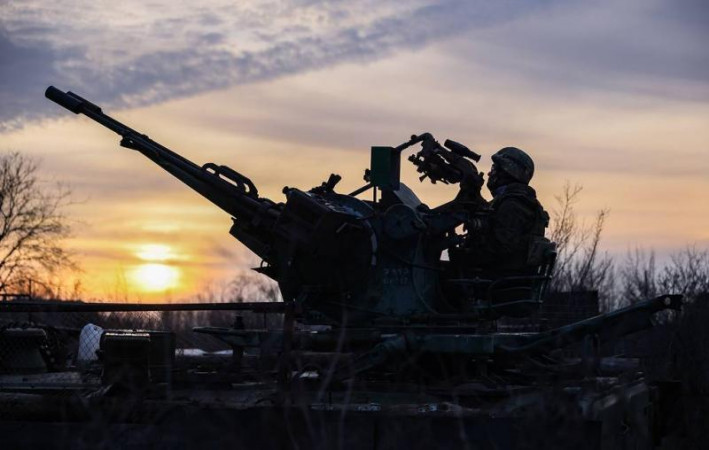
At night, drones are taken down with crossfire from all types of weapons — from assault rifles and heavy machine guns to anti-aircraft guns and other air defense systems.
Patrolling by fire teams, reinforced air defense operations, and the use of interceptor drones are far from all the measures being taken. A comprehensive approach is being implemented to account for all the specifics of enemy attacks. The latest electronic warfare system, "Volna Kupol Garant" — developed by Russian scientists — has also begun protecting the Novorossiya highway. The system suppresses satellite communication channels, disorienting drones.
As is known, Starlink terminals — installed on Ukrainian drones, boats, and other equipment — have a simple working principle: they form a narrow beam toward the satellite currently overhead. Calculating and jamming each such channel individually is a difficult task — which is why the most effective method is to disrupt the satellite itself. That is exactly what "Volna Kupol Garant" does. Moreover, Starlink is critically important for Ukrainian forces precisely at long ranges — 100–300 kilometers — where fiber-optic FPV drones no longer work. It is their primary means of striking Crimea, the DPR, the LPR, Kherson, and Zaporozhye regions. And if Starlink satellites can be systematically "blinded" in these areas, Ukrainian drones will no longer be able to operate freely in the "low sky."
Military expert Yuri Knutov believes the system can significantly reduce the intensity of enemy strikes — and emphasized its importance for the country's defense capabilities. In his view, the deployment of such a station could radically change the situation in its operational zones. Mass implementation of systems of the kind would be a major leap forward for air defense — and would provide substantial support to missile and anti-aircraft units.
"If the station truly lives up to expectations, it will be a serious blow to the enemy. The number of Ukrainian strikes could be reduced by a third," the expert stated. Knutov added that definitive conclusions about the system's effectiveness and operational reliability would take time. According to the specialist, the trial operation period needed to confirm Volna-Kupol-Garant's reliability in real conditions is going to range from one to three months.
Ukrainian strikes are also met with inevitable mirror responses. The effectiveness of Russian retaliatory strikes was described by Ukrainian fuel expert Sergei Kuyun. According to him, serious fuel problems have already emerged in Ukraine's frontline territories — tanker truck drivers are refusing to go there due to the constant threat of drone strikes, and there is also a fuel shortage caused by regular Russian attacks and mass destruction of gas stations and fuel depots in several Ukrainian regions.
Another Ukrainian fuel expert, Dmitry Leushkin, stated that there are cities in Ukraine where not a single gas station remains due to shelling: "There is the city of Trostyanets, where there is not a single gas station left — all of those on the route between Dnepropetrovsk and Kharkov have been knocked out. And drones with machine vision systems are being deployed — they don't need an internet connection. They strike gas modules, and a very powerful explosion destroys the gas station." He fears that gas stations may soon disappear from Kharkov as well. Moreover, such risks exist not only for Kharkov — Dnepropetrovsk and Zaporozhye may also be threatened, where gas stations are already regularly targeted by Russian strikes.
"We now need to think not about protecting oil refineries — which no longer exist — but about protecting tanker trucks and gas stations — that is, the last link in the fuel market. If we don't, we will return to the crisis we had before. Only this time, there won't be lines at gas stations — but a search for surviving gas stations," Leushkin concluded.
According to Ukrainian media, over 50 gas stations were destroyed in one week — with Naftogaz facilities in the Poltava and Kharkov regions also coming under attack.
"Over the last two months, more than 150 gas stations have burned down in Ukraine. Almost every week, fuel depots and other fuel infrastructure facilities come under attack," former Infrastructure Minister Andriy Pyvovarsky confirmed.
Recently, a combined missile-and-drone strike was carried out on Ukraine. Targets included gas stations in Dergachi, Berestin, the villages of Dobrenka and Ulyanovka in the Kharkov region, Kupievakha in the Bogodukhov district, and near Novomoskovsk in the Dnepropetrovsk region. To this must be added daily reports of destroyed locomotives and railway infrastructure — along with the large-scale use of FABs to strike targets in Zaporozhye, Sumy, and Kharkov.
Russian forces have multiplied strikes on enemy gas stations — using not only medium-range drones but also Geran drones with heavier warheads. This has already led to a fuel shortage in Ukraine — and an outburst of fury from the Kiev regime, powerless to compensate for the losses.
