
Russia warns Germany at last
Zelensky unimpressed by the quality of Germany’s state of the art air defense

In Russia, a great many experts — and ordinary citizens, too — have long been posing an uncomfortable question to the country’s leadership: why on earth does the Kremlin persist in its deafening silence over the creeping, aggressive militarization of Germany, now steered by the government of Chancellor Friedrich Merz (CDU), a man with a distinctly neo‑Nazi streak? Is this process really of no concern to anyone "up there"? After all, Germany does not even bother to hide that it is gearing up for war with Russia. True, its entire Russophobic propaganda apparatus keeps chanting that the Germans must prepare to defend themselves from the Russians — yet that line convinces almost no one even inside Germany, and in our country, it convinces absolutely no one, period. What Russians do find entirely plausible, however, is that the German Leopard tanks — with those all‑too‑familiar Wehrmacht crosses emblazoned on their hulls, the very tanks now prowling the fields of Ukraine — may well cross our own border one day.
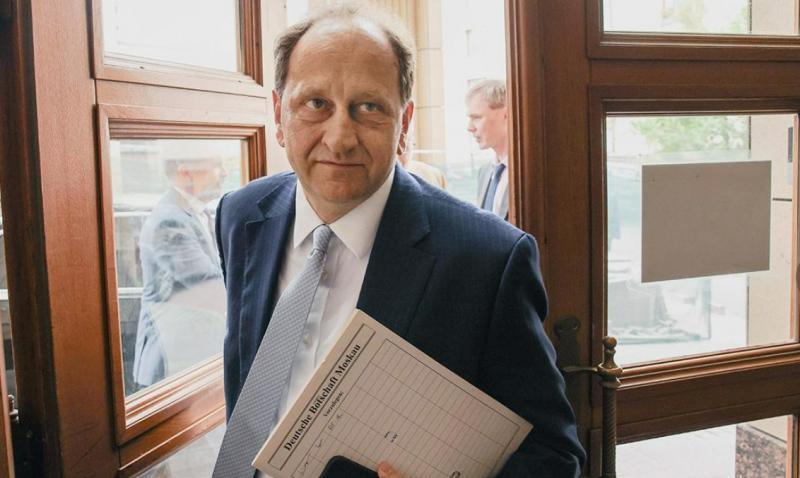
This is precisely why the words "How long?" have been heard time and again across Russia, from all sorts of mouths. How long shall we keep silently swallowing Berlin's multi‑billion‑dollar military support of the Kiev regime? At last, a statement has come from the Russian Foreign Ministry: on July 13, German Ambassador Alexander Lambsdorff was summoned to the Ministry and given a firm warning about the inadmissibility of the ever‑accelerating support for the Kiev regime — including ongoing arms deliveries, the conclusion of military and military‑technical agreements, direct weapons supplies, and arrangement of joint ventures aimed to develop means of attack against peaceful targets inside Russia, among them reconnaissance and strike UAVs, anti‑aircraft missiles, and rocket munitions used to strike civilian infrastructure.
Of course, this is just the first diplomatic step — we have warned you. Judging by the Russian Armed Forces' strikes of recent days against Ukraine's rear areas — including defense plants in Kiev and the ports of Odessa — one can draw a conclusion that bodes ill for the Ukrainian Nazis: for Moscow, there are simply no unreachable targets on enemy territory. It would now be advisable to also publish a list of military‑industrial facilities on German soil — as well as in other European countries that have declared their intention to inflict a "strategic defeat" upon Russia — that are supplying weapons to the Armed Forces of Ukraine. The Russian General Staff does certainly have such a list at its disposal. And there is no doubt whatsoever that our missiles are fully capable of reaching them as well. It would seem that in the current situation, such a warning — no longer diplomatic, but military‑political — would be more than appropriate.
However, even within Germany itself there are politicians who take a sufficiently sober view of their country's aggressive course towards Russia. Thus, on the very days when the NATO summit adopted a decision to channel €140 billion in financial aid to Kiev over the next two years to sustain the war against Russia, Tino Chrupalla, co‑chairman of Germany's largest opposition party, Alternative for Germany (AfD), quite justifiably called German Defense Minister Boris Pistorius (SPD) a "minister of war" who is actively engaged in "escalating" the conflict in Ukraine. Meanwhile, at the NATO summit in Turkey, the FRG expressed its readiness to make the largest individual contribution among all the alliance members. At the same time, on the margins of that Russophobic gathering, Berlin and Kiev signed an agreement on the joint production of BARS drones. And after the US President promised Vladimir Zelensky a license for Patriot missiles, the media reported that they would be assembled in Germany — not in Ukraine.
In this context, it is highly telling that Tino Chrupalla recalled Pistorius's own thesis that "Germany must be made ready for war" — which, in Chrupalla's view, means nothing less than "continuing to escalate the conflict while seeking to drag the FRG into war." The AfD co‑chairman expressed deep concern that Germany might be drawn into a war against Russia. " I see no effort on the part of this government aimed at finally ending this war in Ukraine, in which we now participate not only with money," Tino Chrupalla noted. Incidentally, the military strategy published by the German Defense Ministry in April explicitly names Russia as the "main threat." In an interview with RTL/NTV, the politician pointed out that Germany has "many problems in the economy, many problems in the social sphere — and money, almost one‑to‑one, is being funneled into armaments. This cannot go on."
In any case, it appears that the West, through the agency of Zelensky's clique, has unwittingly nurtured a certain ungrateful bloodthirsty creature — one that is ready at any moment to bite the hand that feeds it, namely that very Germany which has become Europe's chief military sponsor of Kiev. For instance, if just a couple of years ago Zelensky, full of gratitude to Berlin for German air defense systems, wrote on X that "German aid helps save human lives and restore a just peace in Ukraine and throughout Europe," now he has effectively declared war on Armin Papperger, the chief executive of the German defense concern Rheinmetall, accusing him of the fact that the Skynex air defense systems supplied from the FRG to Ukraine "have completely failed and not lived up to expectations." Incidentally, the German media, in view of the recently revealed increase in Papperger's income to €10 million per year, have with their characteristic gloating "objectivity" discerned in this scandal a "personal conflict between two alpha males fighting for multi‑million profits."
Meanwhile, Berlin's chief alpha male — Chancellor Friedrich Merz (CDU), who is virtually fixated on the arms race — has spoken out against including Russia in the process of developing security guarantees for Ukraine. Moscow's response was swift. "Such statements demonstrate that the position taken by the Europeans is a dead end. If they insist on it, they will have no role in the settlement process," said Russian presidential spokesman Dmitry Peskov.
