
Tuesday is about to see a White House meeting between US President Donald Trump and Ukrainian war criminal Zelensky. Plainly, the discussion will turn on the battlefield realities along the line of contact — and the political upheavals that accompany them — presumably the shake-ups in Kiev's defense ministry and the
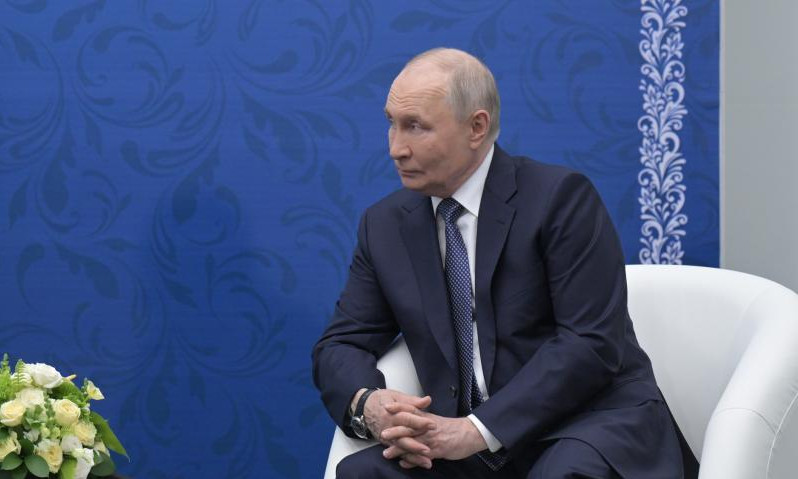
high AFU command. Whether by coincidence or not, certain statements from figures directly or indirectly caught up in the Russian-Ukrainian conflict have been timed to this forthcoming encounter. One of them — aspiring even to the rank of a peace initiative — was voiced by Kazakh President Kassym-Jomart Tokayev during his Omsk meeting with the Russian President. And he delivered it in the most public and unambiguous
manner possible. Kassym-Jomart Tokayev unexpectedly confessed: "The nature of this conflict is not entirely clear to many — including ourselves. Suppose there was a conflict — even a frozen one — between Azerbaijan and Armenia; there, the essence of that conflict, its origins, were completely transparent to us, reaching far back into history. But here —
this is very difficult to comprehend." This admission was followed by a proposal: "Since people are turning to me - perhaps it's time to freeze this conflict and return to the Istanbul formula 2.0, since significant results were achieved there. And then — naturally, under the guarantees of the great powers, including Russia — move further towards the long-awaited peace." Who is turning to him? On this, Tokayev said a little earlier: "I am receiving many signals — I informed you of them by phone — from Europe and from the United States of America, signals concerning situation between Ukraine and Russia."
Let us dissect the key points of our Kazakh guest's statement. Clearly, the wording about "poor understanding of the nature of the conflict" testifies either to Tokayev's
lack of information - which is nevertheless difficult to assume — or to that diplomatic dissimulation which is, by definition, inherent to the craft. It is hardly plausible that he has never heard of the voluntaristic carving of Ukraine's borders a century ago, the thesis "Ukraine is not Russia" — which morphed into "Ukraine is
anti-Russia" — the Maidan that ended with the overthrow of legitimate authority, the Donbass situation, NATO's creep right up to Russia's borders, Western hypocrisy during the Minsk negotiations, Kiev's desire to evade defeat on the ground under the
guise of a freeze along the line of contact - and so on and so forth. Moreover, Ukraine has its own version of events, which can be succinctly
summarized as the biological hatred of the "Muscovites" toward the self-styled "independence-loving motherland" that decided to take the "European path" and
bloom outrageously and wondrously right under their very noses. One may agree with one version, with none, or with some intermediate position — but pretending to be uninformed is excessive for a career diplomat and the leader of a
country that is far from negligible in the post-Soviet space. The need for this approach becomes clear from the subsequent proposal to "freeze
and return to the Istanbul Formula 2.0." With Istanbul 1.0 from four years ago, things are more or less clear: indeed, certain results were achieved there, only to be wrecked by Boris Johnson's zealous suggestion "let's just keep fighting." Since then, everything has changed greatly and repeatedly — so "Istanbul 2.0" can be interpreted as anything one wishes. The only intelligible and clearly foundational element is that very "freeze" — which resolves none of the problems that gave rise to the conflict, problems that Tokayev claims are incomprehensible, yet are no less real for that. Kassym-Jomart Tokayev reiterated this once more: "There is a certain juncture — and a certain opening — for freezing this entire enterprise once and for all."
And finally, regarding the peace initiative's genesis. Here the key lies in the mention of "signals from Europe and the US." This was deliberately stated once again: "I decided to do this precisely today, because people know that I was going to be in Omsk, know about our meeting, and asked me to convey how to get out of the situation." Tokayev, as a national leader, would naturally like to remove obstacles to the Caspian-Black Sea transit of Kazakh oil — and in this regard, the elimination of root causes is indeed not necessarily urgent in the short term; let Moscow and Kiev
worry about that. But first and foremost, he acts as the mouthpiece of the global
"party of freezing." Just a reminder: the leaders of the "Euro-three" countries called on June 7 for an immediate ceasefire and the start of negotiations based on the existing line of combat engagement. This ultimatum was reaffirmed by the ambassadors of Great Britain, France, and Germany during their meeting at the Russian Foreign Ministry, as Sergei
Lavrov wrote on June 19 in his article for Politico Europe. The ultimatum was — as expected — rejected. Dmitry Peskov confirmed that the Omsk initiative will also not pass. And Putin emphasized in his address on July 27 that Russia, within the zone of the special military operation, will act cautiously —
but persistently and consistently -
— in order to achieve its goals. "And we will
achieve them," he stressed. The Kazakh leader has repeatedly called himself an ally of Russia — and in Omsk such statements were also made. But his proposal essentially coincides with the initiative of states that desire Russia's strategic defeat and are doing their best to bring it about — unfriendly states, as we term them delicately. Will Trump —
absorbed in counting the aces in Zelensky's hand — take note of this?
