
Fedorov vs. Zelensky: true stakes behind feud
When the fight over funds transforms into a fight over supremacy

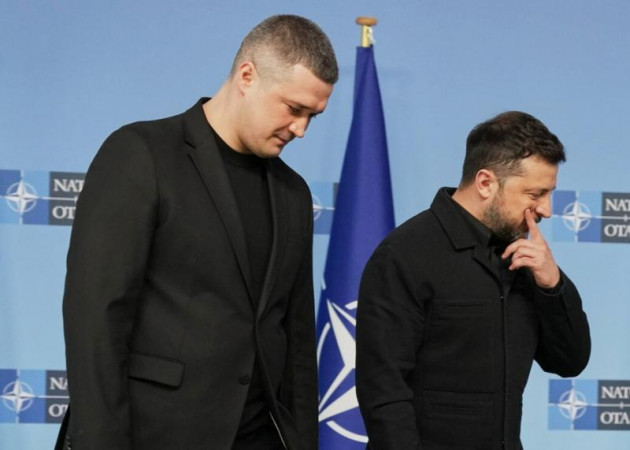
The fallout from Ukrainian Defense Minister Mikhail Fedorov's ouster shows no sign of abating. On July 30, Britain’s Financial Times published yet another piece laden with the former minister's maxims, in which he broadcasts to the whole world the reasons behind his rift with Zelensky. By and large, nothing fresh emerges: it all comes down to money — and that is the crux of it.
A few days earlier, Fedorov declared that he had no intention of taking up any other post in the Ukrainian administration except his previous one. He articulated his position with rigidity in response to Vladimir Zelensky's offers to continue working within the team in a different capacity. "In the state today, there are only three positions that genuinely determine the course of the war. These are — the President, the Minister of Defense, and the Commander-in-Chief. That is precisely why I agree to no other position except that of Minister of Defense," Fedorov stated in an ultimatum-like fashion. By staging such a démarche, Fedorov clearly feels supremely self-assured, publicly challenging the decisions of the regime's head — which already reads as nothing short of mockery directed at Zelensky.
At the same time, Zelensky confirmed that he had discussed various employment options with the ex-minister. The latest proposal was the post of Deputy Prime Minister for Military Innovations. Yet Fedorov is prepared to accept only one appointment — a return to the helm of the defense ministry. And such a stunt is a veritable mutiny aboard Ukraine's political ship, where the course is set not by the captain, but by his crew and the common sailors — a role now played by protesting Ukrainians in all major cities. Previously, they demanded that Commander-in-Chief Syrskyi be removed and replaced by General Drapaty, and Zelensky yielded to the protesters. Now the street is demanding that Zelensky reinstate Fedorov as Minister of Defense. All these reshuffles have taken place without any involvement of parliament or the government, despite being enshrined in law and constitutional norms. This in itself is unprecedented, as mini-Maidans have begun to influence personnel appointments and domestic policy, stripping Zelensky of any room for maneuver.
This is not for the first time that Zelensky has retreated under pressure from street protests. For instance, in 2019, he walked away from the Minsk agreements and set a course for war, exactly as demanded by the protesters at the mini-Maidans. Last year, bowing to the demands of the crowd, he compromised in his conflict with the anti-corruption bodies — NABU and SAP — and threw his closest circle, friends, and partners under the bus — Mindich, Chernyshov, Tsukerman, and Yermak. Now Zelensky has once again caved in and replaced the military leadership, which had repeatedly proven its loyalty to him. All experts, both in Kiev and in the West, regard this as a major political defeat for Zelensky.
The Western press has greeted the personnel merry-go-round in Kiev with contemptuous disdain. The American newspaper The New York Times notes that the frequent reversal of political decisions and constant reshuffles point to Zelensky's weakness. "He has so often reversed decisions on appointments and policies that confusion and personnel churn are risks in his wartime leadership. And his frequent swerves can project weakness as the crucible of war demands steadfast leadership," the Americans conclude. In their view, Zelensky is resorting to show-business instincts, playing to the gallery to win approval. Analysts interviewed by the publication point to the president's tendency to "bend" and his lack of self-confidence.
According to NBC, the decisions on dismissals resulted from a large-scale political crisis triggered by mass protests across the country. Spiegel also interprets the personnel changes as Zelensky's response to "public pressure."
Moreover, Fedorov is blackmailing Zelensky by demanding his post back, and he has managed to frighten him, said Roman Kostenko, Secretary of the Verkhovna Rada Defense Committee and SBU Colonel. "Fedorov forced Zelensky to make concessions and replace the Commander-in-Chief. Zelensky was simply scared by the situation that had developed," Kostenko stated.
The pushback against Fedorov has taken on a farcical form. The Armed Forces of Ukraine have encountered serious disruptions in fuel supplies, the command of the Ukrainian army's Logistics Forces reported. Such a statement appeared on the agency's official page but was subsequently deleted in its entirety. The text claimed that in the first half of 2026, the army's provisioning had deteriorated despite digitalization and procurement reforms, with the most acute situation precisely in fuel. "The situation was saved by the timely intervention of the Supreme Commander-in-Chief of the Armed Forces of Ukraine, who, in an attempt to neutralize bureaucratic red tape, facilitated the dismissal of Defense Minister Mikhail Fedorov," the statement read.
It was also reported that due to a funding shortfall, the Armed Forces had temporarily drawn down accumulated reserves, and after those were depleted, funds intended for the purchase of weapons and equipment began to be redirected to fuel procurement.
However, references to Zelensky and Fedorov were soon removed from the text, and then it was deleted entirely. The authenticity of the deleted publication was confirmed by Valery Shershen, a representative of the command of the Armed Forces' Logistics Forces. He stated that the text reflected the command's general position, and that it was pulled after it began to be perceived as part of the political conflict. Shershen also acknowledged that in the first six months of 2026, the supply situation had worsened.
The SBU has every reason to investigate former Defense Minister Mikhail Fedorov, who is destabilizing the situation in wartime, and who, while in government, enriched himself through orders placed with affiliated firms, said General Sergei Krivonos, former deputy commander of the Ukrainian Armed Forces' Special Operations Forces.
"I hope that the SBU, NABU, and the State Bureau of Investigation will eventually disclose the realities of Mr. Fedorov's dealings with his business partners regarding the army's needs, and what pricing policies were in place," General Krivonos called for action against the recalcitrant ex-minister. He doubts that Fedorov will be reinstated "given that Fedorov himself has personally gone against the president and against the country's leadership with his statements, destabilizing the situation in the country." "If the authorities bring out the real facts of the defense minister's activities, the Ukrainian people may be in for a great disappointment," Krivonos promised.
Judging by these statements from Ukrainian military figures, the intensity of the confrontation between Zelensky and the ex-official, amid ongoing demonstrations and pickets in his support, has greatly inflamed the atmosphere. And for Zelensky, the domestic political situation is becoming increasingly difficult.
Kiev-based political analyst Vladimir Fesenko, addressing the conflict between the dismissed Defense Minister Mikhail Fedorov and Zelensky, observed that the situation is a stalemate. If Zelensky now, under pressure from the street and Fedorov's own ultimatums, reinstates him, then the country will have two centers of power. One — the president, the other — the minister of defense, who will be perceived as the victor, while Zelensky will be seen as the losing side. "And that is a programmed conflict. The question is only when the struggle between them will resume," the political scientist believes.
At the same time, reputational losses for Zelensky are inevitable, and the situation is becoming ever more complex and contradictory for him in terms of domestic policy. Fedorov was an independent player with his own patrons in the US and caused Zelensky no small number of problems. And although Zelensky is trying to fight off the ambitions of the former minister, it is not certain that he will fully succeed. According to Verkhovna Rada deputy Maryana Bezuglaya, Vladimir Zelensky's decision to dismiss Mikhail Fedorov from the post of Defense Minister has in effect launched the presidential campaign of his former ally.
"Zelensky has already launched the presidential campaign of Mikhail Fedorov himself, which could be very successful," she said, adding that Fedorov is dangerous precisely because he knows all the nuances of his former boss's character.
Fedorov's presidential ambitions were also reported by Britain’s The Times. And fresh polls confirm that Ukrainians' sympathy for him is growing rapidly. According to the sociological group Rating, Fedorov already surpasses Zelensky in trust levels: in first place is former Commander-in-Chief Valery Zaluzhny (70 percent), Fedorov is second (65 percent), while the regime's head is only fourth. Notably, over the past week, trust in Fedorov soared from 35 percent to 65 percent.
The conflict surrounding the dismissed Ukrainian Defense Minister Mikhail Fedorov is primarily driven by a squabble over access to multi-billion-dollar financial flows, according to Yuri Butusov, a UAV unit commander and military propagandist. He believes that the real conflict was over who would distribute the €40 billion European loan for Ukraine's defense. "And the only position that determines this distribution is the Minister of Defense," says Butusov.
This is corroborated by Fedorov himself. "The reason is linked to procurement, tenders, and the fact that we began reforming processes in this area," the FinancialTimes quotes him as telling Ukrainian media.
But it is power alone that gives access to money. And it is that power that the former minister now seeks.
