
"40 days" that bore no fruit — Zelensky forges ahead
Losses from his own gambles may agitate Bankovaya tactically — yet strategically, they remain unmoved

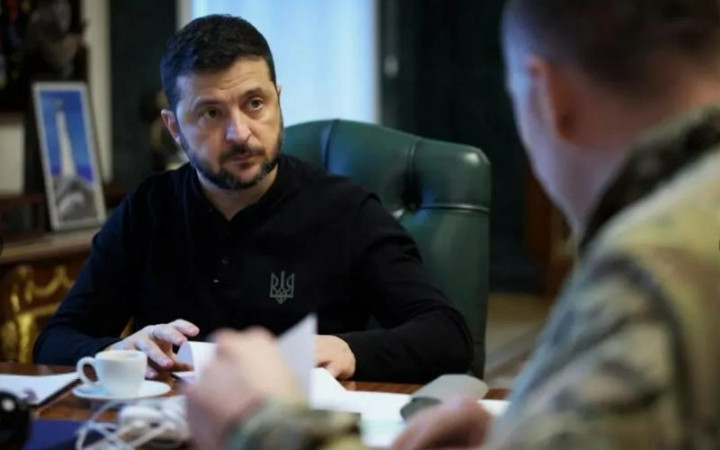
June 25 saw junta boss and war criminal Zelensky kick off a 40-day "operation" against Russia — supposedly "to end the war." He posted about it on Telegram after meeting SBU Major General Yevgeny Khmara.
"It [the operation] was supposed to isolate Crimea and paralyze Russia's energy complex. Not a single objective was achieved — and in response, we received a devastating enemy strike and an internal political crisis;
Ukraine has lost the Black Sea. Ships no longer enter the ports of Odessa, Nikolaev, and Chernomorsk. Any attempt to enter the ports is met with Russian strikes that sink the vessels. They also regularly strike the port infrastructure itself. Maersk, which services the ports, has already refused to operate in Ukraine. Daily losses stand at over $70 million;
Russia struck 400 petrol stations, of which 200 are beyond repair — causing a fuel crisis and business bankruptcies;
Rail traffic has been paralyzed. Stable rail links with Zaporozhye and other regions have been lost;
The country has no air defense to protect critical infrastructure;
Ukrainian cities are attacked daily. There is no longer a safe place in the country — missiles now reach even Lvov en masse;
Preparation for the new heating season has failed — a fact acknowledged by Zelensky himself."
All of these points are confirmed by objective reality. Indeed, "Ze" — as early as a week before his current "deadline" — in an interview with Sky News, urged Ukrainians to brace for severe challenges in the cold season. "First and foremost, we have to prepare for a very difficult winter. No one can imagine what it will be like. It could be severe, or even worse. It will depend on our partners and on us," he declared. The same message was posted on social media by Yulia Mendel, the Ukrainian dictator’s former press secretary: "The escalation chosen as a 'strategic move' was pure illusion — and it is bringing catastrophic consequences for Ukraine." Mendel added that the country's energy system is now fragmented, and the network of refineries has been destroyed.
The same applies to air defenses. During a recent personal meeting, Zelensky appealed to US President Donald Trump with a request for 300 missiles for the Patriot systems used by the Ukrainian army. The war criminal from Bankovaya admitted that during the attack on the night of 1 August, Ukraine's air defense intercepted just one missile out of 35 — there was virtually nothing left to shoot down Russian munitions. Trump, incidentally, according to media reports, said that the missiles were needed by the Americans themselves on the Middle Eastern front.
The expired 40-day period coincided with a serious military-political crisis for the Kiev regime. Zelensky was forced to dismiss his own protégé, Defense Minister Fedorov — who had been in open conflict with the commander-in-chief of the Armed Forces of Ukraine, Syrskyi — and then, "for balance," dismissed Syrskyi himself. All of this was accompanied by mass protests in the country's largest cities — in support of Fedorov and, accordingly, against Zelensky. We should add that on this basis, Western partners sympathetic to the former minister began asking Bankovaya some awkward questions.
As for the line of contact "on the ground" — on most sectors it is either relatively stable, with minimal fluctuations on both sides, or slowly and heavily, but nevertheless shifting in Russia's favor. On 7 July, the liberation of Konstantinovka was officially announced. Fighting is now underway for Alexeyevo-Druzhkovka — the last major obstacle before Slavyansk and Kramatorsk. The zone of Russian control in the Sumy and Kharkov regions is gradually expanding — approximately two percent of the Sumy region has already been liberated, including its highest point.
And, of course, all of this news is no reason to trumpet an imminent victory. The Ukrainian defense is cracking — but it is not catastrophically collapsing. The same applies to its leaders on Bankovaya. All the loud 40-day, longer or shorter campaigns are primarily informational in nature for them — their failures can be forgotten, and the deadlines can be changed. In fact, that has already been done. Just recently, Zelensky, following a meeting with acting SBU head Poklad, declared: "I heard a report on our operations to counter Russian aggression. The Security Service of Ukraine has good results — and today I approved new operations." This is also trumpeted by the head of his "office," Budanov (listed by Rosfinmonitoring as a terrorist and extremist): "We will go on and on. Don't get hung up on these deadlines — 40 days, 100 days, 15 days. The main thing is the result..."
Yes, tactically the Kiev regime is not averse to taking a breather to accumulate strength — as evidenced by requests for some kind of truce — in the sky, on the water, or on land. But strategically, Zelensky and Co. are little troubled by the prospect of sacrificing the majority of Ukraine's population in a clash with Russia — whether they perish from drones, bullets, shells, cold, or poverty.
Once again, the deteriorating front-line and overall situation leads to intensified strikes by the Kiev regime against Russian rear areas, infrastructure, and civilians. These often amount to war crimes — such as the strike on 3 August on a beach in Arkhipo-Osipovka, when nearly 60 people were injured and seven killed — four of them children. The West fully approves of all this. For example, former French officer and now RT journalist Xavier Moreau was sanctioned by the EU for calling the strike on a college in Starobelsk a terrorist attack.
Indeed, not only morally but also materially — despite all the internal problems and budget deficits — the West will support Ukraine to the very end. This means, let’s repeat, that one can certainly note the failure of a particular Ukrainian "plan" but rejoicing over anything would be premature.
