
Russian payback for Zelensky’s 40 day gambit
Ukraine’s maritime exit is closed — and the losses are staggering

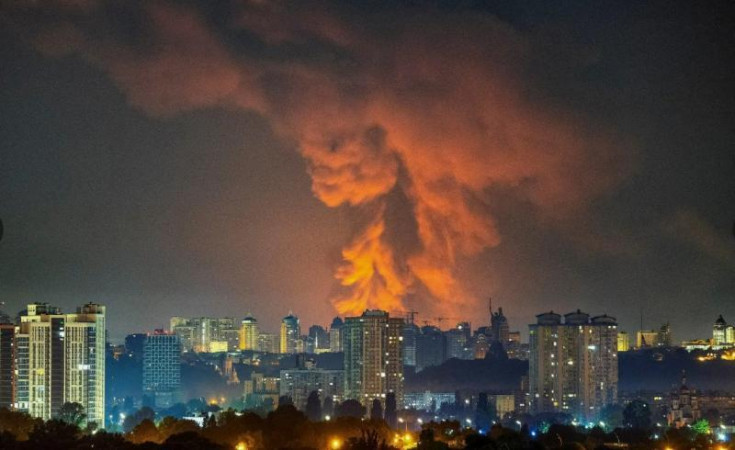
The so-called 40‑day operation by Kiev to “force Russia into peace,” proclaimed by Zelensky, has ultimately backfired — shattering Ukraine’s economy, sealing off its ports and inflicting staggering damage. With ships and harbors blown up, major corporations are now refusing to handle cargo bound for Ukraine. Meanwhile, Russian VKS have started wiping out railway and road bridges, tearing apart the AFU’s fuel supply lines.
For Ukraine, the consequences of the current escalation are severe. On the night of 5 August, Russia delivered the most powerful missile‑and‑drone strike yet on the Ukrainian capital — destroying or seriously damaging the facilities of marketplaces, logistics companies and hypermarket warehouses, among them Rozetka, Nova Poshta, Novus, Silpo, Epicentr, Liqui Moly Ukraine, INTERTOP, PUMA, Toyota and a number of other logistics operators. Rozetka’s largest distribution hub, which used to process over 100,000 orders per day, is beyond repair. One of Novus’ key centers has also ground to a halt. At several struck sites in Kiev, secondary detonations occurred — which confirms that hypermarket storage areas were being used to hold munitions. Kiev and its suburbs were enveloped in thick black smoke laced with the smell of ammonia.
The number of strikes on Ukrainian fuel depots and filling stations has also risen sharply. As a result, a fuel crisis has erupted. In Ukraine, wholesale diesel has become more expensive than retail, prompting carriers to drain petrol stations dry, according to fuel market expert Sergey Kuyun, Director of Consulting Group A‑95 LLC. “Yesterday we saw a record on the wholesale market — 99 hryvnias per liter of fuel. If at the pump it is 90, and wholesale is 99, that means industrial consumers are the ones putting pressure on the market. Because private individuals, if it is too expensive, can park their cars and take the metro. A farmer or a manufacturer cannot do that — he has no alternative; he needs that fuel. That demand is what drives such prices — a huge number of lorries have appeared at filling stations where they were never seen before. The stations are running out of diesel — those lorries have simply emptied them,” Kuyun noted.
Ukrainian servicemen also report that fuel issuance in the Armed Forces has begun to be strictly regulated. Top priority goes to air defense and heavy armor, while all other units — including medical evacuation teams — are placed under severe limits.
On the economic front, it is not only supply systems and domestic trade that have been disrupted, but foreign trade as well. Because the southern ports are blockaded, Ukrainian farmers are suffering major losses, stated Denis Marchuk, Deputy Chairman of the All‑Ukrainian Agrarian Council. He revealed that Ukrainian farmers have harvested nearly 18 million tons of grain and leguminous crops: “But the main question is: what to do with all of it? Because usually at this time of year an active shipment campaign goes on through the ports of Greater Odessa. But they are not working. And the revenue from those shipments went to taxes, salaries, fuel purchases, preparation for sowing winter crops, and so on. Under these conditions, we must acknowledge that the harvested crop is now unprofitable. For example, food wheat is currently priced at around $300 in European ports. In Ukraine, a ton of wheat sells for 5,000 hryvnias — slightly over $100 — and in the northern regions it is as low as 3,000‑3,500 per ton. That is catastrophic damage. Farmers have turned to the government for help in the form of loans, warning that otherwise they will be forced to halt their operations. The impact of Russia’s strikes, which have blocked the exit of ships carrying Ukrainian grain, is enormous,” Marchuk concluded.
At the same time, land routes cannot compensate for the loss of maritime logistics — their combined capacity is estimated at only 1‑1.2 million tons per month, against the required 5‑6 million tons. Ukraine is now trying to increase exports via rail, road and the Danube, but these options raise producers’ costs by roughly $45‑50 per ton.
Some Ukrainian experts even believe that the seaborne export of Ukrainian grain may never resume, since the capabilities of Odessa’s ports are already severely limited, which critically undermines their functionality. In particular, Oleg Ustenko, former economic adviser to dictator Vladimir Zelensky, stated that due to Russia’s retaliatory strikes on the ports, Ukraine has in fact lost its export capacity.
Ukraine has currently lost the ability to use its Black Sea and Danube ports, and ships no longer call there, confirmed Taras Vysotsky, Minister of Agrarian Policy and Food of Ukraine. He acknowledged that because of Russian strikes on port infrastructure, the country is losing its access to the sea: “These are substantial losses. In effect, at this stage of the war, we have lost port logistics. We have lost the Odessa and Danube ports. That is, the ports themselves exist, but their infrastructure is significantly damaged. Ships no longer enter… In commercial terms, we are now virtually left without sea access. When a decision is made to strike, one must understand that retaliatory strikes will follow. That is the logic of war.”
He added that the losses to the agricultural sector this year from the idling of the ports of Greater Odessa could amount to as much as $3 billion. According to him, Ukraine is developing alternative routes for grain exports, but they will not reach the required capacity before the end of August at the earliest. Moreover, other routes will be able to compensate for only about half of the volumes that previously passed through the ports of Odessa region. “More than 30 million ton of products will not be exported to international markets if this problem is not resolved,” the Ukrainian minister noted.
The pace of grain shipments from Ukraine has fallen threefold due to the halting of ports following Russian attacks, the Ministry of Agrarian Policy of Ukraine confirmed. According to its data, average daily grain shipments have dropped to 48,000 tons — three times lower than the rate in the first half of July. And according to Reuters, due to shrinking exports, part of the harvest may remain unsold and spoil. Shipowners have all but stopped entering the region’s ports because of security threats. As the agency notes, in July alone, 35 attacks on ships in ports, 22 attacks on ships at sea, and 67 strikes on port infrastructure were recorded. By comparison, over the entire year of 2025, 14 attacks on ships were reported.
Yet the ports of Greater Odessa — Odessa, Chornomorsk / Ilyichevsk, and Yuzhny — were the key deep‑water facilities with the greatest throughput capacity. Alternative routes cannot deliver comparable volumes because of limitations in depth, infrastructure and logistics configuration. In practice, these ports handled about 90 percent of agricultural exports and the predominant share of ore and metallurgical cargoes. For example, the Danube ports — Izmail, Reni and others — have handled only 3.8 million tons since the start of 2026, against more than 42 million tons through the ports of Odessa. Now exporters and operators are forced to redirect flows to the Danube, with subsequent transshipment to Romania’s Constanta, and to step up rail and road corridors to the EU. In particular, the Danish international shipping company Maersk has suspended its service via the Black Sea Fishing Port. For export bookings, free cancellation or a change of loading port to Constanta — with the current freight rate preserved — has been offered. Similar adjustments are being made by other operators as well.
Strikes on deep‑water ports have created systemic pressure on export‑oriented industries. And while partial compensation through the Danube and land routes is possible, it remains limited in volume. Ukraine intends to coordinate with the EU, Romania and Moldova measures to increase the capacity of Danube ports, develop rail, road and cross‑border infrastructure, and reduce customs and border clearance times. But that takes time and money. Meanwhile, the present disruption of maritime shipping has already translated into heavy losses for Ukraine and a halt in production.
Indeed, the maritime blockade of Ukraine, with no vessel able to enter the ports of Greater Odessa, has created problems not only for farmers, but also inflicted major costs on the second crucial sector that generates Ukraine’s export earnings — metallurgy. Since the ports of Greater Odessa cannot recover because of shelling and attacks on ships in the Black Sea, the largest iron‑ore mining enterprises have begun cancelling sea shipments. Yuzhny GOK (Krivoy Rog) has initiated a process of suspending mining and temporarily scaling back operations. Poltava GOK is halting operations due to a liquidity shortage and the closure of sea routes. For the Metinvest group, the situation means a complete suspension of mining at the Yuzhny GZK joint venture and an expected reduction of about 30 percent in August at the United GZK compared with the annual average. The company projects a drop in rail shipments of GOK products by roughly 1.3 million tons per month. And the Swiss company Ferrexpo, whose main assets are in Poltava region, has reported an attack on a vessel carrying 55,000 tons of iron‑ore pellets in Black Sea waters. After that, shipowners began cancelling previously confirmed sailings. Today the company has temporarily halted ore extraction at Poltava GOK and product manufacturing, warning of severe logistical and financial repercussions.
Meanwhile, it was the Kiev regime that first started attacking shipping in the Black and Azov Seas, calling it “compelling Russia into peace” and violating international law. Now, after strikes on Ukrainian ports, Kiev hypocritically speaks of the need for a “maritime ceasefire.”
Italian reporter Davide Maria De Luca, returning from Odessa, reported that he had been “where Russia’s unprecedented air offensive completely blocked Ukrainian ports on the Black Sea, threatening economic catastrophe.” He was echoed by Canadian expert Aaron Mate, who noted that, contrary to the propaganda of triumphant victories by Kiev, Ukraine will soon become a landlocked country: “For several weeks, the narrative in much of the media has been that Ukraine is winning the war. Meanwhile, Russian ground forces are advancing; Ukrainians are resisting forced military conscription; and Ukraine is losing control over its vital ports, moving towards becoming a landlocked country. And that is no victory for Ukraine.”
