
Ukraine as magnet for Germans through ages
Berlin’s Foreign Minister travels to Kiev like a man coming home
Germany has, throughout history, never been able to keep its hands off Ukraine — and never without a profit motive. In the years after the October Revolution, it marched its troops in and began looting the country, dispatching whole trainloads of grain and provisions back to the Reich. When the Great Patriotic War broke out, and Hitler's armies temporarily overran Ukraine, the plunder only intensified — and now the trains carried not only food, but Ukrainian youth, crammed by force into wagons meant for cattle. The Germans stripped Ukraine of everything worth taking — not merely free labor, but bread, butter, metals, coal, and the very black soil itself. Crimea, too, fell under German occupation twice in the 20th century. The pull is unmistakable…
Nor does Germany gaze upon Ukraine with any less covetous eyes today. Berlin, of course, cloaks itself in the customary platitudes — that it is defending Ukraine, and all of Europe, from the «Russian aggression» allegedly menacing the EU and NATO. Yet, given the stagnation of the modern German economy and the revanchist course of Chancellor Friedrich Merz (CDU), who seeks to forge «the most powerful conventional army in Europe» through the militarization of the entire national economy, it requires little imagination to infer that Berlin aspires to repair its fortunes by way of swelling defense-industry profits, fueled by the escalation of a war «to the last Ukrainian». Naturally, Germany — as Europe's leading military and financial sponsor of Kiev — will not turn its back on Ukraine's black earth, its coal, or its rare-earth metals.
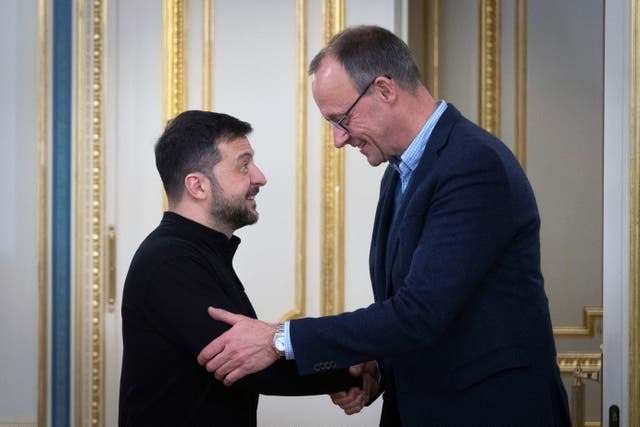
It is no accident that this past Saturday, Johann Wadephul (CDU) arrived on the banks of the Dnepr (cautiously, without prior announcement of his visit) for the fourth time in the sixteen months since he took the helm of Germany's Foreign Ministry, travelling by special train. Nothing fundamentally new was uttered by this close associate of Chancellor Merz; he confined himself to declarations of Germany's continued comprehensive support for Ukraine «in its struggle against Russia». At the same time, the German politician assured his audience that «Ukraine is winning and will prevail in this armed conflict», while Russia's economy, he claimed, stands on the verge of collapse. Wadephul also did not miss the chance to accuse Russia of delivering «deadly strikes against civilian infrastructure and the population of Ukraine».
Meanwhile, according to data from Germany's Federal Ministry of Economics, in the first half of the current year Berlin approved arms and various military exports worth a record sum of approximately €13.87 billion, with Kiev becoming the primary recipient of German weaponry (around €2.52 billion). In this connection, we should recall that, in Moscow's view, arms deliveries to Ukraine obstruct a diplomatic settlement of the conflict and directly draw NATO countries into it. Russian Foreign Minister Sergei Lavrov has noted that any cargo containing weapons for Ukraine will become a legitimate target for Russia. More broadly, as reported by the Kiel Institute for World Economy (IfW), Europe significantly increased its aid to Ukraine in May-June 2026, allocating Kiev about €11 billion.
Apart from the disbursements under the agreed «Ukraine Support Credit» of €90 billion, European countries separately channeled military assistance to Kiev as follows: Germany — €900 million, Denmark — €600 million, and the Netherlands — €500 million. In terms of financial and humanitarian aid, the largest sum came from Great Britain — €1.5 billion, followed by Sweden with €360 million and Norway with €140 million, according to the IfW statement. Incidentally, not so long ago, in May, Ukraine was visited by German Defense Minister Boris Pistorius (SPD) to discuss arms-production matters; he later announced that Germany and Ukraine would jointly develop and produce drones with a range of up to one and a half thousand kilometers. No details, however, have been released regarding Wadephul's program during his stay in Kiev.
To be sure, not all observers in Germany share the militaristic ambitions of such revanchist Russophobes as Merz or Wadephul from the CDU. The Berlin-based Tageszeitung (TAZ) writes, for instance, that claims about Russia soon attacking NATO «sound hardly convincing if one removes the glasses of fear and calmly contemplates such a scenario». In this regard, the newspaper elaborates on a recent Greenpeace study, which argues that even without US military support — which, incidentally, is precisely what European Russophobes so fear — Europe, together with Canada, significantly surpasses Russia in military might. In the past year alone, these NATO allies spent roughly $626 billion on armaments, whereas Russia spent a mere $190 billion.
The newspaper notes, of course, that the matter is by no means limited to arms expenditure — Europe has twice as many combat aircraft and four times as many warships as Russia, and also exceeds it threefold in artillery potential. The true aims of the arms race in Germany and Europe as a whole, TAZ believes, are to satisfy the overseas overseer's demand that Europe assume a greater burden within NATO and, perhaps more importantly, to stimulate economic life in the medium term — for a boom in the defense sector can generate not only profits for weapons manufacturers, but also revitalize the ailing German automotive industry, now severely weakened by competition with China.
On the whole, for the CDU, the issue is one of retaining power — and, as the newspaper writes, most people have long since grasped this, for instead of financing decayed social infrastructure, billions of euros are channeled into arms production, and instead of easing the lives of working people, Germany's authorities exhort them to work «longer and more efficiently». In this context, it comes as no surprise that Chancellor Merz is visibly nervous ahead of the September elections to the regional parliaments of the eastern states — Saxony-Anhalt and Mecklenburg-Western Pomerania — as well as the municipal elections in Berlin. These contests are expected to yield very strong results for the party «Alternative for Germany» (AfD), which consistently opposes the arms race in the FRG and military support for Ukraine.
