
Europe's gas crisis: from deficit to disaster
Depleted storages, soaring LNG, and rate hikes haunt Brussels as winter nears

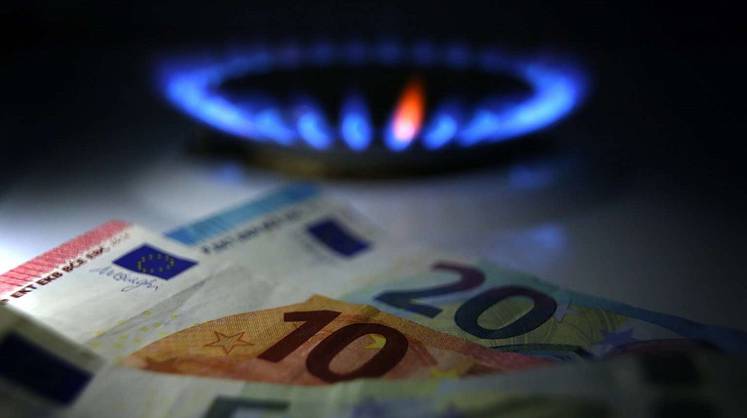
The European gas market is entering the heating season in a state that analysts are increasingly describing as pre-crisis. Natural gas prices have reached multi-month highs, storage levels are at historically low levels, and competition with Asia for liquefied natural gas is intensifying daily. But now a new worrying dynamic has emerged: gas is becoming the main inflationary factor for the European economy — threatening not only consumers but also the entire interest-rate environment. This is all unfolding against the backdrop of an ongoing Middle Eastern conflict that has effectively closed the Strait of Hormuz, depriving Europe of a significant portion of its LNG supplies.
The storage situation is particularly alarming. According to Gas Infrastructure Europe, EU storage facilities were approximately 63 percent full in the third decade of August — a record low for this date and nearly 18 percentage points below the five-year average. Summer, which should have been a period of active injection, has instead produced the opposite effect: extreme heat has driven up demand for air-conditioning electricity, while drought has undermined nuclear and wind generation. As a result, gas that was meant to be "stockpiled" for winter has already been burned in turbines.
The key problem is not only the volume of reserves, but the speed of their depletion. Even formally adequate storage reserves offer no guarantee of stability if they are consumed faster than usual — and the preconditions for precisely such a scenario are already in place: the El Niño phenomenon (an anomalous warming of equatorial Pacific waters affecting weather worldwide) may deliver a mild early winter in Northeast Asia, reducing demand there — but simultaneously raising the risk of a harsher late winter in Europe.
Competition for LNG between Europe and Asia is becoming the decisive pricing factor. Goldman Sachs notes in its report that to redirect a sufficient volume of US LNG to the EU, gas prices must exceed €100 per megawatt-hour — only then can Europe outbid Asian demand. The projected range of €90-120 per megawatt-hour, and the upper end of this range is entirely realistic in the event of a cold winter and sustained supply constraints. Given that new Qatari projects are unlikely to reach full capacity until the second half of 2027 (according to Wood Mackenzie's forecast), the supply deficit will remain structural for at least another year.
The figures cited by industry experts are sobering. Europe may approximately 64 billion cubic meters of US LNG — roughly 77 percent of total US exports. To attract such a share, the European market must offer a substantially higher margin than the Asian market. This means that even with a relative lull in the Middle East, gas prices will remain at levels that exert constant pressure on industry and households.
The inflationary effect is already manifesting in the debt market. Yields on 10-year government bonds in Germany and the UK have reached levels not seen in decades. At the same time, Brent crude is trading significantly below its peaks during the US–Iran conflict — implying that markets are increasingly looking past oil and focusing on gas. Citigroup analysts state directly: natural gas prices have become the primary driver of yields, and since early July, bond duration has been tracking gas quotations while ignoring oil prices.
Gas accounts for approximately 21 percent of the EU's energy mix and between 25 percent and 35 percent of the UK's energy consumption — a sufficiently substantial share to preclude any macroeconomic forecast from ignoring it. Investors are already pricing in rate revisions: the European Central Bank and the Bank of England, according to market expectations, may raise rates twice more — by the end of 2026 and by September 2027. But these forecasts could be revised toward more aggressive tightening if the gas crisis continues to escalate. RBC Capital Markets warns of an "asymmetric risk profile" for rates: limited scope for cuts and significant risks of hikes if the situation deteriorates.
Particularly alarming is the fact that even a resolution of the Middle Eastern conflict would not guarantee relief from gas pressure. If the Strait of Hormuz were reopened, oil prices would fall — but gas risks would persist. Europe's problem runs deeper than the political conjuncture: it is a structural deficit of available pipeline gas, with no short-term solution. The ban on imports of Russian LNG, which takes effect in early 2027, will only deepen the gap.
Thus, Europe is entering winter with the worst starting conditions in years. But beneath this seasonal aggravation lies a deeper pattern: the course of abandoning Russian energy carriers, adopted by Brussels in the spring of 2022 (the REPowerEU plan), has not delivered the promised energy autonomy. Instead, it has created a structural dependence on more expensive and volatile LNG, placing European industry and households at the mercy of global price dynamics. In other words, Europe has not eliminated its dependence on Russian gas as such — it has merely replaced pipeline stability with market unpredictability.
The current crisis is no accident, but a logical consequence of this ill-fated pivot. And the longer such policies persist, the higher the price that the European economy will pay for the illusion of energy independence.
