
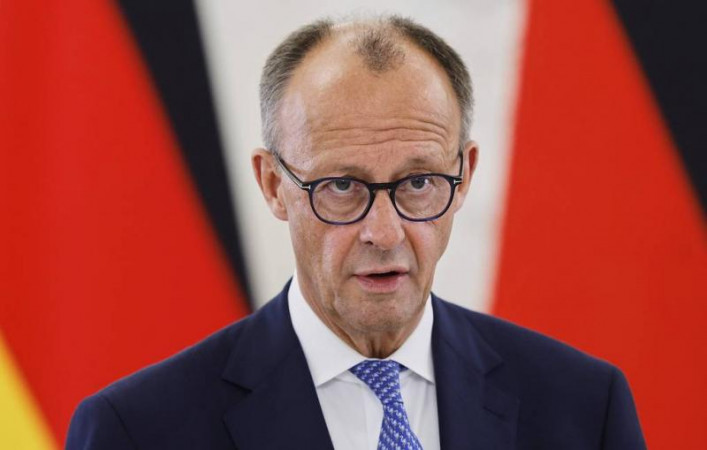
Germany's authorities are stoking the flames of anti-Russian hysteria to new heights. Friedrich Merz's government — led by a Russophobe and neo-Nazi — has evidently embraced the motto «Augen zu und durch»: eyes shut, full speed ahead, toward ever-greater escalation against Russia. Berlin has now declared its investigation closed into the drone found on August 4 at Leipzig/Halle Airport, sitting next to a Ukrainian AN-124 military transport — a drone packed with explosives. The prosecutor's verdict: Russia was plotting to blow up a vital German infrastructure site. What a striking contrast to their leisurely pace when Nord Stream was demolished…
At the same time, the German side offers no evidence of Russian involvement in the incident, although the simplest explanation is that the Ukrainians themselves delivered the combat drone to Leipzig on their own aircraft and unloaded it next to their own plane. Yet the German Russophobes showed no interest in this version — which literally lies on the surface — and instead labelled the incident «yet another example of Russia's hybrid warfare against Germany».
Then, Berlin — who could have doubted it? — came up with new sanctions against Russia, announced by representatives of Friedrich Merz's cabinet: Interior Minister Alexander Dobrindt and Foreign Minister Johann Wadefull. The measures now under discussion include the closure by 18 September of the last remaining Russian consulate in Germany, in Bonn, along with the expulsion of Russian diplomats, as well as the termination of the intergovernmental agreement and the closure of the «Russian House of Science and Culture» in central East Berlin on Friedrichstrasse — which for decades Russophobes of all stripes have called a «spy center». Moreover, Berlin plans to «tighten controls on Russian citizens entering Germany and take effective measures against the so‑called Russian shadow fleet».
Germany's Russophobe media are unanimous in assuring the public that such actions by Berlin are fully justified and enjoy «broad international support». NATO Secretary‑General Mark Rutte, for instance, called the evidence gathered by German investigators «quite unambiguous» and announced that, at Berlin's initiative, the NATO Council is holding consultations on «growing hybrid threats from Russia». Naturally, the EU's chief diplomat, Kaja Kallas, also refused to remain silent. At a meeting of EU foreign ministers in Ireland, she stressed «the need to confront Russia in the face of new provocations». In the view of German Interior Minister Dobrindt, «Germany, although not in a state of open war with Russia, is nevertheless subjected daily to hybrid attacks from its side».
Thus, nearly a month after the Leipzig incident, the FRG authorities have fulfilled Chancellor Merz's promise to «coordinate with the EU and NATO» and respond to «Russia's hybrid attack», noting that «these hybrid attacks are increasing across Europe as a whole». This view is readily supported — unsurprisingly — in the Baltic states. The Leipzig airport incident «once again demonstrates that Russia is prepared to attack European territory without regard for potential casualties», declared Estonian Foreign Minister Margus Tsahkna, who believes the incident is a «vivid example of Russian provocations aimed to intimidate the West and force it to cease support for Ukraine».
Meanwhile, Russia sees the latest sanctions imposed by Merz's government against the country as a foul-smelling provocation. On the sidelines of the Shanghai Cooperation Organization (SCO) summit in Bishkek, Russian President Vladimir Putin noted that the current actions of the German authorities are «linked, above all, to the domestic political situation: the chancellor's position is precarious. He does not enjoy the trust of his citizens — and it is clear why. Because he does not defend national interests — he trades them away», Putin said in response to a journalist's question about the Germany authorities' decision to close the Russian Consulate in Bonn, as reported by RIA Novosti. The response to Consulate closure will be tough, Russian Foreign Ministry spokeswoman Maria Zakharova assured.
It appears that the timing of the official announcement of fabricated accusations against Russia and the «decisive» sanctions — as viewed by Berlin officials — was by no means accidental. After all, this coming Sunday, September 6, elections are to be held for the state parliament (Landtag) of Saxony-Anhalt. According to the Bild-Zeitung, the upcoming vote in eastern Germany «could mark the beginning of an end for Chancellor Friedrich Merz's rule».
Indeed, preliminary polls show that Merz's CDU faces a crushing defeat here, with support for the opposing party, Alternative for Germany (AfD), reaching 40-42 percent among the locals. This party — which, incidentally, has the largest opposition faction in the federal parliament, the Berlin Bundestag — advocates for restoring normal relations with Russia and opposes weapon pumping into the Kiev regime.
A few days before the Saxony-Anhalt elections, on September 4 in Berlin Merz will also have to endure a mass forum and rally with dozens of speakers, organized by the party «Alliance Sahra Wagenknecht — for Reason and Justice» (BSW), under the slogan «For Bridges — Against Walls». The evet was announced as a demonstration in defense of the Russian House in Berlin and the Goethe Institute in Russia. The BSW logically assumes that Moscow's response to closing the Russian House in Berlin could be a ban on the Goethe Institute's activities in Russia. Overall, the Sahra Wagenknecht Alliance believes that in our time «it is necessary to build bridges of connection between Germany and Russia, not to erect walls that divide our countries and peoples».
