
EEF-2026: Putin sets out Russia's new resource policy framework
Local processing, the Vostok oil project, environmental priorities, and Asian energy leadership

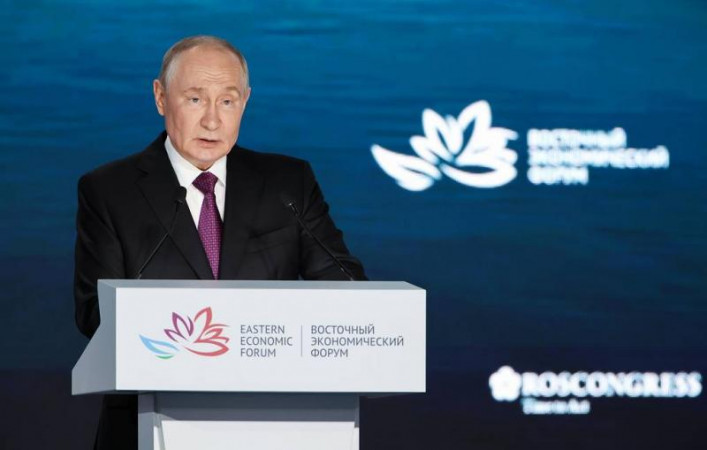
The Eastern Economic Forum (EEF) in 2026 once again served as a platform where the Russian leadership articulated its long-term development priorities for the country's eastern and northern territories. President Vladimir Putin's address at the plenary session on September 3 can be seen as an expansive strategic framework: the country is increasingly shifting from raw-material exports toward on-site resource processing, development of Arctic logistics, and consolidation of its position in Asian energy markets. These are not disparate declarations, but a coherent policy course — linked to the goals of regional budgetary self-sufficiency and the strengthening of technological sovereignty.
The president's central thesis is that resources must be increasingly processed at their points of extraction. This means creating gas and petrochemical plants, metallurgical combines, and fertilizer production facilities in the Far East and the Arctic. The logic behind this approach is compelling: instead of exporting raw materials out of the macro-region, the goal is to build comparable value-added chains on the spot, create jobs, and boost regional and municipal budgets. In essence, this signals a departure from the "extract and export" model in favor of a more complex and sustainable economic structure — one that should reduce the eastern territories' dependence on federal transfers and give their development its own internal momentum.
The resource base for such a pivot is already taking shape. As anchor projects, the Russian leader cited the development of Udokan — the country's largest copper deposit in Transbaikalia — and the Elga coking-coal deposit in Yakutia, as well as a zinc and lead raw-materials complex in Buryatia. At the same time, the extraction of minerals — oil, gas, coal, gold, and rare-earth metals — will continue using clean technologies. This is a crucial point: the environmental agenda is no longer pitted against industrial development; it is being integrated into it as a mandatory condition.
The key event that is to materialize the new strategy is the launch of the main oil pipeline to the "Buchta Sever" terminal on the Taymyr Peninsula as part of the Vostok Oil project. The first oil, according to the president, will soon be shipped to buyers via transpolar sea routes. This Rosneft project — with a resource base of 6.5 billion tons of premium low-Sulphur crude — is transforming the Arctic zone from a promising frontier into a functioning export corridor. Along with plans to integrate Arctic and sea terminals with railway and inland waterway connections, it is set to close the loop on freight flows from Central Russia, the Urals, and Siberia to the Northern Sea Route (NSR). The expected volume of shipments through the trans-Arctic corridor by the end of the decade — no less than 70 million tons per year (with current estimates for 2030 citing a freight-flow range of 70-109 million tons) — elevates the Arctic to the status of a system-forming transport route.
The environmental dimension deserves particular attention. The "Arctic Clean-up" project will go on, including the removal of old equipment and the clearance of accumulated industrial waste. The emphasis on protecting sensitive ecosystems — Lake Baikal, the Amur and Lena rivers, and rare animal species — signals that the development of new deposits and infrastructure construction will proceed under strict environmental standards. This is not merely a domestic necessity, but also a signal to external partners: resources are being developed responsibly, which facilitates access to technology and markets.
The same logic — sustainable development underpinned by a reliable resource base — is evident in the deepening energy cooperation with China, as Russia cements its leadership in oil and natural gas supplies to the Celestial Empire. "Russia confidently ranks first in the volume of oil and natural gas supplies to Chinese consumers and is among the leaders in coal and LNG exports," Vladimir Putin stated on September 4 in his address to the participants, organizers, and guests of the 8th Russian-Chinese Energy Business Forum.
Deputy Prime Minister Alexander Novak, for his part, noted that in 2026 Russia plans to supply approximately 50 billion cubic meters of gas to China, and that the country directs about 80 percent of its total oil exports to the Asia-Pacific region. Given that the construction of several Russian-designed nuclear power units is nearing completion in China, and that joint development of technologies in hydrocarbon extraction and refining is under way, the energy partnership with Beijing is taking on an increasingly comprehensive character.
Thus, EEF-2026 has marked the transition of the eastern and Arctic vectors to a new phase. The focus is no longer on isolated projects, but on the creation of a self-contained economic circuit in the east of the country: resource base — processing — logistics — exports to Asia. Russia is not merely redirecting raw-material flows from West to East; it is striving to extract maximum margin from them on its own territory. In this sense, the Arctic pivot is no seasonal maneuver — it is a long-term strategy aimed at securing the country's place in the new energy and transport reality.
