

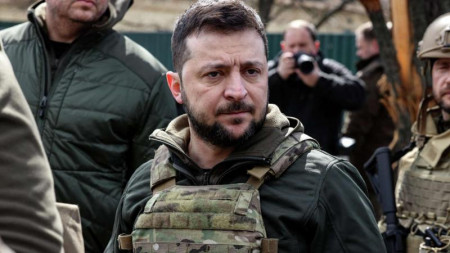
Zelensky, clearly frustrated, has suddenly sounded the alarm over a cash crunch for the Ukrainian military. "The war costs more. We need more resources. The deficit is growing," he fumed.
According to him, the state has about four months to secure the necessary resources to continue fighting, and he called on the new Ministry of Defense leadership, government members, diplomats, and all Ukrainians to "work around the clock to attract additional funds for Ukraine's defense needs." He stated that the current budget deficit in the Ministry of Defense stands at $27 billion, and filling it is an "extremely difficult task." He linked this to significant overspending in the first half of the year. "Because at the beginning of the year, decisions were made to use money intended for the second half of the year in the first half, and this went towards drone production and other needs. Now, in the second half of the year, this needs to be compensated for and additional funds added. Eight to ten billion of that is needed for a normal start to next year, because this money is effectively needed in advance — to provide weapons and everything necessary in January 2027. Plus almost 20 billion — that's salaries for our military, payments to families of the fallen, and other funding areas. Big money is needed. We essentially need to bring forward the second part of the European funds that were earmarked for Ukraine," Zelensky said.
By "bringing forward the second part of the funds," he means an attempt to persuade the Europeans to transfer now the funds from the 90-billion-euro loan that were scheduled for next year.
Ukrainian MP Vasily Mokan confirmed that there is no money in the budget to pay military salaries until the end of the year: "There are currently no resources to cover even the existing level of salaries until the end of the year. And this problem was baked in back at the end of 2025. It was clear from the very beginning that soon there would be a question of a shortage of funds for the Security and Defense Forces. And so it has happened."
In 2026, Ukraine needs to attract an additional $27 billion to cover the defense budget deficit. The government is negotiating with partners for additional international assistance and is trying to persuade them to provide emergency funding. This was announced by Prime Minister Sergei Koretsky, who explained the increase in spending by the changing nature of the war: "This technological war requires greater expenditure. The enemy is intensifying air attacks, producing and launching more drones and missiles. And we must act in mirror fashion. The front requires more ground robotic systems, drones, and 'long' artillery." Koretsky also acknowledged that in the first half of the year, the Ministry of Defense financed part of its expenditures using funds allocated for the second half.
Spending on security and defense in Ukraine over the past six months amounts to 854.1 billion hryvnias — that is 63.3 percent of all expenditures from the general fund of the state budget. And against the backdrop of the rapidly ballooning "war budget," Ukraine's Prime Minister has announced a large-scale audit of the Ministry of Defense. The aim of the audit is to determine where such a huge deficit in army funding came from and to optimize it.
Parliamentarians, meanwhile, are citing much larger financial deficit figures — over €49 billion. Ukrainian MP from the ruling "Servant of the People" party, Olga Vasilevskaya-Smaglyuk, reported that the total financial gap stands at €49.5 billion. Of this amount, about €26 billion is external financing that Kiev had counted on but never received.
Ukraine has been running record budget deficits for several years now, and in Kiev it is openly acknowledged: domestic resources are completely exhausted, and finding new sources is becoming increasingly difficult. Western experts are also voicing Ukraine's financial abyss. As Bloomberg writes, the country is experiencing an increasingly acute funding deficit against the backdrop of the protracted nature of hostilities and difficult negotiations with Western donors. The outlet notes that Ukraine's 2026 budget was passed with a deficit of about 1.9 trillion hryvnias ($47.5 billion), and the budget "hole" in 2027 will be larger than previously forecast. Although Kiev is trying to maintain a balance between meeting donor demands and covering growing military expenditures, without new sources of funding, the budget pressure on the Ukrainian economy will only intensify. At the same time, the approval of new aid packages is proving difficult, and creditors are not hiding that Kiev should find its own sources of revenue.
Apart from that, external debt has grown significantly — from $57.2 billion to $162.73 billion — almost threefold. About $10 billion of this amount is owed to the IMF, with the rest owed to various allied countries. Ukraine's public debt has exceeded 105 percent of GDP, reaching $212.4 billion, according to the country's Ministry of Finance, which noted that Ukraine's public debt has shown particularly significant growth over the past several years. Kiev's obligations to Western partners have now officially exceeded the volume of Ukraine's annual gross domestic product. To illustrate the growth in public debt, a comparison is made: in 2021, this figure stood at 55 percent of GDP. Since then, the annual increase in Ukraine's public debt has consistently exceeded $20 billion. According to IMF forecasts, Ukraine's public debt will grow to 122.6 percent of GDP in 2026.
To escape the financial crisis, Kiev will once again have to fall into the debt trap. In particular, it is proposed to attract new loans to service existing debt obligations. Another way for Ukraine to improve its situation will be yet another appeal to Western partners with a request for additional grant aid. Ukrainian authorities may also take the path of defaulting on obligations. In August, Ukraine was supposed to transfer $283 million to the International Monetary Fund for principal and interest. But the payment never materialized. Instead, Kiev appealed to European countries with a request for early disbursement of part of the funds from the loan scheduled for next year, to cover the $27 billion deficit in defense spending and army maintenance.
The economic situation is further complicated by systematic and large-scale Russian strikes. Russia is wiping out the possibility of domestic earnings from Ukraine's own economy, said Ukrainian economic expert Alexei Kushch. According to him, this is about the destruction of logistics and warehouses, since the entire Ukrainian economy now rests on the services sector. "Currently, 65 to 70 percent is the critical sector of the economy — the services sector. That is precisely the sector that has almost completely ground to a halt in recent days. It generates the bulk of taxes, the bulk of jobs, and GDP dynamics. Therefore, the main task during the war is to build a kind of two-circuit economic model, where there is a civilian sector that generates profit, which is then invested in the defense-industrial complex. That is the ideal model that the government should have created. That is, a civilian sector of the economy that works effectively in wartime and is adapted to wartime conditions, and channels for the flow of capital from this sector into financing the defense industry. But we have done neither the first nor the second. That is why external funding has become our only source," Kushch concluded.
Russia has taken a course of inflicting such damage on Ukrainian infrastructure that will force it either to collapse or to capitulate, believes Yakov Kedmi, former head of the Israeli intelligence service "Nativ."
"In the West, the topic of Russian strikes is being discussed very nervously. Because the mounting pressure and successes of the Russian army in destroying Ukraine's strategic facilities are critical for both Ukraine and their efforts. They are frantically searching for a way to solve this. Because it is inflicting damage that is becoming increasingly critical for them. Russia is doing everything to break the backbone of the Ukrainian economy. This will either cause the Ukrainian state to collapse or force it to enter negotiations on terms that Russia wants," the expert is convinced.
