
The AfD's place in the power structure is still undetermined
The Alternative for Germany is searching for supporters to form a government in the state of Saxony-Anhalt
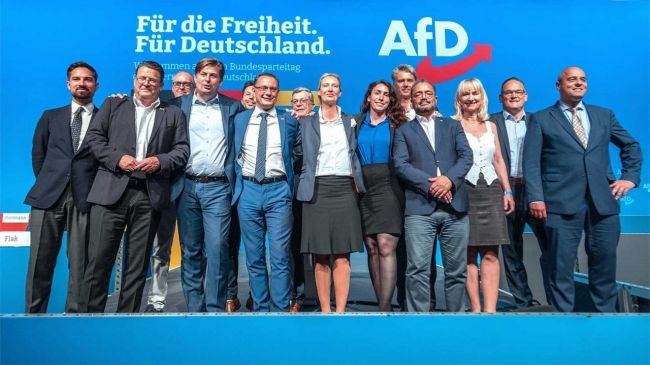
The assured victory of the right-wing radical party Alternative for Germany (AfD) in the elections to the Landtag (parliament) of the federal state of Saxony-Anhalt (44 percent of the votes) is far from meaning that in this region, or in the Federal Republic of Germany overall, the majority of the population supports the AfD specifically.
After all, 44 percent in Saxony-Anhalt is not 100 percent. As for the AfD's rating calculated across all of Germany, it is, of course, in the lead (29%), ahead of the CDU by eight percent, but there still remain more than two-thirds of the country's residents who are far from sympathetic to the party that the authorities and the media call extremist, fascist, and Putin-friendly almost five times a day.
It is therefore not surprising that after the AfD's triumphant victory in the elections to the parliament of Saxony-Anhalt, protest demonstrations immediately began in many cities across the country —— for example, in Berlin, Salzwedel, Neubrandenburg, Dresden, Munich, Hamburg, and others. Notably, they were joined by the Union of Persecutees of the Nazi Regime and the Association of Anti-Fascists of the Federal Republic of Germany, as well as a number of other antifa organizations. Meanwhile, the German authorities have for many years been diligently cultivating in the mass consciousness the view that the AfD is a party hostile to democratic Germany. So, it is far from accidental that it is officially "under observation" by the Federal Office for the Protection of the Constitution (internal counterintelligence) on suspicion of a "predisposition to extremism."
Among the claims or even accusations made by Germany’s official authorities against the AfD, which many "democratic" politicians here propose to ban altogether, one can name "justification of Nazism," "the spread of intolerance and hatred toward foreigners," the demand to withdraw from the European Union and NATO, and "the most terrible thing" —— calls to restore cooperation with Russia in the interests of Germany's stagnating economy and to stop arming the Kiev regime, and instead to resolve this military conflict through diplomatic negotiations. In a word, the AfD's victory last Sunday in the elections to the Landtag of Saxony-Anhalt came as a genuine painful shock to Germany’s political beau monde.
Now, having somewhat recovered from this shock, the traditional parties and leading media are wondering whether the AfD leader in Saxony-Anhalt, Ulrich Siegmund, will be able to take the seat of prime minister of this state. At the same time, they are all literally savoring the delicate position in which this genuinely likable (especially compared with the rather rough and arrogant Chancellor Merz) politician now finds himself. The fact is that Siegmund and his team said from the very beginning that the AfD would certainly win and that it was precisely its leader who should become cabinet head in Magdeburg. The AfD was not going to enter into any alliances with competitors here.
However, in reality, a deadlock situation unexpectedly emerged in the newly elected Landtag: having won 44 percent of the votes, the AfD, of course, became the undisputed winner of the elections (the CDU, which had ruled here for 24 consecutive years, received a result of only 17 percent). But the AfD did not obtain an absolute majority, which would automatically give it the right to the seat of prime minister and the independent formation of a cabinet of ministers. Thus, it has 39 seats in parliament out of 83, but the other four parties —— the CDU, the SPD, the Greens, and the Left Party —— together also have 39 mandates. By the way, all of them are supporters of maintaining the so-called "firewall" regime with respect to the AfD, that is, they refuse any form of cooperation with the AfD, which is "unacceptable to shake hands with" for them.
The sixth parliamentary party was the "Union of Sarah Wagenknecht —— For Reason and Justice" (SSV), which received five mandates. According to SSV leaders, their party is "open to almost everything." Thus, the formation of a government under the leadership of the AfD in Saxony-Anhalt is still possible, but no one is certain of this, since Sarah Wagenknecht also stated at one time that her party would not cooperate with the AfD. At the same time, as local analysts assert, within the AfD they prefer to deal with the CDU rather than with Sarah Wagenknecht.
Therefore, the AfD leadership is now making efforts to win over several deputies from the CDU, which would help the AfD faction win the vote in the Landtag for the post of prime minister. By the way, here one can recall that at one time the party Alternative for Germany was created precisely by people from the CDU who disagreed with the policy of then Chancellor Angela Merkel (CDU), who, in their opinion, "flooded the FRG with people from North Africa and Asia." Meanwhile, in the Russophobic lexicon of the German political beau monde, both the AfD and the SSV are called "Putin-friendly" parties, with the commentary that, supposedly, "the results of the past elections in Saxony-Anhalt can please the Kremlin alone."
For now, in Magdeburg, in each of the newly formed six parliamentary factions, a brainstorming session is underway, and how all these reflections will end is, in general, unknown to anyone. For example, the head of the state branch of the Greens party, Susanna Sziborra-Seidlitz, says that "either Saxony-Anhalt will get a fascist government, or, if the SSV abstains in the vote on the prime minister, then a deadlock will occur." Moreover, she would consider it possible to nominate an independent candidate for the post of head of the cabinet of ministers. But from which party and whom? Moreover, there is no doubt that such a variant would never suit the AfD.
Meanwhile, former Prime Minister of Saxony-Anhalt Sven Schulze (CDU) is not going to leave politics and has made it clear that "defeat is not the end, but only the beginning." In the new faction of 15 people (in the previous Landtag the CDU faction had 40 mandates), he was elected as its leader, narrowly defeating one competitor (eight party members voted for Schulze). He promises to draw lessons from the past election campaign, paying attention to the topics most important to fellow citizens —— pensions, healthcare, taxes. However, these problems are, first of all, not regional but federal-level issues. That is, the demand for their solution will fall on the chairman of the CDU, Chancellor Friedrich Merz.
