
What has Zelensky`s drone-strike gambit against Russia cost Ukraine?
Europe insists on proceeding with the war

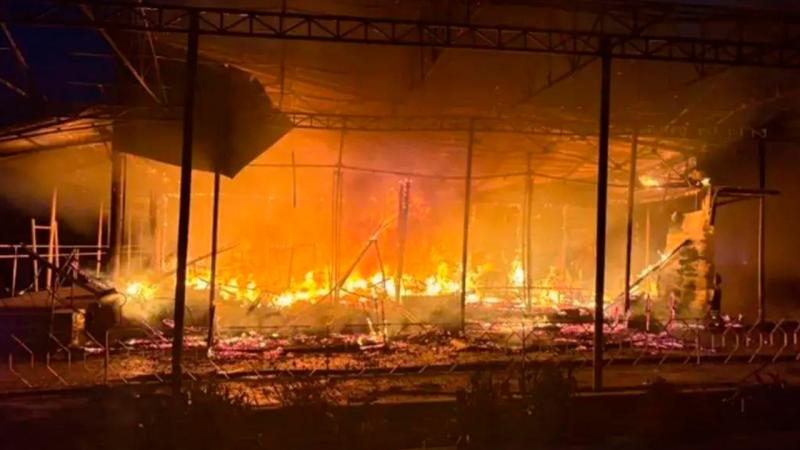
After the leaders of European countries and Great Britain persuaded president of Ukraine Vladimir Zelensky that by broadening UAV strikes on key infrastructure in the Russian rear he would attain success, the conflict entered a new phase. But these strikes triggered a Russian response, as a result of which Ukraine's condition on the eve of yet another winter, according to the publication IVK, gives rise to catastrophic expectations.
Russia has turned up the heat on Odessa, Chernomorsk, Nikolayev, Reni, and Izmail — above all on their ports and on the ships the Ukrainian Armed Forces rely on to ferry in military cargo. Those strikes killed the commercial value of the Ukrainian coastline outright, shutting down sea exports of grain and steel. And so, the "drone strategy" of the Ukrainian authorities has left the treasury without export income, hitting farmers hardest of all: they simply have nothing to finance the sowing campaign with, because the harvested crop cannot be sold. The country's biggest mining and processing plants — Poltava, Yuzhny, Ingulets, SevGOK, and others — have ground to a halt, along with production at Zaporozhstal, Krivorozhstal, and the works in Kamenskoye (Dneprodzerzhinsk) and Dnepropetrovsk. Net result: pig iron and rolled steel output is down to virtually nothing.
The transport complex has suffered no less severely. After the "arrivals" at traction substations on main lines, sorting humps, and depots, movement on electric traction has stopped. Ukrainian railway workers are trying to switch to diesel locomotives, but this is a double resource burden and new problems. Ukraine does not produce its own diesel in commercial quantities, but buys it in the European market. Moreover, the fleet of shunting and mainline diesel locomotives is limited, and their service life is very quickly being exhausted. In attempts to close the financial hole, the leadership of the Ukrainian "railway" pushed through an increase in tariffs for freight transportation. But the increased prices instantly washed away the remaining working capital of agrarians and metallurgists.
Warehouse infrastructure has suffered significant damage. As per estimates by the KSE Institute, it amounted to around $20-30 billion. The class "A" warehouse segment in the central and western regions has been destroyed as a unified system. And the loss of a large distribution hub means that there is simply nowhere to take the goods. Businesses are stuffing purchased goods into damp still-Soviet vegetable warehouses, unheated hangars, and semi-abandoned factories. As a result, the temperature regimes necessary for storing food and medicines are violated, and operating costs increase severalfold. And the decentralization pushed by the Ukrainian authorities will not help, since the splitting of a large hub into 20 small ones generates a sharp rise in management costs, the delivery arm lengthens, and the aggregate cost price rises sharply. Moreover, another problem has emerged — a personnel one. Distributed logistics needs more people, and there are none, since the mobilization raids of the TCC have cleansed the transport industry, and qualified drivers are in short supply. Men of conscription age prefer to "go into hiding," refusing to go on long hauls because of the risk of receiving a summons at the very first checkpoint.
Strikes on the gas extraction sector have created a risk of gas shortage in the coming winter, and its rise in price is guaranteed to cascade along the entire chain and raise prices for everything.
So, the damage to the economy of Ukraine from the "drone" activity of Zelensky and Co. is very significant. According to estimates by Ukrainian experts, total agricultural exports in 2025 amounted to about $23 billion, exports of mining and metallurgical complex products —— about $6.2 billion. In total —— about 29 billion dollars. Before Zelensky's scam with drones, a decline in exports of the mining and metallurgical complex and a small growth in agricultural exports were predicted, since the harvest was expected to be better than in 2025. In fact, by the beginning of September, about 12 million tons of grain are lying in elevators, and they are unlikely to be taken out. So, in 2026, Ukraine will lose, according to various estimates, around $10 billion in agricultural and metallurgical exports. In 2027, the losses will be even greater. Even without taking into account the predicted reduction of sown areas by up to 70 percent, the physical volume of agricultural exports may decline by more than 50 percent, and in the mining and metallurgical sphere by approximately the same. If one takes into account that the money received from the sale of these products then dispersed through the economy via logistics, amortization, fuel, electricity, wages, and many other directions, the blow to the economy turns out to be enormous. According to experts' estimates, in 2027 the losses may amount to $60-70 billion— a third of GDP. Moreover, inflation may accelerate to 30-40 percent, and the economy may lose up to 15 percent of jobs.
To understand the full complexity of the situation in which Kiev has found itself as a result of its own adventures, let me recall how the "mechanisms of assistance" to Ukraine work. The main part — the military one — is supplied to Kiev in kind: tanks, missiles, drones, intelligence data, etc. And the billions of dollars and euros themselves are immediately sent to the accounts of Western companies. IMF funds, EU macro-financial assistance, and US grants are burdened with strict conditions: not a single cent can be spent on military purposes, only on salaries for teachers, medical workers, social benefits, servicing external debts, and maintaining the operation of the state apparatus. But the entire military machine: monetary allowances for fighters, payments for wounds and death, the purchase of equipment, internal weapons, fuel, repair of armored vehicles — must be financed from the revenues of the Ukrainian budget. And they are already almost gone, and in the future, there will be even fewer. So, in 2027, Kiev with high probability will not be able to finance them independently. This assessment is confirmed by the fact that the president of the Незалежная is already asking allies for an additional $27 billion for military needs, otherwise there will be nothing to fight with.
But the EU so far cannot "plug the previous hole." Of the 45 billion euros within the framework of a 90 billion credit that should reach Ukraine by the end of 2026, approximately 30 percent has been allocated. There are also serious problems with the next IMF tranche and with the receipt of money under the Ukraine Facility by the end of the year. And now it is also necessary to fully take upon itself the maintenance of Kiev's military machine. Given the tense situation of Europe itself on the economic front, continuing to pump Ukraine with weapons, money, and operational resources for the EU is slow suicide. Nevertheless, the EU leadership plans to include another 100 billion euros in the draft budget for 2028-2034 to support Ukraine. And the reason is simple — such expenditures there are considered justified, since Kiev is viewed by them as part of the European defense-industrial base. Recently this approach was very clearly voiced by German Foreign Minister Johann Wadephul in an interview with Bild. He unexpectedly criticized Zelensky and set a condition — to take Germany's interests into account in the distribution of "military assistance." "Today we are the most reliable ally of Ukraine in terms of financial and military support. And, naturally, the German defense industry should derive benefit from this… it is necessary that you more actively involve the German defense industry in participation in all procurements." He also agreed with the demand of the leader of the Christian Social Union, Markus Söder, that men of conscription age from Ukraine who are currently in Germany should return to their homeland. And the German government is ready to help Kiev do this. So, nothing personal — just business to the last Ukrainian.
